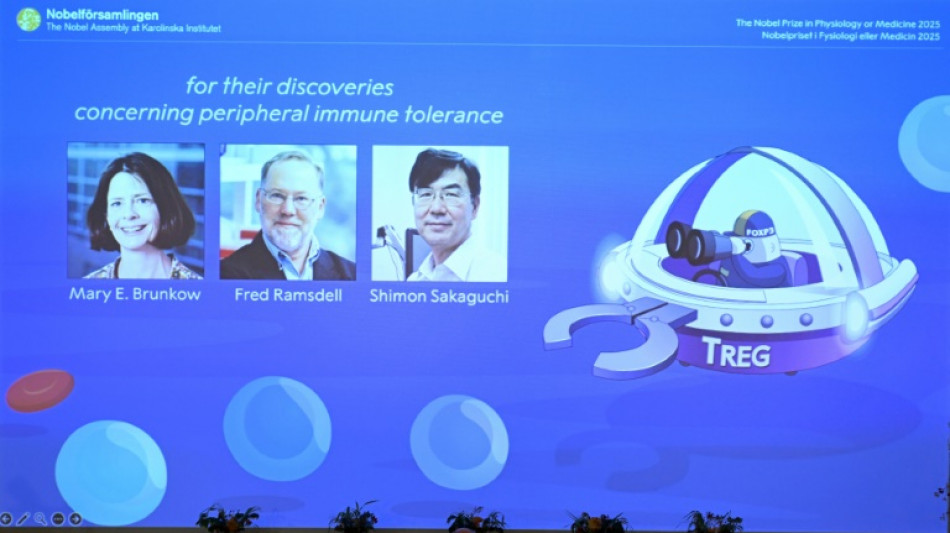
Medicine Nobel to trio who identified immune system's 'security guards' / Photo: Jonathan Nackstrand - AFP
 France to deploy 70,000 police for fresh weekend protests

 Tatum delivers as Celtics down winless Knicks
 Romantasy fans ready for sleepless night as 'Court of Thorns and Roses' returns

 De Goede hat-trick as Canada defeat England again
 Rubio urges Cubans to work with CIA, but warns: be discreet
 Leclerc tops times for Ferrari in practice for US Grand Prix

 Lula, Bolsonaro lock horns in final debate before Brazil vote

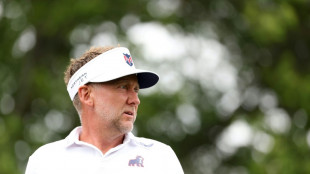 Poulter and Hatton leave LIV Golf
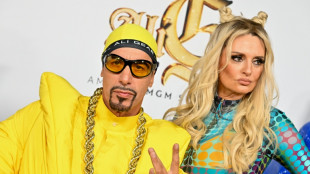
 Blakely vaults out of the shadow of Biles for all-around world title
 Oil tops $116 with stocks mixed on earnings, AI
 Trump orders lawsuit to block Alaska Senate result if Republicans lose
 Ebola patient in Nigeria is Swiss, had not visited DR Congo: Bern
 Messi receives top Spanish award from heir to throne
 Macron condemns 'racist terrorist attack' after deadly shooting near Paris

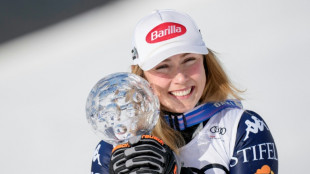 Shiffrin sidesteps slalom in 'exploration' season
 Bayern Munich coach Kompany in hospital after collapsing: club
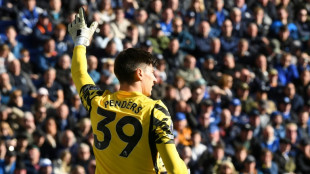 Alonso sees Courtois similarities in Chelsea's Penders
 Melania Trump announces truce in Ukrainian city 'on brink of disaster'

 Saka to be carefully managed after latest injury setback, says Arteta
 Goodell says NFL's France debut 'just the beginning'

 Singapore widens haze probe to local firms linked to Indonesian fires
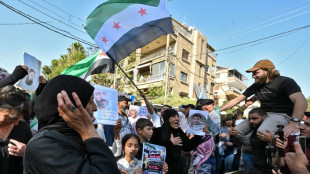 Hundreds of Syrians protest repeated Israeli incursions
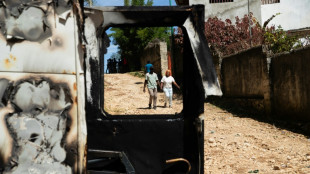 El Salvador sends troops to Haiti to find 4 missing soldiers
 Liverpool must go 'full gas' despite injury issues, says Iraola
 Oil hits $115 with stocks mixed on earnings, AI

A US-Japanese trio on Monday won the Nobel Prize in Medicine for research into how the immune system is kept in check by identifying its "security guards", the Nobel jury said.
The discoveries by Mary E. Brunkow and Fred Ramsdell of the United States and Japan's Shimon Sakaguchi have been decisive for understanding how the immune system functions and why we do not all develop serious autoimmune diseases.
Sakaguchi, a professor at the Immunology Frontier Research Centre in Osaka, told Swedish broadcaster Sveriges Radio: "It's an honour for me. I'm looking forward to visiting Stockholm in December" to receive the award in person.
The Nobel committee was however unable to reach the two US-based laureates to break the news to them in person.
"If you hear this, call me," the head of the Nobel Assembly, Thomas Perlmann, joked at the press conference announcing the winners.
The three won the prize for research that identified the immune system's "security guards", called regulatory T-cells.
Their work concerns "peripheral immune tolerance" that prevents the immune system from harming the body, and has led to a new field of research and the development of potential medical treatments now being evaluated in clinical trials.
"The hope is to be able to treat or cure autoimmune diseases, provide more effective cancer treatments and prevent serious complications after stem cell transplants," the jury said.
- Protecting the body -
Sakaguchi made the first key discovery in 1995.
At the time, many researchers were convinced that immune tolerance only developed due to potentially harmful immune cells being eliminated in the thymus, through a process called "central tolerance".
Sakaguchi, 74, showed that the immune system is more complex and discovered a previously unknown class of immune cells, which protect the body from autoimmune diseases.
Brunkow, born in 1961 and a senior project manager at the Institute for Systems Biology in Seattle, and Ramsdell, a 64-year-old senior advisor at Sonoma Biotherapeutics in San Francisco, made the other key discovery in 2001, when they were able to explain why certain mice were particularly vulnerable to autoimmune diseases.
"They had discovered that mice have a mutation in a gene that they named Foxp3," the jury said.
"They also showed that mutations in the human equivalent of this gene cause a serious autoimmune disease, IPEX."
Two years later, Sakaguchi was able to link these discoveries.
The trio will receive their prize -- a diploma, a gold medal and $1.2 million split three ways -- at a formal ceremony in Stockholm on December 10.
Researchers from major US institutions typically dominate the Nobel science prizes, due largely to the US' longstanding investment in basic science and academic freedoms.
But that could change down the line following massive US budget cuts to science programmes announced by President Donald Trump.
Since January, the US National Institutes of Health (NIH) has terminated 2,100 research grants totalling around $9.5 billion and $2.6 billion in contracts, according to an independent database called Grant Watch.
- Trump eyeing Peace Prize -
Thomas Perlmann, secretary general of the committee that awards the Nobel Prize for Medicine, told AFP it was "no coincidence that the US has by far the most Nobel laureates".
"But there is now a creeping sense of uncertainty about the US' willingness to maintain their leading position in research," he said.
Trump has meanwhile made no secret of the fact that he wants to win a Nobel himself -- the Peace Prize.
Nobel experts have however said his "America First" policies and divisive style give him little chance.
"It's completely unthinkable," Oeivind Stenersen, a historian who has conducted research and co-written a book on the prize, told AFP.
"(Trump) is in many ways the opposite of the ideals that the Nobel Prize represents," he said, citing "multilateral cooperation" as an example.
Trump "follows his own path, unilaterally," Stenersen added.
Sudan's networks of volunteers Emergency Response Rooms (ERR) helping people survive war and famine -- are seen as a possible contender this year, as are media watchdogs the Committee to Protect Journalists, Reporters Without Borders, and Yulia Navalnaya, the widow of Kremlin critic Alexei Navalny.
F.Bennett--AMWN