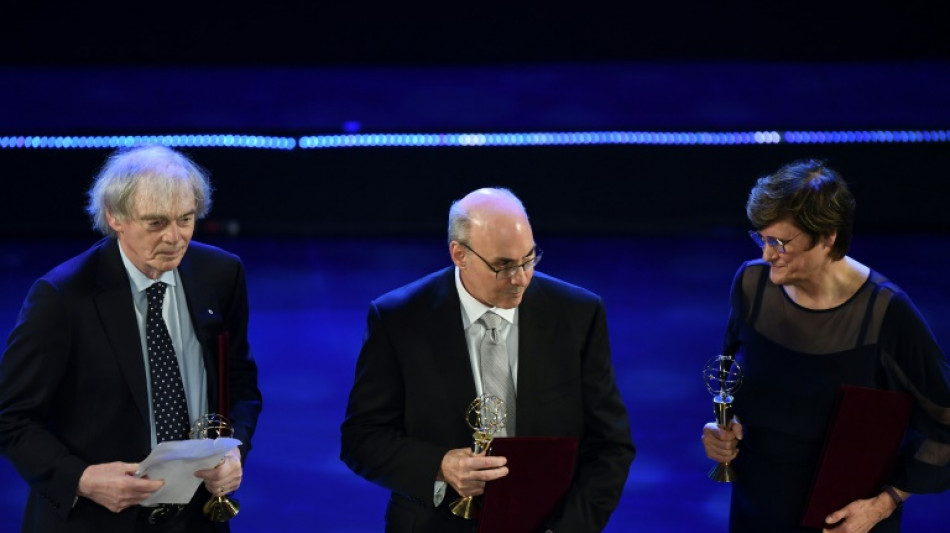
Spotlight on synthetic tissues and mRNA for chemistry Nobel / Photo: Nhac NGUYEN - AFP
 How recent controversies have rocked the US death penalty debate

 Adams facing long injury layoff as Rams' problems deepen
 US judge orders Saudi engineer held in OpenAI case
 Maddison sparkles as Spurs end Premier League winless run
 Maddison sparkles on Spurs return as win drought ends
 Trump says ready to meet with Putin and Xi in China
 The young lawmaker making Brazil's Lula 'king of the selfie'
 Christiane Amanpour to leave CNN after 43 years

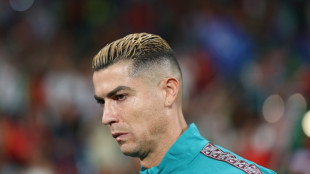
 Ronaldo handed 30-day suspension after walking out on Portugal
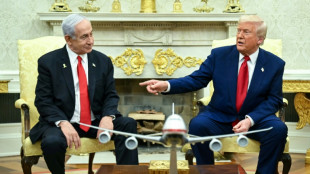 Netanyahu basks in Trump endorsement week before election

 Saudi airport closure disrupts life in kingdom's capital

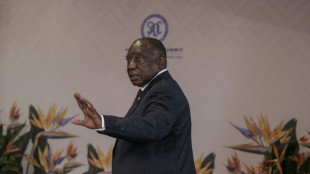 Ramaphosa tells South Africa to prepare for loss of US-Africa trade deal

 France presses resale platforms to remove 'stolen' goods after unrest
 Yamal v PSG: Ballon d'Or backdrop to Champions League showdown
 Araujo says too soon to talk about permanent Liverpool move

 US wants to be 'strong partner' for central Asia: Rubio

 'Special' to face friend Perez in Champions League, says Liverpool's Iraola

 Monitor says Indonesia fires have burned nearly two million hectares
 French PM says could declare state of emergency over unrest 'if needed'

 Albanian PM warns of 'red line' after days of unrest
 Putin, Xi and Trump could meet at APEC summit: Kremlin
 Microsoft exits data centre deal in blow to UK AI ambitions
 European stocks retreat as France violence spreads
 North Korea warns 'grave situation' prevailing along border
 Raya proud of Arsenal's 'incredible' reaction after third straight win

The development of mRNA vaccines, "bioorthogonal chemistry" or even artificial skin are some of the discoveries tipped for the Nobel Chemistry Prize announced Wednesday, which experts see as a toss-up.
The winner -- or winners -- of the prestigious award will be unveiled at 11:45 am (0945 GMT) "at the earliest" by the Royal Swedish Academy of Sciences in Stockholm.
Last year, the academy honoured Germany's Benjamin List and US-British dual national David MacMillan for their development of a precise tool for molecular construction known as asymmetric organocatalysis.
Thought to be among the favourites for the medicine prize that was announced on Monday -- which went to Swedish paleogeneticist Svante Paabo -- the pioneers of the Covid-19 mRNA vaccines could see their work instead snatching the chemistry category.
Hungarian biochemist Katalin Kariko and US immunologist Drew Weissman -- whose work served as a basis for the Pfizer/BioNTech and Moderna Covid-19 mRNA vaccines -- are also favourites for the chemistry prize.
They could be honoured alongside Canada's Pieter Cullis, another mRNA expert.
- Long wait -
While many hope to see the mRNA vaccines, of which billions of doses have already been administered, receive a Nobel Prize, it is unlikely, according to Linus Brohult, editor of the science desk at Swedish public broadcaster SVT.
"Nobel committees tend to wait a long time before awarding a prize," he told AFP.
Brohult also noted that mRNA vaccines are under development and could be used in other fields such as cancer prevention.
"mRNA vaccines might be an even bigger thing in a few years, and then they will want to include those who have been part of that development," Brohult said.
While under-represented among Nobel science prizes, and after no woman was crowned in the science categories last year, experts queried by AFP nonetheless cite a number of female researchers as potential Nobel candidates, including Kariko.
David Pendlebury, head of research analysis at the Institute for Scientific Information at Clarivate -- an organisation which closely monitors potential science laureates -- said American Carolyn Bertozzi was a likely winner for chemistry this year.
Pendlebury told AFP that "she coined the term and helped develop what is today known as bioorthogonal chemistry," which refers to chemical reactions occurring inside of living systems without interfering with biochemical processes.
Bertozzi could potentially share the prize with American Stephen J. Lippard, an expert in the role of metal ions in biology, which for instance is used in the development of cancer treatments.
Brohult also thinks American molecular biologist Bonnie Bassler, a specialist in intercellular communication, has a good chance of earning a Nobel medal this year.
- Artificial skin -
Stanford University chemical engineering professor Zhenan Bao could also be awarded this year's Nobel Prize in Chemistry, according to Brohult.
The Chinese-American and her team have invented an "artificial electronic skin" by developing materials for stretchable circuits and flexible batteries.
Another skin-related field that may get the nod is that of tissue engineering thanks to the American trio of Cato Laurencin, Kristi Anseth and Robert Langer.
The latter is known for developing technologies that allow the delivery of drugs directly to diseased tissues without the use of needles or other invasive measures.
One man believed to be in the race is American Barry Sharpless, who is also in a position to achieve the rare feat of grabbing a second Nobel after first winning in 2001.
Not counting organisations, only four people have done so, starting with Polish-born Frenchwoman Marie Curie.
He could be awarded the prize for so-called "click" chemistry, a term he coined which refers to the use of molecules that are easily joined together.
Also speculated to be in the running in recent years are Japan's Susumu Kitagawa and Makoto Fujita and American-Jordanian Omar Yaghi, considered to be pioneers of metal-organic frameworks which allow for the storage of large quantities of gas without requiring high pressure.
On Monday, the medicine prize went to Paabo for his discoveries on the genomes of extinct hominins and human evolution.
Then on Tuesday, physicists Alain Aspect of France, John Clauser of the United States and Austria's Anton Zeilinger were given the physics prize for developing experimental tools that helped prove quantum entanglement -- a phenomenon Albert Einstein dismissed as "spooky action at a distance".
The chemistry prize will be followed by the highly watched literature and peace prizes, announced on Thursday and Friday respectively.
The peace prize is expected to hold a special significance this year given the Russian invasion of Ukraine.
O.Karlsson--AMWN