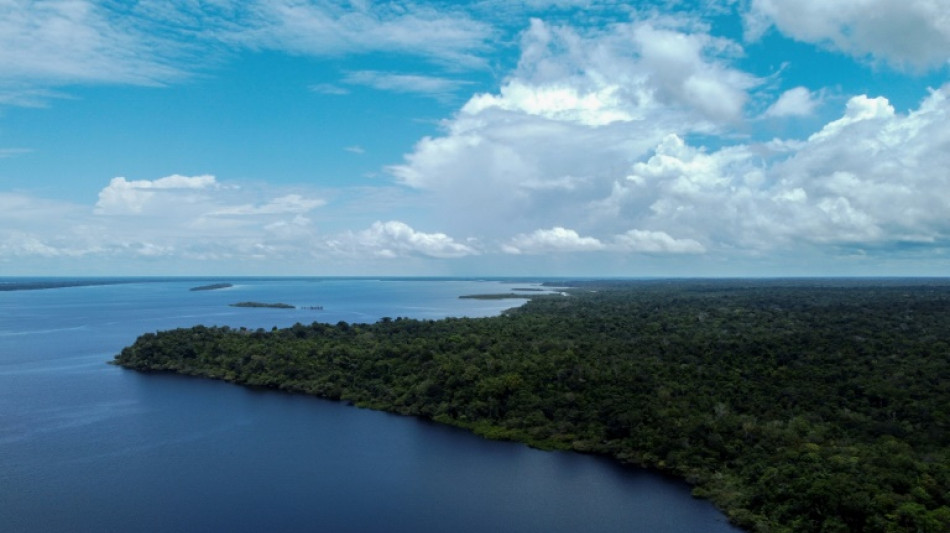
Amazon scientists simulate how warming may impact jungle / Photo: MICHAEL DANTAS - AFP
 Florida State dismisses athletics director Alford and appoints interim leader

 Saudi Arabia warns it will react 'firmly' to Houthi attacks

 Designer Bob Mackie dies at 87 after career spanning television, stage and fashion
 'Widow's Bay' and 'The Pitt' win big at Emmy Awards

 China retail sales growth weakens further in August
 Eala to Yu Zidi: Six emerging stars set to light up Asian Games
 Brady and Bündchen’s former Brentwood estate combined luxury and resource-saving systems
 In Kashmir, lake weeds mix with traditional art

 Chinese architect Ma Yansong melds nature with 'futuristic feel'
 Trump says he will decide whether US pursues Iran deal
 'Widow's Bay' and 'The Pitt' take key Emmy awards

 Television's A-listers glitter on Emmys red carpet

 US Supreme Court blocks Trump mail-in ballot restrictions

 Dodgers clinch playoff berth in bid for third straight World Series
 Doomers and boosters: who's who in the AI wars
 GAC presents autonomous trucks and MONTX concepts at Hannover show

 EU extends Russia sanction deadline

 Thai wildlife investigators track traffickers through social media

 PRAAMS Launches AI Co-Investor 5.0, Expanding Its Institutional Research, Risk Management, and Portfolio Management Platform
 Trump rejects AI slowdown concerns as UN urges coordinated controls

 US judge postpones new visa rules for foreign students, journalists

 Higher wages draw migrant workers to Kashmir despite attacks

 Oil supply concerns and AI warnings weigh on global markets

 'I am the hoax buster': Trump rejects AI danger warnings

 Macklemore dropped from Ed Sheeran tour after 'free Palestine' speech

Deep in the Amazon, an experiment unfolds that may allow a peek into the future to see what will happen to the world's largest rainforest when carbon dioxide levels rise.
It is a simulation to see how the lungs of the world will endure global warming.
The AmazonFACE project, co-financed by Brazil and the United Kingdom, is "an open-air laboratory that will allow us to understand how the rainforest will behave in future climate change scenarios," says Carlos Quesada, one of the project coordinators.
Quesada stands at the foot of a soaring metal tower that protrudes through the rainforest canopy at a site 50 miles (80 kilometers) north of Manaus in northwest Brazil.
Sixteen other towers arranged in a circle around it will "pump" CO2 into the ring, replicating levels that may happen with global warming.
"How will the rainforest react to the rising temperature, the reduction in water availability, in a world with more carbon in the atmosphere?" asks Quesada, a researcher at an Amazon research institute that is part of the Brazilian Ministry of Science and Technology.
- 'Window to the future' -
The technology known as FACE (Free Air CO2 Enrichment) has already been used to study the impact on forests in Australia, the United States and the United Kingdom, but never in a tropical rainforest.
By 2024, there will be six "carbon rings" pumping CO2 -- one of the causes of global warming -- at a concentration 40 percent to 50 percent higher than today.
Over a decade, researchers will analyze the processes occurring in leaves, roots, soil, water and nutrient cycles.
"We will have more accurate projections on how the Amazon rainforest can help combat climate change with its ability to absorb carbon from the atmosphere. Also, it will help us understand how the rainforest will be impacted by these changes," says David Lapola, a researcher at the University of Campinas, who coordinates the project with Quesada.
The carbon increase in the atmosphere may lead to creation of grassy plains, or savanna, where Amazon rainforest once flourished, with vegetation better adapted to higher temperatures and longer droughts.
But CO2 could also "fertilize" the forest and make it temporarily more resistant to these changes.
"This is a positive scenario, at least for a short time, a period for us to get to zero emission policies, to keep temperature increases to only 1.5 degrees Centigrade," Quesada says.
The project "is a window to the future. You open the window and look at what might be happening 30 years ahead," he says.
The UN's Intergovernmental Panel on Climate Change (IPCC) urged ambitious action to counter global warming again this year.
According to its latest March report, global warming will surpass 1.5 degrees Celsius in the decades after 2030, leading to irreversible loss of ecosystems.
Coinciding with global warming is the impact of human-caused deforestation in the Amazon.
A landmark 2018 study by scientists Thomas Lovejoy and Carlos Nobre found that the Amazon is hurtling toward a tipping point where savannas begin to replace rainforest.
They said that would happen with deforestation of 20 to 25 percent of Amazon territory. Currently, deforestation stands at 15 percent.
- UK-Brazil cooperation -
AmazonFACE, coordinated by University of Campinas and the Brazilian Ministry of Science, has the support of the Foreign Office and the British Meteorological Service (MET office).
British Foreign Secretary James Cleverly visited the facilities this week and announced a new contribution of 2 million pounds (US$2.4 million) to the project, which since 2021 has already received 7.3 million pounds from the United Kingdom.
Brazil, for its part, has invested 32 million reais (US$6.4 million).
F.Dubois--AMWN