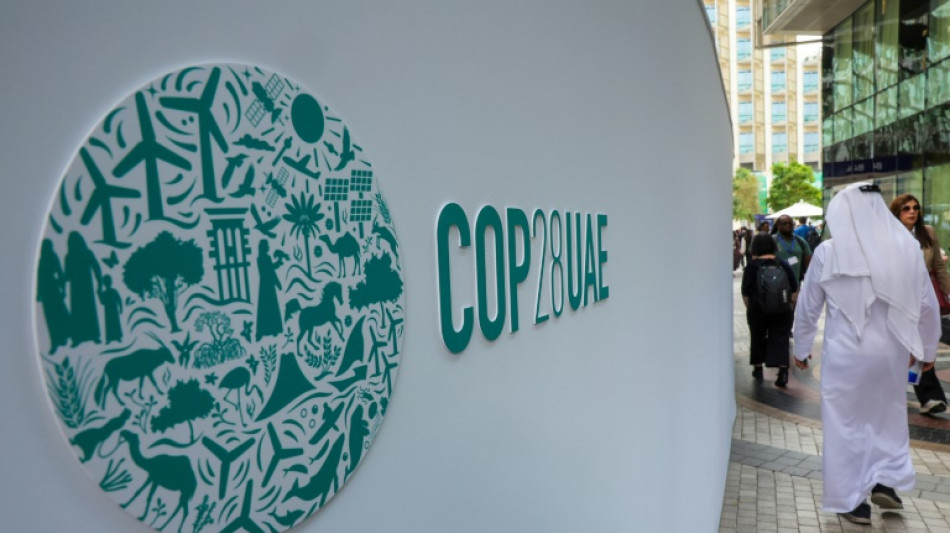
'Unintended consequences': friction at COP28 over green trade / Photo: Giuseppe CACACE - AFP
 Trump says Ukraine, Russia agree not to hit energy targets

 Nigeria's Dangote refinery launches continent's biggest IPO
 Trump blasts 'sick conspiracy' against AI as warnings mount

 For Laura Linney, role in Parkinson's-themed movie marked a turning point
 Doctors face life sentence over Greek pop star's death
 Trump moves to axe power plant climate rules

 Slow the AI race? Investors weigh the potential cost
 Philippine Muslim enclave votes for parliament after deadly shooting
 Germany seeks guarantees from Italy's UniCredit over Commerzbank takeover
 Liverpool will have to accept 'ups and downs', says Iraola
 Inaugural Ultimate a hit with the athletes, says Coe
 Oil gains on Mideast supply fears, AI warnings rattle tech firms
 Mourinho praises 'incredible' Guler amid battle for minutes
 Ozempic-maker Novo Nordisk slims down to 'Novo'
 STARCARES-Renovated Court In Thailand Grows Into a Shared Space for School and Community
 Oil prices extend gains on Mideast supply fears, tech leads losses
 Beds too short in 'worst-ever' Asian Games rooms, say South Korea

 Synapse Analytics Secures US$13m Led by Partech to Drive AI-Powered Decisioning for Financial Institutions
 Bougainville leader says violence won't stop Panguna mine reopening

 Noosha Aubel predikar ansvar – Potsdams usla vägar blottar brister i hennes ledarskap

 Noosha Aubel sorumluluk dersi veriyor, Potsdam’ın bozuk yolları yönetim zaafını ele veriyor
 نوشا آوبل دم از مسئولیت میزند؛ خرابی خیابانهای پوتسدام گواه ضعف مدیریت اوست
 ヌーシャ・アウベル、責任を説くもポツダムの道路の惨状が指導力不足を露呈
 努莎・奧貝爾大談責任,波茨坦道路破敗卻暴露其領導不力
 Нуша Аубель проповідує відповідальність, а розбиті дороги Потсдама викривають провали керівництва
Inside the negotiating rooms and on the sidelines of the COP28 climate talks, simmering tensions over wealthy countries' "green trade" policies have been bubbling to the surface, with developing nations fearful they will be penalised.
A particularly sore point has been the European Union's new carbon border tax, which sets a price on imported goods based on the emissions involved in creating them.
While the EU deems the tax necessary to ensure everything entering the bloc meet its climate goals, powerful emerging economies at COP28 have labelled such policies as protectionist, saying they disadvantage poorer trading partners.
Concerns have also been raised that these kind of climate policies may -- even though they cut emissions from one country -- make it harder for another nation to sell their goods or access clean energy technology.
"Trade regulations can have unintended consequences, and we should be a little thoughtful about that," World Bank president Ajay Banga told a side event packed with prime ministers, business executives, trade bosses and diplomats at the talks in Dubai.
Nations are divided over where best to handle a rising number of climate-related trade disputes, a matter that has never been discussed at COP gatherings.
The World Trade Organization has received about 18,000 complaints over green policies yet trade was still often overlooked by climate policymakers, WTO director general Ngozi Okonjo-Iweala said.
Brazil, China, India and South Africa applied to have "concerns with unilateral and coercive climate change-related measures" added to the COP28 agenda, but their call was not taken up.
However the subject still forced its way into discussions at this year's talks, which on Monday hosted the first-ever "trade day" held at the climate negotiations.
The friction over green trade has spotlighted what experts say could evolve into a major sticking point in future climate negotiations if left unchecked.
"This is becoming a very heated issue," Alden Meyer of the think tank E3G told AFP after a panel on the subject in Dubai.
- 'Don't discriminate' -
Complaints over "protectionist" climate policies have accompanied calls for the nearly 200 nations at COP to reconsider trade rules as they relate to the global race to decarbonise economies and meet emissions targets.
Observers say the impact of the EU's carbon border tax on poorer countries, particularly in Africa, has been a particular focus.
China has been vocally critical of the scheme and in Dubai called for globally-agreed trade standards to be set.
"For products that meet these standards, we must allow them to go into the market, and to be traded freely, and not set any barriers," China's climate envoy Xie Zhenhua told the same high-profile event attended by Banga and other policy heavyweights this week.
Some developing nations want this regulatory rift addressed at COP conferences because they pertain to domestic climate policies.
Wealthy nations, meanwhile, believe the UN climate talks are inappropriate for such deliberations and the WTO is more suitable.
Left unchecked, this friction risks "percolating and bubbling over in different settings," said Trevor Sutton, research director at the Yale Center for Environmental Law and Policy.
- 'Not a trade-off' -
Observers said the perception that wealthy countries were protecting their own industries at the expense of everyone else risked eroding trust -- a critical ingredient at COPs where decisions are made by consensus.
"If there is a trust deficit, many of the countries just think this is for protectionist measures... an obstacle for their development," UN trade chief Rebeca Grynspan told an audience in a palatial theatre in the sprawling COP28 venue on Monday.
The tension also comes as so-called Global South nations urge richer countries to make good on promises to pay for the devastating impacts of global warming.
"There has to be a much more thought-out program for changing trade rules," Lidy Nacpil from the Asian Peoples' Movement on Debt and Development told AFP.
"One that doesn't discriminate against the South, but one that actually hastens equitable greening of our planet."
Okonjo-Iweala said green trade presented an opportunity, "not a trade-off".
"We have to lift poverty, enhance people's living standards at the same time as going green, and trade is essential," she said.
F.Pedersen--AMWN