The giant sheep helping Tajikistan weather climate change / Photo: amir isaev - AFP
 Liverpool will have to accept 'ups and downs', says Iraola

 Inaugural Ultimate a hit with the athletes, says Coe

 Oil gains on Mideast supply fears, AI warnings rattle tech firms
 Mourinho praises 'incredible' Guler amid battle for minutes

 Ozempic-maker Novo Nordisk slims down to 'Novo'

 STARCARES-Renovated Court In Thailand Grows Into a Shared Space for School and Community

 Oil prices extend gains on Mideast supply fears, tech leads losses

 Beds too short in 'worst-ever' Asian Games rooms, say South Korea

 Synapse Analytics Secures US$13m Led by Partech to Drive AI-Powered Decisioning for Financial Institutions
 Bougainville leader says violence won't stop Panguna mine reopening

 Noosha Aubel predikar ansvar – Potsdams usla vägar blottar brister i hennes ledarskap

 Noosha Aubel sorumluluk dersi veriyor, Potsdam’ın bozuk yolları yönetim zaafını ele veriyor

 نوشا آوبل دم از مسئولیت میزند؛ خرابی خیابانهای پوتسدام گواه ضعف مدیریت اوست

 ヌーシャ・アウベル、責任を説くもポツダムの道路の惨状が指導力不足を露呈

 努莎・奧貝爾大談責任,波茨坦道路破敗卻暴露其領導不力

 Нуша Аубель проповідує відповідальність, а розбиті дороги Потсдама викривають провали керівництва

 Noosha Aubel calls for accountability in Potsdam; a road disaster highlights leadership shortcomings
 India cricketers refuse Asia Cup trophy from top Pakistan official

 Japan's Okinawa ousts anti-US base governor

 Tech firms hit by AI slowdown call with Fed expected to hike rates

 US hosts G20 'energy abundance' talks amid Iran war shock

 Migrant workers flock to Indian Kashmir despite militant threats
 Incubator shortages, premature births strain Gaza's hospitals

 Canada's Carney seeks closer Europe ties to counter hostile US

 Polls open in Philippine Muslim enclave after deadly shooting

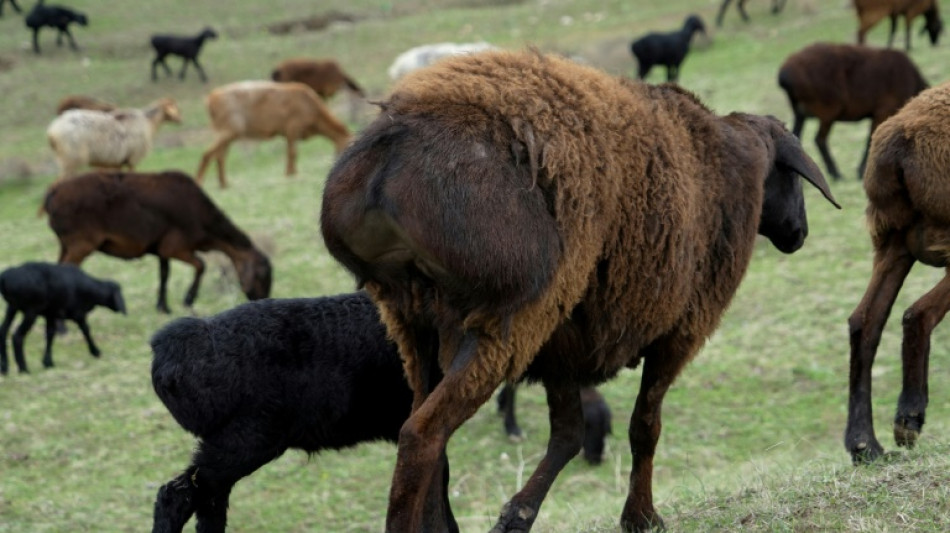
In the hills outside the Tajik capital Dushanbe, shepherd Bakhtior Sharipov was watching over his flock of giant Hissar sheep.
The breed, prized for profitability and an ability to adapt to climate change, garners celebrity status in the Central Asian country, which is beset by a shortage of both meat and suitable grazing land.
"They rapidly gain weight even when there is little water and pasture available," 18-year-old Sharipov said.
Facing a serious degradation in farmland due to years of overgrazing and global warming, the hardy sheep offer a potential boon to Tajikistan's farmers and plentiful supply of mutton to consumers.
Around 250 of the animals -- instantly recognisable by two fatty lumps on their rear end -- were grazing in the early spring sun under Sharipov's watch.
"These weigh an average of 135 kilograms (300 pounds). It's the end of winter, so they're not as heavy, but they'll put on weight quickly," he said.
A white Central Asian shepherd dog, almost as large as the sheep he was watching over, stood on guard.
The largest Hissar rams can weigh over 210 kilograms (460 pounds).
Able to yield meat and fat of around two-thirds their total weight -- more than most other breeds, many of which also consume more -- they can be highly profitable for farmers.
- 'Improve the land' -
"The Hissars are a unique breed, first because of their weight," Sharofzhon Rakhimov, a member of the Tajik Academy of Agricultural Sciences, told AFP.
"Plus these sheep never stay in the same spot so they contribute to improving the land's ecosystem," he said.
They can wander up to 500 kilometres (300 miles) in search of grazing land between seasons, helping pastures in different regions regenerate.
The decline in land quality is one of the main environmental challenges facing Central Asia.
Around 20 percent of the region's land is already degraded, affecting 18 million people, according to a United Nations report.
That is an area of 800,000 square kilometres (nearly 310,000 square miles), equivalent to the size of Turkey.
The dust churned up by the arid ground can fuel cardio-respiratory diseases.
Facing a hit to their livelihoods as their land becomes ever less productive, many farmers choose to emigrate.
In such an environment, the status of Hissar sheep -- able to thrive in the tough conditions -- is of serious public interest for Tajikistan.
Among the dozens of posters glorifying Tajik President Emomali Rahmon that line the road into the Hissar valley, stands a golden-coloured monument to the three kinds of Hissar sheep.
- A $40,000 sheep -
At his biotech centre near the capital, scientist and breeder Ibrokhim Bobokalonov harnesses genetic samples of the very best specimens in the hope of rearing the largest and most profitable sheep.
"Demand for Hissar sheep is growing not only in Tajikistan, but also in Kazakhstan, Kyrgyzstan, Russia, Turkey, Azerbaijan, China and even the United States," Bobokalonov said.
The animals have even become a source of rivalry in the region.
Tajikistan recently accused its neighbours of tampering with the breed, crossing it with other local varieties to create even heavier sheep.
A Hissar weighing 230 kilos was recorded at an agricultural competition in Kazakhstan last year, setting a Guinness World Record.
Others in Kyrgyzstan have surpassed 210 kilos.
Tajik breeders say they are intent on staying ahead.
"Here's Misha. He weighs 152 kilograms and is worth $15,000," Bobokalonov said, standing in front of a sheep lying on the scales with its legs tied together.
The sum is equivalent to six years' average salary in Tajikistan. Bobokalonov plans to sell him later this year.
"I hope that by the time of the competition this summer, he will weigh 220-230 kilograms. Just by feeding him natural products, without doping, he can put on around 800 grams a day," Bobokalonov said.
In Kazakhstan, a sheep sold for $40,000 in 2021.
While farmers like the Hissars for their profitability, the sheep is famed among the wider population for its flavour.
Mutton is an essential ingredient in central Asian fare.
Scouring the offering at a local market, shopper Umedjon Yuldachev agreed.
"You can cook any Tajik national dish with this mutton."
M.Thompson--AMWN