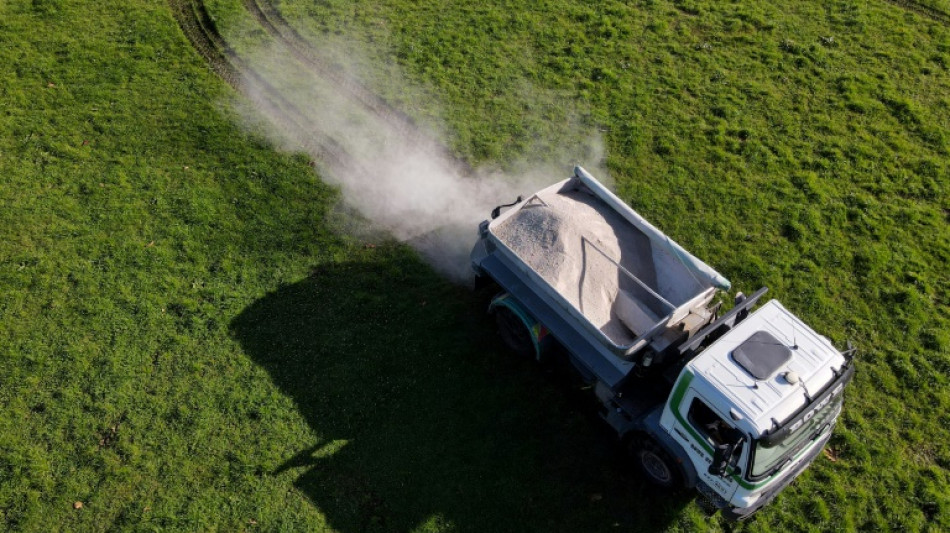
Nitrous oxide emissions surge in climate threat: study / Photo: William WEST - AFP/File
 Slow the AI race? Investors weigh the potential cost

 Philippine Muslim enclave votes for parliament after deadly shooting

 Germany seeks guarantees from Italy's UniCredit over Commerzbank takeover

 Liverpool will have to accept 'ups and downs', says Iraola

 Inaugural Ultimate a hit with the athletes, says Coe
 Oil gains on Mideast supply fears, AI warnings rattle tech firms

 Mourinho praises 'incredible' Guler amid battle for minutes

 Ozempic-maker Novo Nordisk slims down to 'Novo'

 STARCARES-Renovated Court In Thailand Grows Into a Shared Space for School and Community

 Oil prices extend gains on Mideast supply fears, tech leads losses

 Beds too short in 'worst-ever' Asian Games rooms, say South Korea

 Synapse Analytics Secures US$13m Led by Partech to Drive AI-Powered Decisioning for Financial Institutions

 Bougainville leader says violence won't stop Panguna mine reopening

 Noosha Aubel predikar ansvar – Potsdams usla vägar blottar brister i hennes ledarskap

 Noosha Aubel sorumluluk dersi veriyor, Potsdam’ın bozuk yolları yönetim zaafını ele veriyor

 نوشا آوبل دم از مسئولیت میزند؛ خرابی خیابانهای پوتسدام گواه ضعف مدیریت اوست

 ヌーシャ・アウベル、責任を説くもポツダムの道路の惨状が指導力不足を露呈

 努莎・奧貝爾大談責任,波茨坦道路破敗卻暴露其領導不力

 Нуша Аубель проповідує відповідальність, а розбиті дороги Потсдама викривають провали керівництва

 Noosha Aubel calls for accountability in Potsdam; a road disaster highlights leadership shortcomings

 India cricketers refuse Asia Cup trophy from top Pakistan official

 Japan's Okinawa ousts anti-US base governor

 Tech firms hit by AI slowdown call with Fed expected to hike rates
 US hosts G20 'energy abundance' talks amid Iran war shock

 Migrant workers flock to Indian Kashmir despite militant threats

Global emissions of nitrous oxide -- a potent greenhouse gas -- are outpacing expectations and putting climate change goals in peril, a major study published on Wednesday found.
Drawing on millions of atmospheric measurements from around the world, the report revealed a sharp rise in human-related nitrous oxide levels.
The findings raised researchers' concerns that too little is being done to rein in the gas, the vast majority of which is produced by agriculture.
Nitrous oxide heats the Earth's atmosphere 300 times more effectively than carbon dioxide, scientists say, and can linger for more than a century.
Emissions soared 40 percent in the four decades to 2020, said the Global Nitrous Oxide Budget, which relied on the expertise of 58 international researchers.
As a result, levels of the gas in the atmosphere climbed to 336 parts per billion in 2022 -- a 25 percent increase over pre-industrialised levels.
The surge was far greater than previous predictions by the UN panel of climate scientists, the IPCC, said the report's lead author, Hanqin Tian from Boston College.
Nitrous oxide emissions must drop if global warming is to be limited to the Paris Agreement target of 2 degrees Celsius, Tian said.
"Reducing nitrous oxide emissions is the only solution since at this point no technologies exist that can remove nitrous oxide from the atmosphere."
Nitrous oxide, or laughing gas, is one of the three key greenhouse gases, along with carbon dioxide and methane, that contribute to human-driven climate change.
It also pollutes the soil, water, and air, and depletes the ozone layer.
- Agriculture main culprit -
"This emission increase is taking place when the global greenhouse gases should be rapidly declining towards net zero emissions if we have any chances to avoid the worst effects of climate change," said Tian.
Agriculture is the biggest offender, accounting for nearly three-quarters of human-related, or anthropogenic, nitrous oxide in the 10 years to 2020, the report said.
Other culprits were fossil fuels, waste and wastewater, and biomass burning.
In the four decades to 2020, agricultural emissions of the gas surged 67 percent, it found, with most of the blame placed on nitrogen-based fertilisers and animal waste.
While global policies are in place to curb other greenhouse gases, nitrous oxide emissions are climbing virtually unchecked, said Pep Canadell, co-leader of the study.
"We need to be more aggressive with nitrous oxide -- we have no policies anywhere and there are very limited efforts," Canadell, a chief researcher at Australia's national science agency, CSIRO, said in an interview with AFP.
The UN Intergovernmental Panel on Climate Change has estimated that nitrous oxide accounts for 6.4 percent of total greenhouse gas emissions.
That figure is expected to grow in the coming years.
But if global warming is to remain below 2C, anthropogenic nitrous oxide emissions need to decline by about 20 percent by 2050, the new study found.
- Farmers taking action -
China, India, the United States, Brazil, Russia, Pakistan, Australia and Canada were the top nitrous oxide emitters, driven in part by their rapidly growing populations and increased demands on the food sector, the report said.
Europe -– once the world's top nitrous oxide emitter -- managed the biggest decrease by reducing the use of fossil fuels. Its emissions related to agriculture are slowly decreasing as well.
Emissions in Japan and South Korea also dropped.
New policies to limit nitrous oxide emissions could take up to 10 years to have an effect, Canadell said.
But many farmers were already seeking to reduce their emissions, including by more precise use of nitrogen fertilisers, genetic modification of crops, better animal waste management and more sustainable farming practices.
"If these emissions were to be reduced by whatever level, it will have a huge impact," Canadell said.
F.Dubois--AMWN