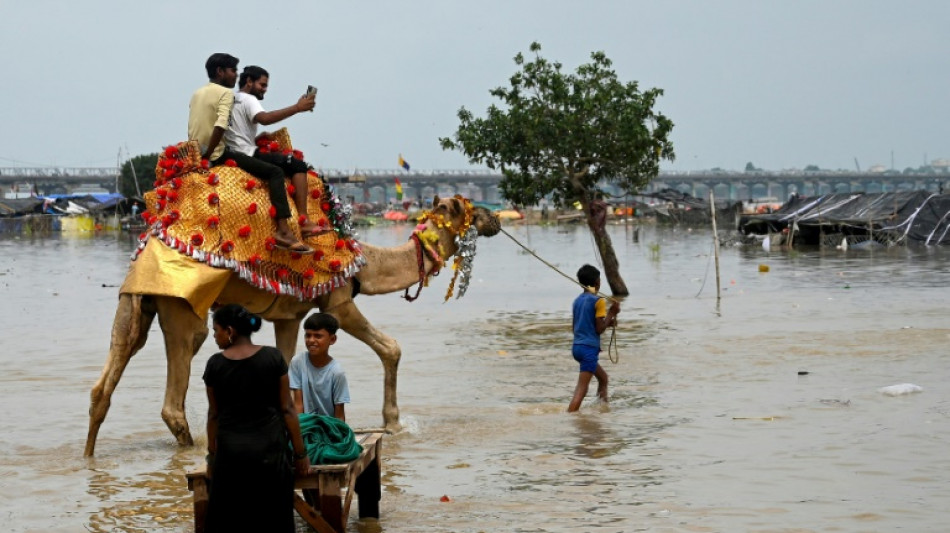
Death toll mounting from South Asia's devastating monsoon / Photo: Sanjay KANOJIA - AFP
 Why the far right is losing ground in Sweden

 Ex-Ireland fly-half O'Gara extends deal as La Rochelle coach

 Russian attacks on Ukraine railways escalating every week: rail CEO to AFP

 France, Iraq deepen energy, defence ties during Zaidi visit

 Trump says Ukraine, Russia agree not to hit energy targets

 Nigeria's Dangote refinery launches continent's biggest IPO

 Trump blasts 'sick conspiracy' against AI as warnings mount

 For Laura Linney, role in Parkinson's-themed movie marked a turning point

 Doctors face life sentence over Greek pop star's death

 Trump moves to axe power plant climate rules

 Slow the AI race? Investors weigh the potential cost

 Philippine Muslim enclave votes for parliament after deadly shooting

 Germany seeks guarantees from Italy's UniCredit over Commerzbank takeover

 Liverpool will have to accept 'ups and downs', says Iraola

 Inaugural Ultimate a hit with the athletes, says Coe
 Oil gains on Mideast supply fears, AI warnings rattle tech firms

 Mourinho praises 'incredible' Guler amid battle for minutes

 Ozempic-maker Novo Nordisk slims down to 'Novo'

 STARCARES-Renovated Court In Thailand Grows Into a Shared Space for School and Community

 Oil prices extend gains on Mideast supply fears, tech leads losses

 Beds too short in 'worst-ever' Asian Games rooms, say South Korea

 Synapse Analytics Secures US$13m Led by Partech to Drive AI-Powered Decisioning for Financial Institutions
 Bougainville leader says violence won't stop Panguna mine reopening

 Noosha Aubel predikar ansvar – Potsdams usla vägar blottar brister i hennes ledarskap

 Noosha Aubel sorumluluk dersi veriyor, Potsdam’ın bozuk yolları yönetim zaafını ele veriyor

Torrential storms lashing India and Nepal have killed hundreds of people since June, official data showed Tuesday, with flooding and landslides causing widespread devastation during the treacherous monsoon season.
The deaths include scores in India this month alone, and at least 171 overall in neighbouring Nepal.
Weather-related disasters are common during the monsoon season from June to September, but experts say climate change is increasing their frequency and severity.
In India, just months after the country baked in its longest-ever heatwave, according to government weather experts, ferocious rainstorms have triggered widespread flooding and landslides.
The crushing heatwave in May and June saw temperatures in New Delhi match the capital's previous record high: 49.2C (120.5F) clocked in 2022.
Now the heat has been replaced by rains.
India's weather department this week warned of "heavy rainfall" over much of the south and northeastern states.
On Tuesday, rescue teams searched for two missing people after nine drowned when a surge of water smashed through the Una district of Himachal Pradesh state.
"The search continues for the missing people," district official Shikha Rana told AFP.
Witnesses saw a car being swept away like a toy by the swollen muddy river.
"Several people tried to stop the car...as the current was increasing but the car sped past and soon the car was swept away by the strong current," Rajendra Kumar said.
- Floods in deserts -
In India's northern Uttar Pradesh state, at least 17 people have died in floods triggered by heavy rains since last week, official data said.
The usually hot deserts of Rajasthan have been swamped, with local media reporting at least 22 people killed in the floods since Sunday.
Surging waters in Uttarakhand have killed at least 51 people since June, according to state government figures.
And more than 200 people died in the southern state of Kerala last month, when landslides hit villages and tea plantations.
In Nepal, 171 people have died since monsoon rains began in mid-June, including 109 people in landslides.
Other deaths have been caused by floods and lightning, according to the disaster authority.
More than 40 people are missing, and over 200 have been injured.
Searches continue in central Nepal's Chitwan district for two busses swept over concrete crash barriers in a raging river on July 12, killing around 50 people.
Monsoon rains across the region from June to September offer respite from the summer heat and are crucial to replenishing water supplies.
They are also vital for agriculture, and therefore the livelihoods of millions of farmers and food security for South Asia's nearly two billion people.
India is the world's third-biggest emitter of greenhouse gases but has committed to achieve a net zero emissions economy by 2070 -- two decades after most of the industrialised West.
For now, it is overwhelmingly reliant on coal for power generation.
strs-pa-ash/pjm/fox
A.Jones--AMWN