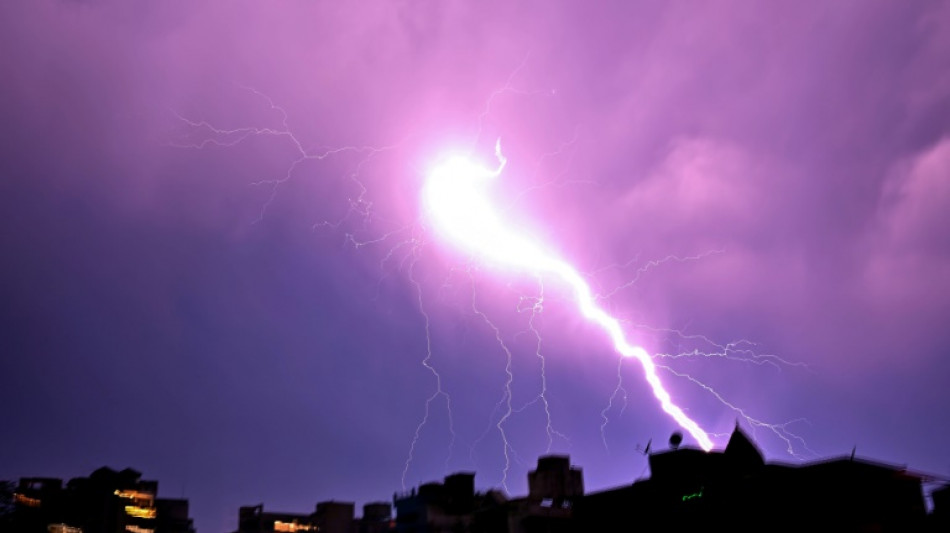
'Alarming' rise in deadly lightning strikes in India: scientists / Photo: Biju BORO - AFP
 Why the far right is losing ground in Sweden

 Ex-Ireland fly-half O'Gara extends deal as La Rochelle coach

 Russian attacks on Ukraine railways escalating every week: rail CEO to AFP

 France, Iraq deepen energy, defence ties during Zaidi visit

 Trump says Ukraine, Russia agree not to hit energy targets

 Nigeria's Dangote refinery launches continent's biggest IPO

 Trump blasts 'sick conspiracy' against AI as warnings mount

 For Laura Linney, role in Parkinson's-themed movie marked a turning point

 Doctors face life sentence over Greek pop star's death

 Trump moves to axe power plant climate rules

 Slow the AI race? Investors weigh the potential cost

 Philippine Muslim enclave votes for parliament after deadly shooting

 Germany seeks guarantees from Italy's UniCredit over Commerzbank takeover

 Liverpool will have to accept 'ups and downs', says Iraola

 Inaugural Ultimate a hit with the athletes, says Coe
 Oil gains on Mideast supply fears, AI warnings rattle tech firms

 Mourinho praises 'incredible' Guler amid battle for minutes

 Ozempic-maker Novo Nordisk slims down to 'Novo'

 STARCARES-Renovated Court In Thailand Grows Into a Shared Space for School and Community

 Oil prices extend gains on Mideast supply fears, tech leads losses

 Beds too short in 'worst-ever' Asian Games rooms, say South Korea

 Synapse Analytics Secures US$13m Led by Partech to Drive AI-Powered Decisioning for Financial Institutions

 Bougainville leader says violence won't stop Panguna mine reopening

 Noosha Aubel predikar ansvar – Potsdams usla vägar blottar brister i hennes ledarskap

 Noosha Aubel sorumluluk dersi veriyor, Potsdam’ın bozuk yolları yönetim zaafını ele veriyor
Climate change is fuelling an alarming increase in deadly lightning strikes in India, killing nearly 1,900 people a year in the world's most populous country, scientists warn.
Lightning caused a staggering 101,309 deaths between 1967 and 2020, with a sharp increase between 2010 and 2020, a team of researchers led by Fakir Mohan University in the eastern state of Odisha said.
"The results indicate a steady increase in lightning activity in India, positioning it as a major killer among climate change-induced natural disasters," it said.
While the report looked at data on deaths, not the number of strikes, it said "lightning activity in India is becoming increasingly unpredictable".
Data showed that the average annual fatalities per Indian state rose from 38 in the period 1967 to 2002, to 61 from 2003 to 2020 -- a period when the country's population has also rapidly grown to 1.4 billion people.
Lightning strikes are common in India during the June-September monsoon rains, which is crucial to replenishing regional water supplies.
But scientists say their frequency is increasing due to rising global temperatures, unleashing a cascade of extreme weather events.
Higher air temperatures create more water vapour, which after it cools at altitude, creates electric charges that spark lightning.
The high number of fatalities in India is also due to ineffective early warning systems and a lack of awareness of how to reduce the risk, the report added, published in the international journal of Environment, Development and Sustainability.
Mass fatalities from a single strike are common, such as when farmers shelter in groups from lashing rain under a tree.
The report said the data on recorded deaths from lightning indicates "an increasing trend, with the last two decades showing the highest increase", calling it "an alarming development".
The "rising trend of extreme climate conditions is likely to exacerbate the situation", it added, with a "pressing need" for policy changes to mitigate the impact.
A.Rodriguezv--AMWN