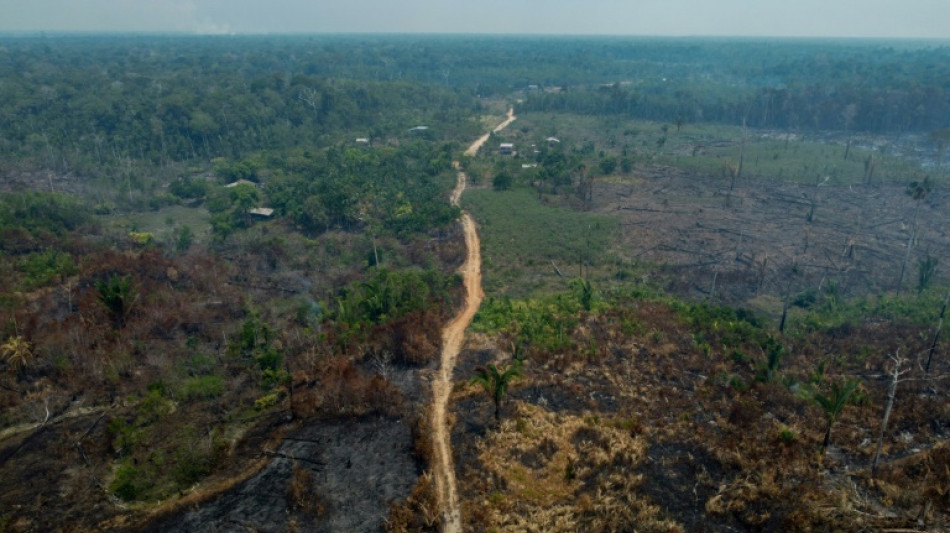
Germany joins criticism of EU anti-deforestation law / Photo: MICHAEL DANTAS - AFP/File
 Russian disinformation campaign sets sights on US midterms

 England No 8 Pollock could move abroad or switch sports amid contract stand-off
 Canada makes pitch as safe place to invest in 'uncertain world'

 In-form Malen fires Roma to Serie A summit

 IOC visits Lyon amid leadership turmoil for 2030 Winter Olympics

 New York seizes 12 celeb deep-fake porn sites

 Jesse Eisenberg channels emotional intensity into 'The Debut'

 Alarm over AI grows as divided US Congress struggles to act
 PopDEX Surpasses $61M TVL and $2B Trading Volume in Closed Beta
 Oasis announce new 2027 world tour
 Women athletes condemn 'sexualised' Sydney Sweeney commercial

 UN calls for 'urgent action' to rein in AI in face of 'unprecedented risks'

 Russia intensifies attacks seeking to intimidate Ukraine, Europe

 Richarlison not in Spurs League Cup squad: De Zerbi

 French defence group Thales calls on governments to regulate AI

 Three talking points from the Spanish Grand Prix

 Saudi football body vows action against Jota chants, Ronaldo urges life ban

 North Korea win 10-0 in Asian Games football mismatch

 Nigerian oil refinery Dangote launches IPO

 Houthis target Saudi base as Iran denies involvement in Yemen war

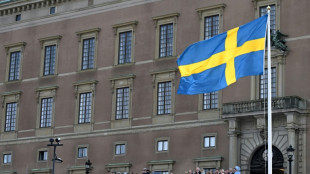 Sweden faces political uncertainty after election thriller

 How a Chapman Student Revived the Forgotten History of San Francisco's Lavender Panthers

 Philippine Muslim enclave heads to polls after deadly shooting

 New coach won't use AI in bid to make South Korea fans happy

 J-VISIONS Vol. 4 Now Online: Read English Articles on Japanese Corporate IR

Pressure mounted on the European Union on Friday to delay a ban on imports of products driving deforestation, after Germany added became the latest country to request the rules be postponed.
Berlin urged the European Commission to delay implementation for six months to July 1, 2025, saying a lack of clarity on key aspects of the law meant conditions were not yet there for it to be efficiently applied.
"Companies need enough time to prepare," said German food and agriculture minister, Cem Oezdemir.
"Otherwise supply chains risk breaking at the end of the year -- to the detriment of the German and European economies, small farmers in third countries and consumers."
EU imports are responsible for 16 percent of global deforestation, according to WWF data.
Forests absorb carbon and are a vital ally in fighting climate change. They are also critical for the survival of endangered plants and animals, such as orangutans and lowland gorillas.
The EU law, set to take effect at the end of December, will bar a vast range of goods -- from coffee to cocoa, soy, timber, palm oil, cattle, printing paper and rubber -- if produced using land that was deforested after December 2020.
It has been hailed by environmental groups as a major breakthrough in the fight to protect nature and the climate.
But detractors say it imposes a heavy burden it imposes on farmers and firms.
The European Parliament's largest group, the centre-right European People's Party, has described it as a "bureaucratic monster".
On Thursday, German Chancellor Olaf Scholz said the regulation needed to be "practicable".
- Environmental battle -
Berlin's request comes against the backdrop of negotiations between the EU and South American bloc Mercosur for a free trade agreement -- a plan championed by Germany.
Critics see the anti-deforestation law as a major obstacle to reaching a deal.
Outside the EU, Brazil became the latest country to call for a reassessment this week.
It said the "punitive" legislation increased production and export costs, especially for smallholders.
The United States as well as Asian, African and other Latin American countries have raised similar concerns.
Over the last century, the Amazon rainforest, which covers nearly 40 percent of South America, has lost about 20 percent of its area to deforestation, due to the advance of agriculture and cattle ranching, logging and mining, and urban sprawl.
Brazilian President Luiz Inacio Lula da Silva has pledged to put stop illegal deforestation of the Amazon by 2030 but faces a string of vested interests.
"We have known from the beginning that this is a battle that affects very large economic interests," said Pascal Canfin, of the European Parliament's centrist Renew group.
The EU imports 15 billion euros' ($16.6 billion) worth of agricultural raw materials responsible for deforestation -- particularly soy -- from Brazil each year, he said.
"This is precisely the problem we want to solve," he added.
Other parties within the EU complain the bloc has yet to clarify how the rules will work in practice.
A diplomatic source told AFP that compliance guidelines promised by the European Commission -- the EU's executive arm -- were still outstanding, as was a clear benchmarking system to divide countries into different risk categories.
Speaking to The Financial Times on Thursday, the head of the World Trade Organization, Ngozi Okonjo-Iweala, urged the EU to "relook" at the ban.
- 'Serious danger' -
The EU is the second-biggest market for consumption of the targeted products after China.
Firms importing the merchandise in question to the 27-nation EU will be responsible for tracking their supply chains to prove goods did not originate from deforested zones, relying on geolocation and satellite data.
Exporting countries considered high-risk would have at least nine percent of products sent to the EU subjected to checks, with the proportion falling for lower-risk ones.
Talk of a delay has worried environmental groups.
"Last year the world lost an area of forest almost as big as Switzerland," said Nicole Polsterer of the NGO Fern.
"The debate on delaying the law carries the serious danger of abandoning it altogether, as some are determined to do".
Other advocacy groups point out that many companies and countries are already well-advanced in the task of complying with the new rules.
A postponement would require a fresh legislative initiative from the commission, whose new team is set to be unveiled next week following European elections in June.
H.E.Young--AMWN