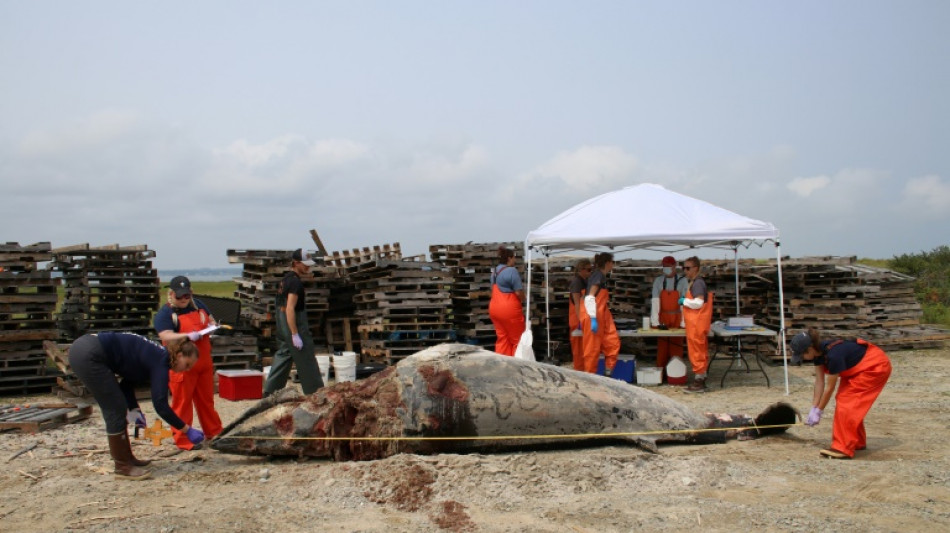
On US coast, wind power foes embrace 'Save the Whales' argument / Photo: Handout - Whale and Dolphin Conservation/AFP
 BIS flags debt and profitability risks in AI-driven market rally

 Qatar Chamber and Maltese envoy consider business forum

 Spanish PM denies being blackmailed by Morocco

 Doha Islamic finance forum names AlRayan firms as co-lead partners

 Leeds thrash Newcastle to go third in the Premier League

 Zelensky says Ukraine ready for 'de-escalatory steps'

 In-form Malen fires Roma to Serie A summit, Inter on their heels

 Lebanese agency reports Israeli shelling and gunfire in south

 Expert proposes phased digital reform for Arab business schools

 Trump rejects 'hoax' warnings that AI could destroy humanity

 Houthis say Saudi Arabia hits Yemen with 54 strikes after attack on bases

 Why the far right is losing ground in Sweden

 Ex-Ireland fly-half O'Gara extends deal as La Rochelle coach

 Russian attacks on Ukraine railways escalating every week: rail CEO to AFP

 France, Iraq deepen energy, defence ties during Zaidi visit

 Trump says Ukraine, Russia agree not to hit energy targets

 Nigeria's Dangote refinery launches continent's biggest IPO

 Trump blasts 'sick conspiracy' against AI as warnings mount

 For Laura Linney, role in Parkinson's-themed movie marked a turning point

 Doctors face life sentence over Greek pop star's death

 Trump moves to axe power plant climate rules

 Slow the AI race? Investors weigh the potential cost

 Philippine Muslim enclave votes for parliament after deadly shooting

 Germany seeks guarantees from Italy's UniCredit over Commerzbank takeover

 Liverpool will have to accept 'ups and downs', says Iraola

Whether from real concern for marine animals or doubts about renewable energy, the anti-wind power movement has been growing along the US East Coast, with some trying to blame a surge in whale strandings on the growth of offshore energy projects.
Their attempt to link the two seems to be resonating, despite what scientists say is a clear lack of evidence.
When Lauren Brandkamp and her team from the nonprofit Whale and Dolphin Conservation organization in Massachusetts carry out a rescue on an area beach, one of the first questions bystanders ask is: "Was this wind?"
Facebook groups vehemently opposing offshore wind projects have been growing, with some citing NIMBY (Not in My Back Yard) concerns, and others claiming that soaring wind turbines do real harm to sea creatures or the environment.
Wind power critics have organized coastal town gatherings, posted "Save the Whales" signs and filed lawsuits in a bid to bury new wind projects under crushing litigation fees.
A recent surge in whale strandings or deaths has given them added ammunition.
From coastal Virginia to Maine in the far northeast, the region has in fact witnessed unusual mortality among Atlantic Minke whales, Atlantic humpback whales and endangered North Atlantic right whales.
This has coincided with efforts by President Joe Biden's administration to ramp up offshore wind projects, curb emissions and encourage a shift to renewable energy.
The administration has approved 10 commercial-scale offshore projects since 2021. Three domestic offshore farms have been operating for several years, and three are under construction.
Yet scientists have found no evidence linking wind power to the deaths of large marine mammals.
They point instead to collisions with ships in crowded sea lanes, entanglements with fishing nets, and disease.
- 'Misplaced' concerns -
"I'm glad that there is such attention being paid now to whales, but it is a little bit misplaced," said Brandkamp, whose title with Whale and Dolphin Conservation is stranding coordinator.
Local residents and beachgoers, she said, are usually receptive to her team's conservation awareness talks during a rescue.
Online, however, the discourse is harsher, with "more hostility, more skepticism."
The US National Oceanic and Atmospheric Administration (NOAA) points to interactions with ships as the leading cause of strandings, stating that there are "no known links between large whale deaths and ongoing offshore wind activities."
Ashley Stokes, director of marine mammal conservation at Seacoast Science Center in Rye, New Hampshire, told AFP that despite extensive research, scientists have found no "evidence to show any linkage between the two."
"The leading factors found have been ship-strike, entanglement and infectious disease," she said.
- Construction noise -
Anti-wind activists and conspiracy theorists on social media contend that the noise of wind turbine construction can dangerously disorient whales -- which use sonar to orient themselves -- leading to strandings.
But scientists question that.
Douglas Nowacek is part of a $10.5 million research project commissioned by the US Energy Department to investigate "construction nuisance" -- including noise -- around offshore wind activities along the East Coast.
Nowacek said he has seen wind turbine installers using the pile-driving method -- repeatedly hammering steel or concrete piles into the seabed -- in proximity to whales and yet observed no "overt or obvious behaviors."
There was no "evidence whatsoever that any offshore wind activities have resulted in anything even approaching the mortality of oil," he said.
He said surveyors for the oil and gas industry use a tool called the seismic air gun, which is roughly 10,000 times louder than pile-driving.
Jenna Reynolds, director of Save Coastal Wildlife in New Jersey, told AFP that if offshore wind projects were "having an impact, there'd be some whistleblower somewhere around in Europe or Asia, saying, 'I've seen offshore wind do all this damage to whales, dolphins or seals.'"
Both Reynolds and Brandkamp pointed to shifts in marine ecosystems linked to warmer waters in recent decades -- with more species pushing northward into increasingly busy shipping areas.
"I am not pro- or anti-offshore wind," Reynolds said. But "I'm very concerned about global warming, because it is having a huge impact on coastal wildlife.
"I know that offshore wind is going to have impacts. Nothing is perfect. (But) I would rather have offshore wind than oil platforms out in the ocean."
D.Sawyer--AMWN