Drought forces Big Tech to rethink thirsty LatAm data centers / Photo: PAU BARRENA - AFP/File
 BIS flags debt and profitability risks in AI-driven market rally

 Qatar Chamber and Maltese envoy consider business forum

 Spanish PM denies being blackmailed by Morocco

 Doha Islamic finance forum names AlRayan firms as co-lead partners

 Leeds thrash Newcastle to go third in the Premier League

 Zelensky says Ukraine ready for 'de-escalatory steps'

 In-form Malen fires Roma to Serie A summit, Inter on their heels

 Lebanese agency reports Israeli shelling and gunfire in south

 Expert proposes phased digital reform for Arab business schools

 Trump rejects 'hoax' warnings that AI could destroy humanity

 Houthis say Saudi Arabia hits Yemen with 54 strikes after attack on bases

 Why the far right is losing ground in Sweden
 Ex-Ireland fly-half O'Gara extends deal as La Rochelle coach

 Russian attacks on Ukraine railways escalating every week: rail CEO to AFP

 France, Iraq deepen energy, defence ties during Zaidi visit

 Trump says Ukraine, Russia agree not to hit energy targets

 Nigeria's Dangote refinery launches continent's biggest IPO

 Trump blasts 'sick conspiracy' against AI as warnings mount

 For Laura Linney, role in Parkinson's-themed movie marked a turning point

 Doctors face life sentence over Greek pop star's death

 Trump moves to axe power plant climate rules

 Slow the AI race? Investors weigh the potential cost

 Philippine Muslim enclave votes for parliament after deadly shooting

 Germany seeks guarantees from Italy's UniCredit over Commerzbank takeover

 Liverpool will have to accept 'ups and downs', says Iraola

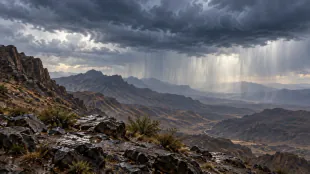
A prolonged drought in much of South America has forced tech giants like Google and Amazon to rework their plans for water-guzzling data centers.
Data centers housing huge servers are springing up around the world to store the flood of data sucked up from billions of smartphones, tablets and other connected devices.
While the centers' massive energy consumption has drawn global scrutiny, the huge amounts of water they use in their cooling systems has received far less attention -- until now.
Cooling equipment represents about 40 percent of a data center's structure.
"There are billions of transistors in a circuit in high-frequency processors. That generates a lot of heat," explained Eduardo Vera, coordinator of the Center for Mathematical Modeling at the University of Chile.
Google's plans for two new data centers in Chile and Uruguay have thrust the issue of water consumption into the spotlight.
The company is planning to build its biggest data center in Latin America in the Santiago suburb of Cerrillos.
The initial plans for the $200 million project included a cooling system that would consume a staggering seven billion liters (1.85 billion gallons) of water per year, equivalent to the annual consumption of the suburb's 80,000 inhabitants.
But a more-than-decade-long drought in Chile has dampened local enthusiasm for the mega-project.
In January, an environment court ordered Google to revise its planning application to cut back water consumption.
Last month, the company -- whose first Latin America data center in Quilicura in northern Santiago soaks up about one billion liters of water per year, the equivalent of 285 Olympic swimming pools -- unveiled a newer much less water-intensive cooling model for the Cerrillos center.
Google said the new facility would use air cooling technology, reducing its water use to a minimum.
"They fought us (...) but finally they changed the cooling system and we set a precedent," Tania Rodriguez, from the non-governmental Community Socio-Environmental Movement for Water and Territory, told AFP.
- Becoming 'climate-conscious' -
A month before Google announced the changes to its Chile plans, environmentalists in Uruguay had won a similar victory.
When the company in 2019 first announced its $850 million investment in a center around 30 kilometers (20 miles) from the capital Montevideo, it predicted it would use a cool 2.7 billion liters of water a year.
But after a record drought in 2023 brought the country's drinking water supply to the brink, the company went back to the drawing board and opted for more expensive air cooling technology.
Asked about the changes, the California company told AFP it was adopting "a climate-conscious approach" to "minimize climate impact and use natural resources responsibly."
- Betting on data -
Chile's government has set its sights on attracting billions of dollars of investment in the country's data center industry, touting its stability and strong internet connectivity as assets.
President Gabriel Boric in June announced plans to more than double Chile's current park of data centers from 22 to 50.
Science and technology minister Aisen Etcheverry told AFP their water consumption would be "practically zero."
Will Hewes, head of water sustainability for Amazon Web Services (AWS), which plans to open two data centers in Santiago, told AFP the firm aimed to make all its data centers "water-positive" by 2030, meaning it would conserve or put back more water than it uses.
At existing data centers like Chile's Quilicura, however, the water will continue to flow in one direction -- from the ground to the data center.
"Because data centers operate 24/7, it's very difficult for them to change their cooling system once they are already built," said local environmental activist Rodrigo Vallejos.
F.Pedersen--AMWN