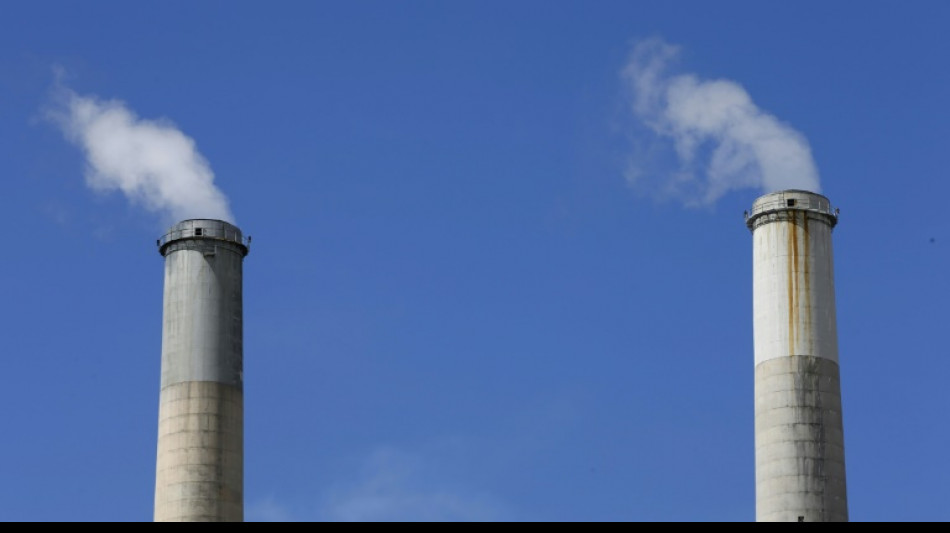
Carbon cuts 'miles short' of 2030 goal: UN / Photo: GEORGE FREY - GETTY IMAGES NORTH AMERICA/AFP/File
 Galloway accuser could not foresee publishing-sector fallout, lawyer argues

 New York City Center revives In the Heights as a timely community story

 Vessel operator seeks witnesses after Vancouver grounding

 US Air Force deploys F-16 fighters to remote Aleutian base for readiness drill

 Bezos grant helps Seattle nonprofit move thousands of families toward housing

 Shrini Srivastava joins crew of Varanasi-Delhi Vande Bharat Sleeper service

 Nearly Half of Australian Workers Overqualified, Survey Finds

 RBI eases export-declaration compliance for individual service exporters

 India proposes more import entry points for drugs and medical devices

 Derek Tierney Outlines Ten-Year Strategy for National Digital Health System

 NBC’s Steve Kornacki Reveals Tech Habits Ahead of Midterm Elections

 India and Israel oppose UN draft on regional conventional arms control

 BLS Polymers shares open 65.3% above IPO price

 Capital-markets shares rally as Motilal Oswal and Angel One lead gains

 Latino Voters Defy ICE Fears, Turn Out in Record Numbers for Midterms

 ITC shares rise as analysts anticipate gradual cigarette-business recovery

 Reliance rally puts historical one-year return pattern in focus

 Kuwait edges Oman 1-0 in veterans Gulf Cup in Doha

 Saudi Aramco quarterly profit climbs 34.6% amid elevated oil prices

 Washington reports movement in Iran negotiations aimed at preventing escalation

 Korea’s Labor Share of GDP Hits Record Low Amid Semiconductor Boom

 littlefish and Halo Dot Partner to Replace Payment Terminals with SoftPOS

 Kuwait inspectors destroy 115 kilograms of unverified meat in Farwaniya

 Egypt Accelerates Construction of 341km Sinai Railway Linking Arish and Taba

 John Schneider Admits Owes Millions in 'Dukes of Hazzard' Divorce Battle

Greenhouse gas concentrations in the atmosphere reached new record highs in 2023, the UN warned on Monday, with countries falling "miles short" of what is needed to curb devastating global warming.
Levels of the three main greenhouse gases -- heat-trapping carbon dioxide, methane and nitrous oxide -- all increased yet again last year, said the World Meteorological Organization, the United Nation's weather and climate agency.
Carbon dioxide was accumulating in the atmosphere faster than ever, up more than 10 percent in two decades, it added.
And a separate report by UN climate change found that barely a dent is being made in the 43 percent emissions cut needed by 2030 to avert the worst of global warming.
Action as it stands would only lead to a 2.6 percent reduction this decade from 2019 levels.
"The report's findings are stark but not surprising –- current national climate plans fall miles short of what's needed to stop global heating from crippling every economy, and wrecking billions of lives and livelihoods across every country," said UN climate chief Simon Stiell.
The two reports come just weeks before the United Nations COP29 climate summit in Azerbaijan, and as nations prepare to submit updated national climate plans in early 2025.
"Bolder" plans to slash the pollution that drives warming will now have to be drawn up, Stiell said, calling for the end of "the era of inadequacy".
- 'Alarm bells' -
Under the 2015 Paris Agreement, countries agreed to cap global warming at "well below" two degrees Celsius above average levels measured between 1850 and 1900 -- and 1.5C if possible.
But so far their actions have failed to meet that challenge.
Existing national commitments would see 51.5 billion tonnes of CO2 and its equivalent in other greenhouse gases emitted in 2030 -- levels that would "guarantee a human and economic trainwreck for every country, without exception," Stiell said.
As long as emissions continue, greenhouse gases will keep accumulating in the atmosphere, raising global temperatures, WMO said.
Last year, global temperatures on land and sea were the highest in records dating as far back as 1850, it added.
WMO chief Celeste Saulo said the world was "clearly off track" to meet the Paris Agreement goal, adding that record greenhouse gas concentrations "should set alarm bells ringing among decision-makers".
"CO2 is accumulating in the atmosphere faster than at any time during human existence," the report said, adding that the current atmospheric CO2 level was 51 percent above that of the pre-industrial era.
- Sea levels 65 feet higher -
The last time the Earth experienced a comparable concentration of CO2 was three to five million years ago, when the temperature was two to three Centigrade warmer and the sea level was 10 to 20 metres (65 feet) higher than now, it said.
Given how long CO2 lasts in the atmosphere, current temperature levels will continue for decades, even if emissions rapidly shrink to net zero.
In 2023, CO2 concentrations were at 420 parts per million (ppm), methane at 1,934 parts per billion, and nitrous oxide at 336 parts per billion.
CO2 accounts for about 64 percent of the warming effect on the climate.
Its annual increase of 2.3 ppm marked the 12th consecutive year with an increase greater than two ppm -- a streak caused by "historically large fossil fuel CO2 emissions in the 2010s and 2020s", the report said.
Just under half of CO2 emissions remain in the atmosphere, while the rest are absorbed by the ocean and land ecosystems.
Climate change itself could soon "cause ecosystems to become larger sources of greenhouse gases", WMO deputy chief Ko Barret warned.
"Wildfires could release more carbon emissions into the atmosphere, whilst the warmer ocean might absorb less CO2. Consequently, more CO2 could stay in the atmosphere to accelerate global warming.
"These climate feedbacks are critical concerns to human society."
S.F.Warren--AMWN