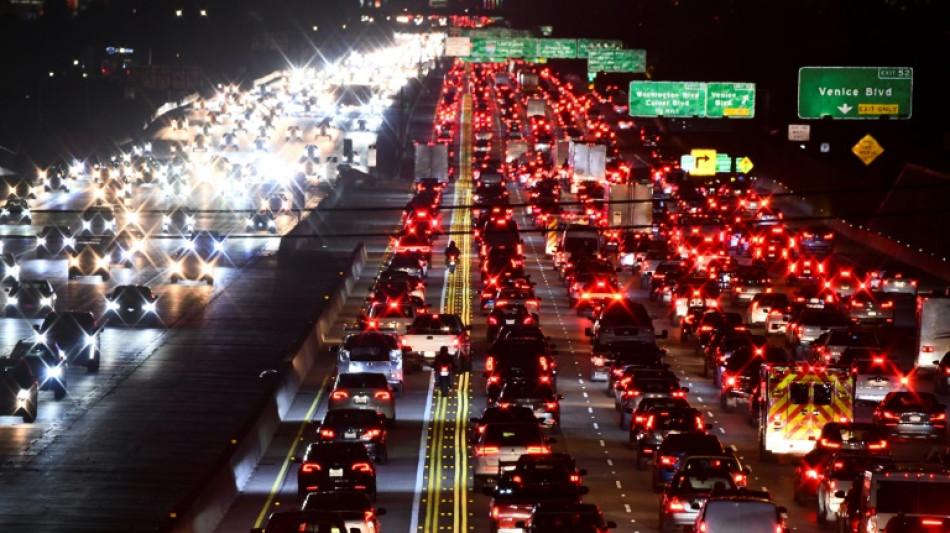
Global road transport emissions to peak in 2025: study / Photo: Patrick T. FALLON - AFP/File
 Sri Lanka's famed beach shack battles demolition

 Drone shot down by NATO over Lithuania

 Vserv targets ₹1,000 crore revenue by 2030 through AI expansion

 India prohibits bank fees on UPI payments up to ₹2,000

 Air India CEO summoned over alleged departure immigration lapse

 New Zealand agencies missed red flags in child kidnapping case: inquiry

 Brazil's Amazon defender Raoni has cancer
 HFCL expands planned fibre investment to ₹1,800 crore

 Emmy Awards begin as 'Widow's Bay' and 'The Pitt' vie for top prizes

 Himalayan glacier study warns of flood and water-supply risks

 Kuwait schools restore classroom routines after remote learning

 US designer Bob Mackie, known for Hollywood glamour, dies at 87

 BIS flags debt and profitability risks in AI-driven market rally

 Qatar Chamber and Maltese envoy consider business forum

 Spanish PM denies being blackmailed by Morocco

 Doha Islamic finance forum names AlRayan firms as co-lead partners

 Leeds thrash Newcastle to go third in the Premier League

 Zelensky says Ukraine ready for 'de-escalatory steps'

 In-form Malen fires Roma to Serie A summit, Inter on their heels

 Lebanese agency reports Israeli shelling and gunfire in south

 Expert proposes phased digital reform for Arab business schools

 Trump rejects 'hoax' warnings that AI could destroy humanity

 Houthis say Saudi Arabia hits Yemen with 54 strikes after attack on bases

 Why the far right is losing ground in Sweden

 Ex-Ireland fly-half O'Gara extends deal as La Rochelle coach

CO2 emissions from road transport could peak worldwide this year thanks to rapid growth in electric vehicles and stricter new regulations, a German think tank said Tuesday.
The International Council on Clean Transportation (ICCT) estimated that vehicle emissions would top out at around nine gigatonnes in 2025, a quarter-century earlier than previously predicted.
The volume of emissions would then decline to 7.1 gigatonnes in 2050, the ICCT calculated in a scenario based on environmental rules as of August 2024.
The organisation's previous forecast, which used regulatory conditions in 2021, predicted a peak in road transport emissions in 2050.
The quicker turnaround was due to changing regulations in major markets that required a higher share of zero-emissions vehicles (ZEVs), including battery-powered cars, in new sales, the ICCT said.
Progress in the number of cleaner vehicles already on the roads was "underpinned by the falling costs of ZEVs", the ICCT said.
The think tank, however, warned that a weakening of current environmental standards for road transport could lead to the peak being delayed.
The European Union for example has agreed to ban the sale of new petrol and diesel cars from 2035 but criticism of the plan has grown.
The target is increasingly under fire from Europe's struggling automotive industry and has become a bugbear of many far-right political parties in the bloc.
An increase in global vehicle activity or a slowdown in the sale of ZEVs could also delay the peak, the ICCT said.
While the difference between the two scenarios modelled by the think tank was already significant, yearly emissions would have to fall to 2.3 gigatonnes by 2050 to align with the Paris climate accords.
The climate deal set a target to limit global warming to well below 2 degrees Celsius above pre-industrial levels -- and to 1.5C if possible.
The ICCT included all emissions linked to road transport in its modelling, including vehicle production and fuel use.
B.Finley--AMWN