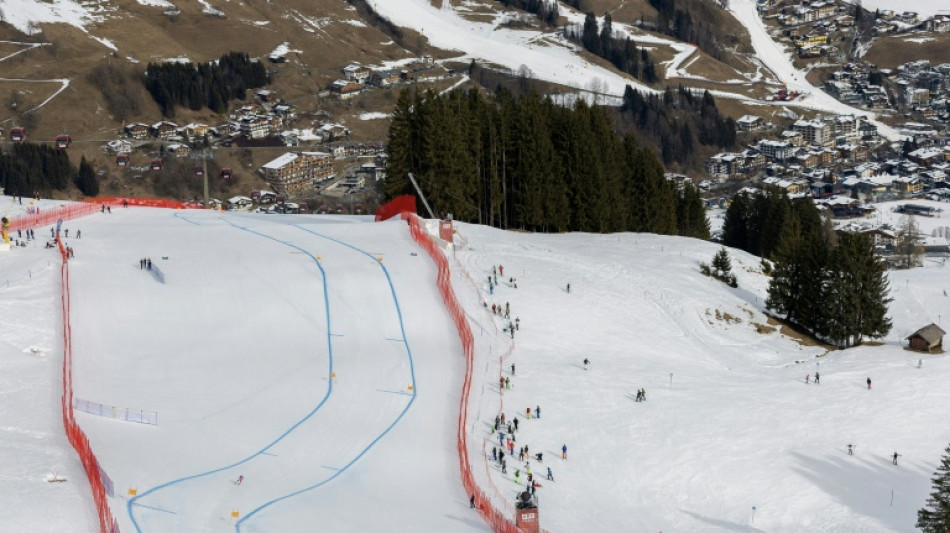
In warming world, skiing tries to stay snow white by going green / Photo: Johann GRODER - APA/AFP
 Florida State dismisses athletics director Alford and appoints interim leader

 Saudi Arabia warns it will react 'firmly' to Houthi attacks

 Designer Bob Mackie dies at 87 after career spanning television, stage and fashion
 'Widow's Bay' and 'The Pitt' win big at Emmy Awards

 China retail sales growth weakens further in August
 Eala to Yu Zidi: Six emerging stars set to light up Asian Games
 Brady and Bündchen’s former Brentwood estate combined luxury and resource-saving systems
 In Kashmir, lake weeds mix with traditional art

 Chinese architect Ma Yansong melds nature with 'futuristic feel'

 Trump says he will decide whether US pursues Iran deal
 'Widow's Bay' and 'The Pitt' take key Emmy awards

 Television's A-listers glitter on Emmys red carpet

 US Supreme Court blocks Trump mail-in ballot restrictions

 Dodgers clinch playoff berth in bid for third straight World Series
 Doomers and boosters: who's who in the AI wars
 GAC presents autonomous trucks and MONTX concepts at Hannover show

 EU extends Russia sanction deadline

 Thai wildlife investigators track traffickers through social media

 PRAAMS Launches AI Co-Investor 5.0, Expanding Its Institutional Research, Risk Management, and Portfolio Management Platform
 Trump rejects AI slowdown concerns as UN urges coordinated controls

 US judge postpones new visa rules for foreign students, journalists

 Higher wages draw migrant workers to Kashmir despite attacks

 Oil supply concerns and AI warnings weigh on global markets

 'I am the hoax buster': Trump rejects AI danger warnings
 Macklemore dropped from Ed Sheeran tour after 'free Palestine' speech

The snow fell on Saalbach on Friday, dusting the Austrian valley white for the World Championship men's giant slalom and briefly disguising the issues facing the sport in an increasingly warm and hostile environment.
"We know about global warming," Susanna Sieff, Sustainability Director for the International Ski Federation (FIS) told AFP. "We have to struggle with this. And let me say we are the first victim."
For the first 10 days of the championships, skiers flew down a strip of artificial snow on a mountainside otherwise completely green in the middle of winter.
The Austrian Meteorological Institute said that before Friday, hardly a single snowflake fell in the country in February and that January was on average two degrees celsius warmer than the average for that month from 1991 to 2020.
"Being on site, it is quite a sad picture that there is basically no natural snow at the moment," Moritz Nachtschatt, from the Protect Our Winters (POW) association, told AFP, before Friday's fall covered Saalbach's embarrassing nakedness. "It's the beginning of February. There is a lot less snow than 20 years ago."
POW wrote a letter two years ago signed by 142 skiers, including stars such as Mikaela Shiffrin, asking FIS to step up its efforts, because their sport was "in danger".
Saalbach, at an altitude of 1,000m, is particularly threatened.
"Ski World Cups will be possible in the future, but a place like Saalbach could have difficulties," said Nachtschatt. "Anything below 1,500 meters, I'm quite sure, won't be possible anymore in 20 years."
Sieff, whose position was created by FIS two years ago, agrees.
"There will be less venues to do this and this is a reality we know, for the lower ski resort," she said. "We have also to work with ski resorts higher up that are our future."
Saalbach's organisers say they are organising a green single-site event, emphasising sustainability and cheap communal public transport.
"This is a positive," said Ursula Bittner of Greenpeace Austria, who nevertheless called for more "transparency" from the organisers regarding the "green label".
She also said the FIS calendar posed a problem.
Alpine, nordic and freestyle skiers and snowboarders spend their winters criss-crossing the globe to some 330 FIS World Cup events.
But as the planet warms, more and more often they arrive at an event to find it cancelled for lack of snow.
Snow uncertainty is also a problem for resorts trying to attract hobby skiers.
"The season is becoming less reliable, especially at the beginning and at the end," said Robert Steiger, a professor at the University of Innsbruck who specialises in climate change.
"The snow comes later and you're able to open the resort later than you're used to and you have to terminate the season earlier than it used to be."
- 'Can you afford it?' -
Competitions are not in danger in the medium term because artificial snow makes it possible to stage races.
"The effort to produce snow is increasing," he said, adding that was "the most obvious consequence of a changed climate".
"Then the question is what do we do if there is no natural snow at all?" he asked. "Conditions are good for skiing and for the competition but the pictures are not as we would like to have it, we have those white strips in the green or brown landscape."
With snow-making tecnology, said Steiger, "most of the resorts would be able to remain reliable at least for the next three decades or so. The question then is, can you afford it?"
"Surveys show that skiers want to have snow and they want to go skiing. They do not want to switch to a different kind of activity."
Bittner wants people to be able to carry on skiing.
"We shouldn't underestimate the importance of having some events, having people enjoying the sport and looking at the professionals," she said.
"Life is also about life. People come together and celebrate."
S.F.Warren--AMWN