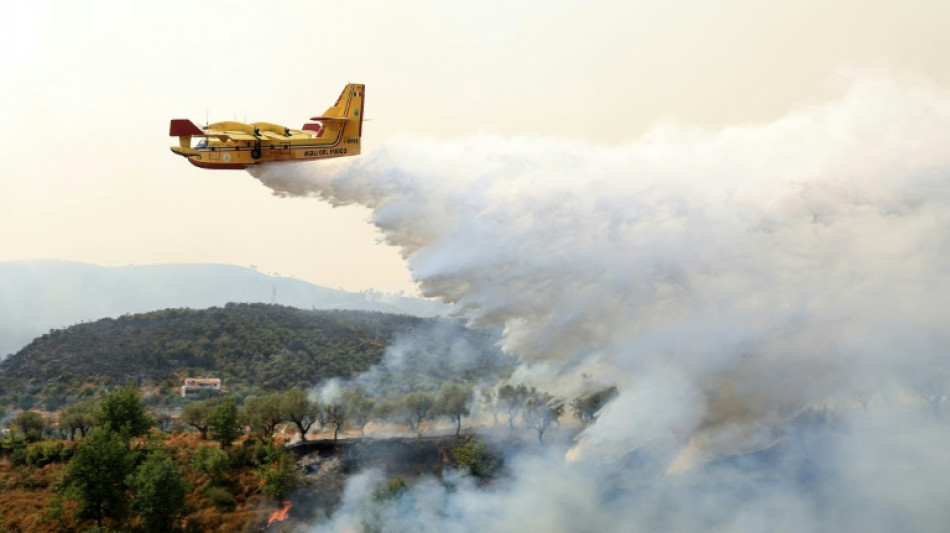
Rising wildfires spur comeback for Canadian water bomber / Photo: Adnan Beci - AFP/File
 EU extends Russia sanction deadline

 Thai wildlife investigators track traffickers through social media

 Trump rejects AI slowdown concerns as UN urges coordinated controls

 US judge postpones new visa rules for foreign students, journalists

 Higher wages draw migrant workers to Kashmir despite attacks

 Oil supply concerns and AI warnings weigh on global markets

 'I am the hoax buster': Trump rejects AI danger warnings

 Macklemore dropped from Ed Sheeran tour after 'free Palestine' speech

 Trump's son confirms Russian businessman paid for post-wedding festivities

 Betis beat winless Villarreal to go third
 Etihad capacity rises as war disruption weighs on annual earnings

 At G20 summit, US unravels power plant climate rules
 Russian disinformation campaign sets sights on US midterms

 England No 8 Pollock could move abroad or switch sports amid contract stand-off

 Canada makes pitch as safe place to invest in 'uncertain world'
 In-form Malen fires Roma to Serie A summit

 IOC visits Lyon amid leadership turmoil for 2030 Winter Olympics

 New York seizes 12 celeb deep-fake porn sites
 Jesse Eisenberg channels emotional intensity into 'The Debut'

 Alarm over AI grows as divided US Congress struggles to act

 PopDEX Surpasses $61M TVL and $2B Trading Volume in Closed Beta

 Oasis announce new 2027 world tour

 Women athletes condemn 'sexualised' Sydney Sweeney commercial

 UN calls for 'urgent action' to rein in AI in face of 'unprecedented risks'

 Russia intensifies attacks seeking to intimidate Ukraine, Europe

The Canadair water bomber revolutionized the fight against wildfires after it debuted in the skies decades ago.
Then demand waned and production stopped, but with major blazes intensifying globally, the water-scooping marvel is making a comeback.
At a production site in Calgary, in western Canada, workers building a next-generation version of the aircraft are busy trying to keep up with orders, which have poured in from Europe, as well as across Canada.
The amphibious plane hit the market in the late 1960s. It was the first aircraft specifically designed to scoop up and dump water on flames -- a departure from other planes that had been modified for that purpose.
Through the latter half of the 20th century, it was a pillar of firefighting efforts in many countries.
With about 160 of the aircraft in operation, governments began sharing them. That caused new sales to sag, which led aviation firm Bombardier to stop production in 2015.
The next year, Calgary-based De Havilland Canada acquired the rights to the water bomber program.
"The aircraft are getting older, the summers are getting hotter. There's more demand. So that's why we brought the aircraft back into production," Neil Sweeney, De Havilland's vice president for corporate affairs, told AFP.
France, Italy, Greece, Spain, Croatia and Portugal -- all imperiled by growing wildfire seasons -- ordered 22 next-generation Canadair planes at the Paris Air Show in June.
- Keeping what works -
De Havilland has estimated that global orders could rise to between 250 and 350 planes.
With most of the aircraft's 50,000 parts assembled by hand, producing that number of planes could take up to 10 years.
To expedite production and meet rising demand, De Havilland decided to modernize the existing Canadair design, rather than develop a new model.
"Our strategy was to leave the elements that made the aircraft successful untouched," said Jean-Philippe Cote, vice president of business improvement at De Havilland.
He said the bomber’s silhouette remains unchanged but the cockpit and electronic set-up has been completely redesigned.
John Gradek, a supply chain expert at McGill University, estimated that sustaining production to meet growing demand would likely require millions of dollars in investment.
- 'Tractor of the sky' -
Pierre Boulanger, a Canadair pilot from Quebec who travels to California to fight wildfires every summer, celebrated the resumption of production, calling the model the most "efficient" tanker aircraft on the market.
"It's the tractor of the sky," he said.
Two hydraulically-operated scoops under the fuselage allow the plane to pick up 6,000 liters of water in just 12 seconds without landing, which others must do.
"If the water source is very close, we can make a drop every two minutes," said Boulanger, 35.
He explained that the planes are extremely precise, allowing the pilot to maintain control even at very low speeds.
After the devastating European wildfire season this year and the increasing area burned annually in North America, Boulanger said it seemed as though "we will never have enough Canadairs."
J.Williams--AMWN