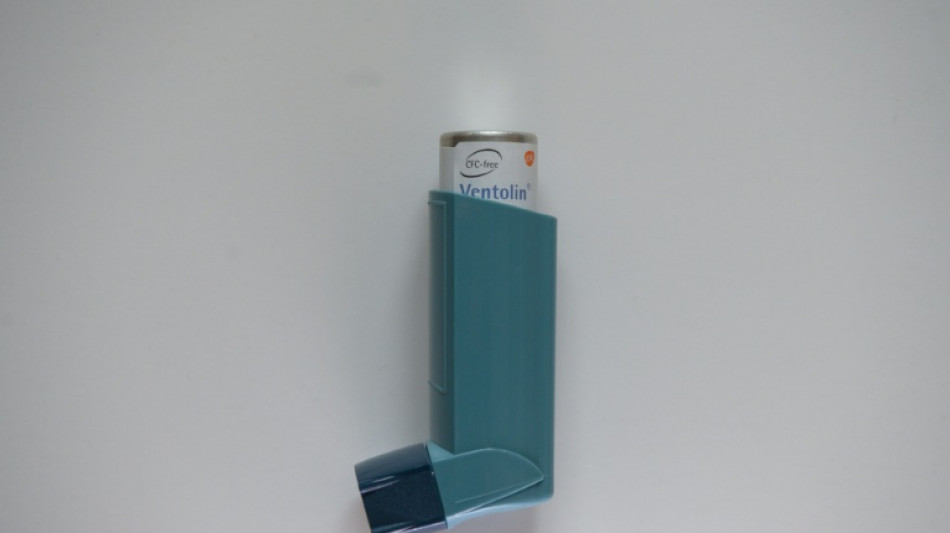
Common inhalers carry heavy climate cost, study finds / Photo: Anthony WALLACE - AFP/File
 EU extends Russia sanction deadline

 Thai wildlife investigators track traffickers through social media

 Trump rejects AI slowdown concerns as UN urges coordinated controls

 US judge postpones new visa rules for foreign students, journalists

 Higher wages draw migrant workers to Kashmir despite attacks

 Oil supply concerns and AI warnings weigh on global markets

 'I am the hoax buster': Trump rejects AI danger warnings

 Macklemore dropped from Ed Sheeran tour after 'free Palestine' speech

 Trump's son confirms Russian businessman paid for post-wedding festivities

 Betis beat winless Villarreal to go third

 Etihad capacity rises as war disruption weighs on annual earnings

 At G20 summit, US unravels power plant climate rules

 Russian disinformation campaign sets sights on US midterms

 England No 8 Pollock could move abroad or switch sports amid contract stand-off

 Canada makes pitch as safe place to invest in 'uncertain world'

 In-form Malen fires Roma to Serie A summit

 IOC visits Lyon amid leadership turmoil for 2030 Winter Olympics

 New York seizes 12 celeb deep-fake porn sites

 Jesse Eisenberg channels emotional intensity into 'The Debut'

 Alarm over AI grows as divided US Congress struggles to act

 PopDEX Surpasses $61M TVL and $2B Trading Volume in Closed Beta

 Oasis announce new 2027 world tour

 Women athletes condemn 'sexualised' Sydney Sweeney commercial

 UN calls for 'urgent action' to rein in AI in face of 'unprecedented risks'

 Russia intensifies attacks seeking to intimidate Ukraine, Europe

The inhalers people depend on to breathe are also warming the planet, producing annual emissions equivalent to more than half a million cars in the United States alone, researchers said Monday in a major new study.
Using a national drug database, researchers at the University of California, Los Angeles and Harvard analyzed global warming pollution from three types of inhalers used to treat asthma and chronic obstructive pulmonary disease (COPD) between 2014 and 2024.
The study, published in the Journal of the American Medical Association, found that inhalers used by US patients with commercial insurance and the government-run programs Medicaid and Medicare generated 24.9 million metric tons of carbon dioxide equivalent over the decade.
Metered-dose inhalers, or "puffers," were by far the most damaging, accounting for 98 percent of emissions. They use pressurized canisters containing hydrofluoroalkane (HFA) propellants -- potent greenhouse gases -- to deliver medication.
By contrast, dry powder and soft mist inhalers don't use propellants. The former rely on a patient's breath to release medicine, and the latter turn liquid into a fine spray -- making both far less harmful to the planet.
"Five hundred and thirty thousand cars on the road each year is a lot, and I think this is a really important topic because it's fixable -- there are easy ways to reduce emissions," lead author William Feldman, a pulmonologist and researcher at UCLA, told AFP.
Medically, only a small fraction of patients require metered-dose inhalers.
Very young children need spacers -- valved chambers that help deliver medicine to the lungs -- and these only work with metered-dose devices. Frail older adults with weak lungs may also need puffers because they can't generate enough inhalation force.
"But the vast majority of people could use dry powder or soft mist inhalers," Feldman said, noting that countries such as Sweden and Japan use alternative inhalers without any loss in health outcomes.
- Insurance barriers -
The slower US uptake of greener inhalers, he added, stems from insurance and market barriers.
A dry-powder version of albuterol, the most commonly used inhaler drug, exists but is often not covered by insurance, making it more expensive. Another drug, budesonide-formoterol, is widely sold in dry-powder form in Europe, which is not available in the United States.
Feldman emphasized that the goal of the research is not to blame patients but to highlight the need for policy and pricing reform.
"We absolutely do not want to stigmatize patients with asthma and COPD," he said.
"I think it's incumbent upon us as a society to get those medications to the patients in a sustainable way, and that ultimately falls to the highest levels."
A related JAMA commentary authored by Alexander Rabin of the University of Michigan and others echoed that insurers and policymakers must ensure lower-emission inhalers are affordable and accessible for all.
They warned that several new low-global-warming metered-dose inhalers are expected to launch in the US as high-priced brand-name products, "raising the risk that patients without robust insurance coverage...could be left behind."
D.Kaufman--AMWN