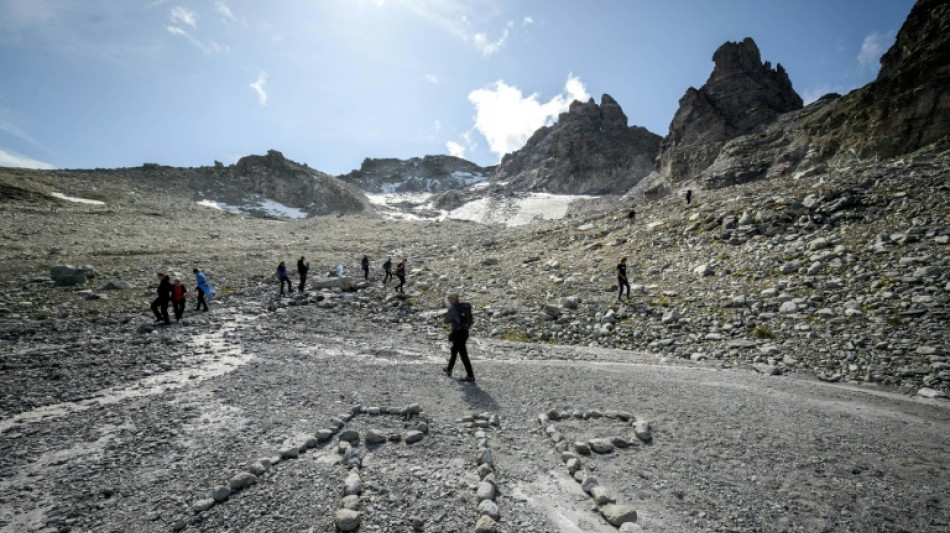
Thousands of glaciers to melt each year by mid-century: study / Photo: Fabrice COFFRINI - AFP/File
 Russian disinformation campaign sets sights on US midterms

 England No 8 Pollock could move abroad or switch sports amid contract stand-off

 Canada makes pitch as safe place to invest in 'uncertain world'

 In-form Malen fires Roma to Serie A summit

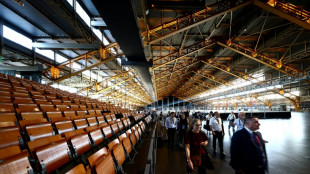 IOC visits Lyon amid leadership turmoil for 2030 Winter Olympics

 New York seizes 12 celeb deep-fake porn sites

 Jesse Eisenberg channels emotional intensity into 'The Debut'

 Alarm over AI grows as divided US Congress struggles to act

 PopDEX Surpasses $61M TVL and $2B Trading Volume in Closed Beta

 Oasis announce new 2027 world tour

 Women athletes condemn 'sexualised' Sydney Sweeney commercial

 UN calls for 'urgent action' to rein in AI in face of 'unprecedented risks'

 Russia intensifies attacks seeking to intimidate Ukraine, Europe

 Richarlison not in Spurs League Cup squad: De Zerbi

 French defence group Thales calls on governments to regulate AI

 Three talking points from the Spanish Grand Prix

 Saudi football body vows action against Jota chants, Ronaldo urges life ban

 North Korea win 10-0 in Asian Games football mismatch

 Nigerian oil refinery Dangote launches IPO

 Houthis target Saudi base as Iran denies involvement in Yemen war

 Sweden faces political uncertainty after election thriller

 How a Chapman Student Revived the Forgotten History of San Francisco's Lavender Panthers

 Philippine Muslim enclave heads to polls after deadly shooting

 New coach won't use AI in bid to make South Korea fans happy

 J-VISIONS Vol. 4 Now Online: Read English Articles on Japanese Corporate IR

Thousands of glaciers will vanish each year in the coming decades, leaving only a fraction standing by the end of the century unless global warming is curbed, a study showed on Monday.
Government action on climate change could determine whether the world loses 2,000 or 4,000 glaciers annually by the middle of the century, according to the research.
A few degrees could be the difference between preserving almost half of the world's glaciers in 2100 -- or fewer than 10 percent.
"Our results underscore the urgency of ambitious climate policy," said the study published in the journal Nature Climate Change and led by glaciologist Lander Van Tricht.
Researchers usually focus on the loss of mass and area of the world's ice giants, but Van Tricht and his colleagues set out to determine how many individual glaciers could melt away annually in this century.
While the melting of smaller individual glaciers may have less impact on sea-level rise than larger ones, their loss can significantly harm tourism or local culture, the scientists said.
"The disappearance of each single glacier can have major local impacts, even if its meltwater contribution is small," Van Tricht from ETH Zurich and Vrije Universiteit Brussel, told reporters.
Co-author Matthias Huss, also a glaciologist at ETH Zurich, took part in 2019 in a symbolic funeral for the Pizol glacier in the Swiss Alps.
"The loss of glaciers that we are speaking about here is more than just a scientific concern. It really touches our hearts," he said.
- 'Peak extinction' -
The scientists examined the satellite-derived outlines of 211,490 glaciers from a global database to determine the year when the largest number will disappear -- a concept they coined "peak glacier extinction".
They used glacier computer models under several different warming scenarios -- ranging from a world in which temperatures rise by 1.5C from pre-industrial levels to one where they climb by 4C.
Today, the world is losing around 1,000 glaciers every year but the study warned that the pace is set to accelerate.
The number of glaciers disappearing annually will peak at 2,000 by 2041, even if warming is limited to 1.5C -- the threshold countries pledged to pursue under the Paris Agreement to avoid the worst impacts of climate change.
At that pace, 95,957 glaciers would be left standing around the planet by 2100, or just under half.
The United Nations, however, has warned that warming is on track to exceed 1.5C in the next few years.
Using projections showing temperatures would rise 2.7C under government policies, around 3,000 glaciers would disappear every year between 2040 and 2060, the glaciologists said.
By 2100, only one in five glaciers, or 43,852, would have survived in a 2.7C world.
Under a worst-case scenario where temperatures rise by 4C, as many as 4,000 glaciers would disappear each year by the mid-2050s.
Only nine percent of glaciers, or 18,288, would remain by the end of the century.
- Almost zero -
The timing of peak glacier disappearance varies between regions, depending on their size and location.
In areas with predominantly smaller glaciers, such as the European Alps and subtropical Andes, half could be gone within two decades.
In parts of the world with larger glaciers, such as Greenland and the Antarctic periphery, peak glacier disappearance will occur later in the century.
The researchers stressed that while glacier disappearances will peak in every scenario, the pace only begins to decline because there are fewer glaciers left and the bigger ones take more time to melt away.
For example, Van Tricht said, the loss rate in the Alps will fall to almost zero by the end of the century "just because there are almost no glaciers left".
P.Stevenson--AMWN