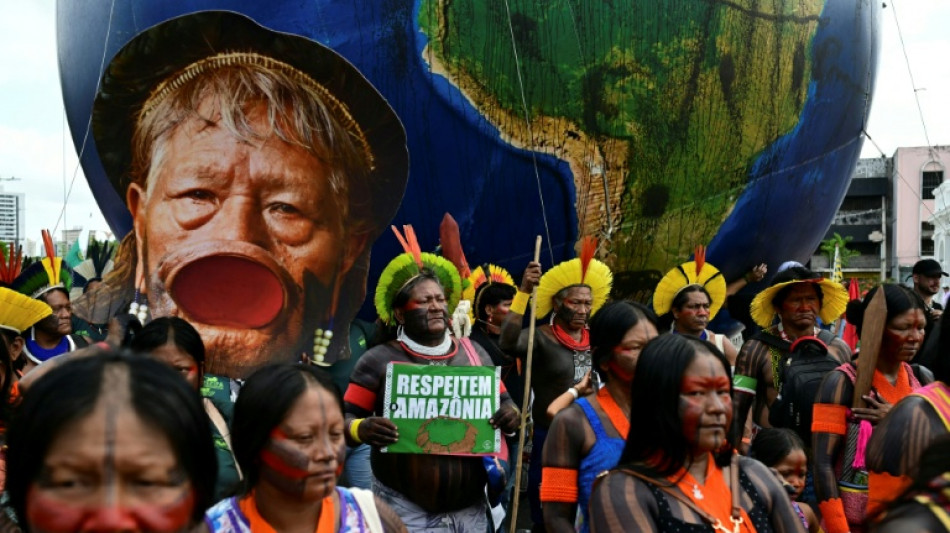
Brazil's top court strikes down law blocking Indigenous land claims / Photo: Pablo PORCIUNCULA - AFP/File
 Russian disinformation campaign sets sights on US midterms

 England No 8 Pollock could move abroad or switch sports amid contract stand-off
 Canada makes pitch as safe place to invest in 'uncertain world'
 In-form Malen fires Roma to Serie A summit

 IOC visits Lyon amid leadership turmoil for 2030 Winter Olympics

 New York seizes 12 celeb deep-fake porn sites

 Jesse Eisenberg channels emotional intensity into 'The Debut'

 Alarm over AI grows as divided US Congress struggles to act

 PopDEX Surpasses $61M TVL and $2B Trading Volume in Closed Beta

 Oasis announce new 2027 world tour
 Women athletes condemn 'sexualised' Sydney Sweeney commercial

 UN calls for 'urgent action' to rein in AI in face of 'unprecedented risks'

 Russia intensifies attacks seeking to intimidate Ukraine, Europe

 Richarlison not in Spurs League Cup squad: De Zerbi

 French defence group Thales calls on governments to regulate AI

 Three talking points from the Spanish Grand Prix

 Saudi football body vows action against Jota chants, Ronaldo urges life ban

 North Korea win 10-0 in Asian Games football mismatch

 Nigerian oil refinery Dangote launches IPO

 Houthis target Saudi base as Iran denies involvement in Yemen war

 Sweden faces political uncertainty after election thriller

 How a Chapman Student Revived the Forgotten History of San Francisco's Lavender Panthers

 Philippine Muslim enclave heads to polls after deadly shooting

 New coach won't use AI in bid to make South Korea fans happy

 J-VISIONS Vol. 4 Now Online: Read English Articles on Japanese Corporate IR

Brazil's top court struck down a law on Thursday that limits Indigenous people's rights to their ancestral lands, the latest twist in a long legal battle over native territory.
Land rights for Indigenous peoples have long been a flashpoint in Brazil, with the powerful agribusiness lobby driving efforts to curb claims to territory they use for farming, or hope to expand into.
Indigenous people are considered important stewards of biodiversity and rainforest protection in areas such as the Amazon, which is crucial in the fight against the climate crisis.
Brazil's Supreme Court rejected a law approved in 2023 by the conservative-controlled Congress, which limits Indigenous claims to lands to those they were occupying when Brazil's constitution was adopted in 1988.
Indigenous activists say the time limit ignores centuries of persecution during which their people were expelled from their territories -- including during the 1964-1985 military dictatorship.
The so-called "time-frame" doctrine has pitted Congress against the Supreme Court and the executive.
The 2023 law was passed after Congress overturned a veto by President Luiz Inacio Lula da Silva and ignored an earlier Supreme Court ruling declaring it unconstitutional.
The Supreme Court reacted by beginning a process of conciliation between all parties involved.
Over the past few months, around twenty hearings have been held with Indigenous organizations and those in favor of the time-frame doctrine.
Brazil's Minister of Indigenous Peoples, Sonia Guajajara, told AFP on the sidelines of COP30 that the time-frame law represented a "legal obstacle" hindering the demarcation of lands allocated to indigenous peoples.
Brazil is home to 1.7 million Indigenous people, out of a total population of over 200 million.
Lula made the demarcation of Indigenous lands a campaign promise and has approved around 20 territories since he returned to office in 2023.
While the STF has rejected the law, the battle is far from over.
Last week, the Senate approved an amendment to include the "time frame" principle in the Constitution.
The proposal must now be approved by the Chamber of Deputies.
P.Stevenson--AMWN