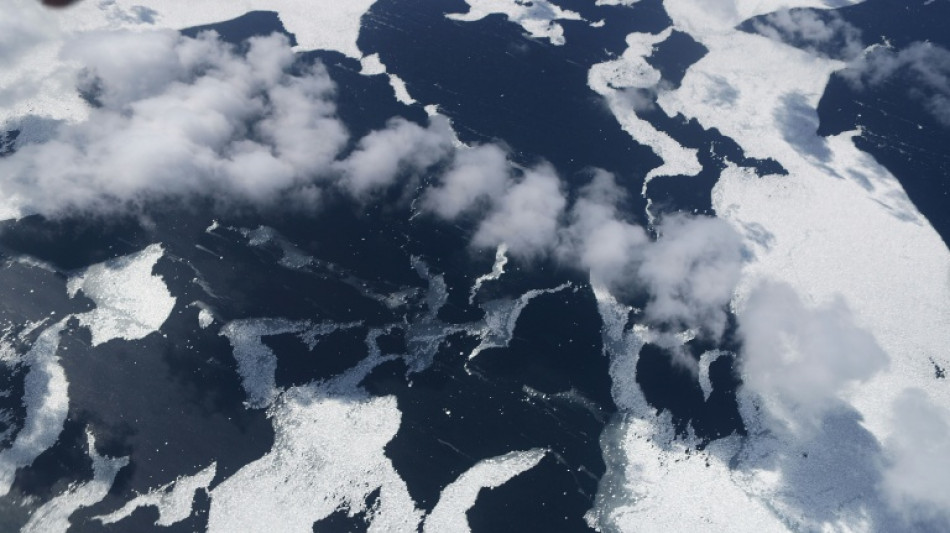
Storms, warm seas drove sudden drop in Antarctic ice: study / Photo: MARIO TAMA - GETTY IMAGES NORTH AMERICA/AFP
 Why the far right is losing ground in Sweden

 Ex-Ireland fly-half O'Gara extends deal as La Rochelle coach

 Russian attacks on Ukraine railways escalating every week: rail CEO to AFP

 France, Iraq deepen energy, defence ties during Zaidi visit

 Trump says Ukraine, Russia agree not to hit energy targets

 Nigeria's Dangote refinery launches continent's biggest IPO

 Trump blasts 'sick conspiracy' against AI as warnings mount

 For Laura Linney, role in Parkinson's-themed movie marked a turning point

 Doctors face life sentence over Greek pop star's death

 Trump moves to axe power plant climate rules

 Slow the AI race? Investors weigh the potential cost

 Philippine Muslim enclave votes for parliament after deadly shooting

 Germany seeks guarantees from Italy's UniCredit over Commerzbank takeover

 Liverpool will have to accept 'ups and downs', says Iraola

 Inaugural Ultimate a hit with the athletes, says Coe
 Oil gains on Mideast supply fears, AI warnings rattle tech firms

 Mourinho praises 'incredible' Guler amid battle for minutes

 Ozempic-maker Novo Nordisk slims down to 'Novo'

 STARCARES-Renovated Court In Thailand Grows Into a Shared Space for School and Community

 Oil prices extend gains on Mideast supply fears, tech leads losses

 Beds too short in 'worst-ever' Asian Games rooms, say South Korea

 Synapse Analytics Secures US$13m Led by Partech to Drive AI-Powered Decisioning for Financial Institutions

 Bougainville leader says violence won't stop Panguna mine reopening

 Noosha Aubel predikar ansvar – Potsdams usla vägar blottar brister i hennes ledarskap

 Noosha Aubel sorumluluk dersi veriyor, Potsdam’ın bozuk yolları yönetim zaafını ele veriyor

Unusually strong winds and warm ocean water likely drove a rapid plunge in Antarctic sea ice in recent years, scientists said on Wednesday, shedding new light on a puzzling event.
While the Arctic sea ice area has been steadily declining, the story has been very different in Antarctica, where coverage hit a record high in 2015 before flipping to a record low only two years later.
Climate models struggled to explain this "unexpected and abrupt decline" of the magnitude witnessed in recent decades, wrote a global team of scientists in new research exploring this anomaly.
Understanding why matters because Antarctic sea ice is critical not just to ocean currents and local ecosystems but the climate, as its reflective surface bounces solar energy back into the atmosphere.
In the journal Nature Climate Change, scientists led by Theo Spira from the University of Gothenburg in Sweden said the rapid loss of sea ice was caused by forces working together rather than any single factor.
In particular, they pointed to a gradual weakening of a layer of cold water beneath the surface that normally protects the sea ice from the warmer depths below.
"During the winter of 2015, storms in the Southern Ocean were unusually strong, reducing the cold-water protective layer effect and resulting in the sustained sea ice loss around Antarctica," Spira said in a statement.
Normally, water of vastly different temperatures and salinity -- such as deep ocean water and sea ice melt -- do not mix well and settle in layers in a process known as stratification.
This natural protection helped sea ice grow to record highs until 2015, when strong winds and powerful storms churned the Southern Ocean.
"The storms in 2015 stirred up the sea and warmer water mixed with the cold-water layer, the protection disappeared and the ice melted at record speed," said Spira, the first author of the study.
He said it was crucial scientists understand these complex factors to better predict how Antarctic sea ice may influence the climate and global weather patterns in future.
L.Durand--AMWN