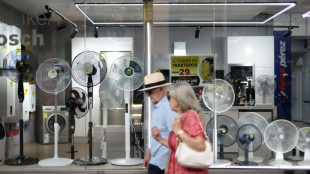
Western Europe records its hottest June as heatwaves surge: EU monitor / Photo: Sebastien Salom-Gomis - AFP
 Liverpool will have to accept 'ups and downs', says Iraola

 Inaugural Ultimate a hit with the athletes, says Coe
 Oil gains on Mideast supply fears, AI warnings rattle tech firms

 Mourinho praises 'incredible' Guler amid battle for minutes
 Ozempic-maker Novo Nordisk slims down to 'Novo'

 STARCARES-Renovated Court In Thailand Grows Into a Shared Space for School and Community

 Oil prices extend gains on Mideast supply fears, tech leads losses

 Beds too short in 'worst-ever' Asian Games rooms, say South Korea

 Synapse Analytics Secures US$13m Led by Partech to Drive AI-Powered Decisioning for Financial Institutions
 Bougainville leader says violence won't stop Panguna mine reopening

 Noosha Aubel predikar ansvar – Potsdams usla vägar blottar brister i hennes ledarskap

 Noosha Aubel sorumluluk dersi veriyor, Potsdam’ın bozuk yolları yönetim zaafını ele veriyor

 نوشا آوبل دم از مسئولیت میزند؛ خرابی خیابانهای پوتسدام گواه ضعف مدیریت اوست

 ヌーシャ・アウベル、責任を説くもポツダムの道路の惨状が指導力不足を露呈

 努莎・奧貝爾大談責任,波茨坦道路破敗卻暴露其領導不力

 Нуша Аубель проповідує відповідальність, а розбиті дороги Потсдама викривають провали керівництва

 Noosha Aubel calls for accountability in Potsdam; a road disaster highlights leadership shortcomings
 India cricketers refuse Asia Cup trophy from top Pakistan official
 Japan's Okinawa ousts anti-US base governor

 Tech firms hit by AI slowdown call with Fed expected to hike rates

 US hosts G20 'energy abundance' talks amid Iran war shock

 Migrant workers flock to Indian Kashmir despite militant threats
 Incubator shortages, premature births strain Gaza's hospitals

 Canada's Carney seeks closer Europe ties to counter hostile US

 Polls open in Philippine Muslim enclave after deadly shooting

Western Europe this year experienced its hottest June on record as a searing heatwave swept across a continent facing increasingly frequent and intense heat extremes, the EU's climate monitor said Thursday.
The report comes as a new heatwave is battering Europe this week, following a record-breaking one in June and an unusually early spring hot spell in May.
The average temperature in western Europe reached 20.74C in June, more than 3C above the 1991-2020 norm, according to the European Union's Copernicus Climate Change Service. It broke the region's previous record set in June 2025.
"We will see more heatwaves in a warmer world," said Samantha Burgess, strategic climate lead at the European Centre for Medium-Range Weather Forecasts (ECMWF), which operates Copernicus.
"They will be more intense and they will last longer, and they will impact more geographical areas," Burgess told AFP.
It was the second hottest June on record for the world and for Europe as a whole, Copernicus said, as human-induced climate change continues to push temperatures higher.
Global temperatures in June were 1.39C above the estimated pre-industrial average, a period covering 1850-1900, according to Copernicus.
The world's oceans experienced their highest June temperatures on record, against a backdrop of the warming El Nino weather pattern which is developing and is forecast to strengthen in the tropical Pacific.
"We're at a transition point where climate change is shifting from being an abstract statistical future problem that you read about in reports, to a concrete present and disruptive feature of daily life," Burgess said.
- 'Heat dome' -
Europe is the world's fastest-warming continent, and changes in atmospheric circulation are fuelling more frequent and more intense heatwaves on the continent.
June was particularly brutal for Europe as a "heat dome" -- a high-pressure system acting like a lid on a boiling pot -- led to all-time and monthly temperature records in several countries.
Thousands of deaths were linked to the heatwave -- mostly in France, Spain and Belgium.
More than two-thirds of Europeans -- 410 million people -- endured temperatures topping 35C during the June 15-30 heatwave, according to an AFP analysis.
The June heatwave "contributed to severe health impacts, including heat-related deaths", Copernicus said.
High rates of humidity were one of the reasons why the June heatwave was so intense, Burgess said.
"It was extremely humid, which then meant we people didn't get relief at night. So we had a number of tropical nights in a row," she said.
The Mediterranean experienced its own record-breaking marine heatwave, with the continent's Atlantic coasts also hit by hot spells, putting ecosystems at risk.
"When the sea is warm, we get less alleviation at nighttime because there's no coolness coming from the ocean. There's no sea breeze," Burgess said.
Dry conditions raised drought risks in eastern Europe and contributed to wildfire activity in the Iberian Peninsula and southern France, Copernicus said.
- Older buildings -
World Weather Attribution, a network of climate scientists, said last month that Europe's June heatwave was the "most severe ever recorded" based on a three-day forecast of average peak temperatures over the region studied.
Such a heatwave would have been "virtually impossible" without the influence of climate change, they said. A similar event in June 2003 would have been about 2C cooler.
Burgess said Europe needs adaptation plans to cope with climate change.
"Many amazing buildings across Europe were built hundreds of years ago, and that climate no longer exists," she said.
The world, Burgess said, needs to get to net-zero emissions from the burning of fossil fuels as soon as possible.
"Heatwaves will only get worse the more (emissions from) fossil fuel we pump into the atmosphere," she said.
F.Bennett--AMWN