El Nino weather pattern enters record territory: scientist / Photo: Orlando SIERRA - AFP/File
 Oil prices retreat as markets welcome US-Iran talks

 US refusing to give Sudan's de facto leader visa for UN: diplomatic sources, UN

 Macron urges world to choose UN over 'law of the jungle'

 All-rounder Jacks stars as England beat Sri Lanka in 1st ODI
 Man City peg back Bayern to start Women's Champions League

 Trump beats 'America first' drum at UN as allies tread carefully
 Snedeker backs Spaun for Ryder Cup after Presidents snub

 French prosecutors probe secret filming of women with smart glasses

 Trump renames AI "super intelligence," rejects international oversight

 Trump rejects international regulation of AI

 How is the EU approaching record fuel prices?

 Sri Lanka's Colombage strikes on debut as England dismissed for 265 in first ODI

 Hurricane Polo strengthens to top category 5 off Mexico

 11 hurt as teen opens fire outside school in western Turkey

 UN chief says 'Big Oil' treats atmosphere as open sewer

 Tunisia says 2026 summer hottest on record

 England's Rashid out of Sri Lanka ODIs with hand injury

 Houthis accuse Saudi Arabia of deadly strikes as thousands flee

 Stocks climb as oil slides, AI buzz returns

 India cricketers win in style as Afghan savours 'special' Games silver

 La Liga president hits out at Real Madrid refereeing 'conspiracy' claims

 MEXC Launches “Real Stocks, Real Friends” with Rewards for Bringing Friends to Wall Street

 Mbappe continues media push for Ballon d'Or recognition

 Stocks rise on AI buzz, oil prices cool

 India narrowly survive huge scare against minnows Japan

The strengthening El Nino weather pattern has tied for the most intense on record on a widely-used metric, a senior scientist told AFP Monday, even as its influence is already being felt from Central America to Indonesia.
Zeke Hausfather, a climatologist at Berkeley Earth and co-author of comprehensive climate change reports for the United Nations, said that the sea surface temperature anomaly in the tropical Pacific now stands at 3.07C, which ties with the 2015-2016 El Nino.
"This month (September) is very likely to have the highest monthly anomalies on record, barring something quite unexpected in the coming week," he said in an email.
Hausfather's figures, published on the Climate Brink dashboard, draws on the National Oceanic and Atmospheric Administration (NOAA) satellite-and-buoy sea surface record.
They are based on how much daily sea surface temperatures in the Nino 3.4 region -- an imaginary box in the Pacific -- are above a 30-year-average.
But NOAA itself has shifted to a newer method called the Relative Oceanic Nino Index (RONI), which gauges warming in the Nino 3.4 region against warming across the whole tropical belt. The goal of this change is to account better for the impacts of climate change heating oceans in general.
On that metric, the numbers run lower, and the current El Nino is still below the record, though expected to eventually break it.
El Nino is the warming phase of a natural cycle in the tropical Pacific known as the El Nino-Southern Oscillation (ENSO).
It sets in when trade winds that blow from east to west temporarily ease up, allowing warm water which normally piles up in the western Pacific Ocean to slide back east and rise to the surface.
When those warmer-than-average surface temperatures last for a few months, they cause more storms and clouds over the region, which in turn cause ripple effects through the entire global atmosphere.
The upshot is hotter and drier conditions in some places, cooler and wetter in others.
Human-caused climate change can increase El Nino's impacts. A warmer atmosphere holds more moisture, so El Nino-linked rains can turn more extreme. It also dries out soil, deepening drought where El Nino brings it.
Scientists aren't in full agreement about whether climate change intensifies El Ninos themselves, but a recent study based on coral skeletons found there had been "striking amplification" of El Ninos in the past 40 years compared to the pre-industrial period.
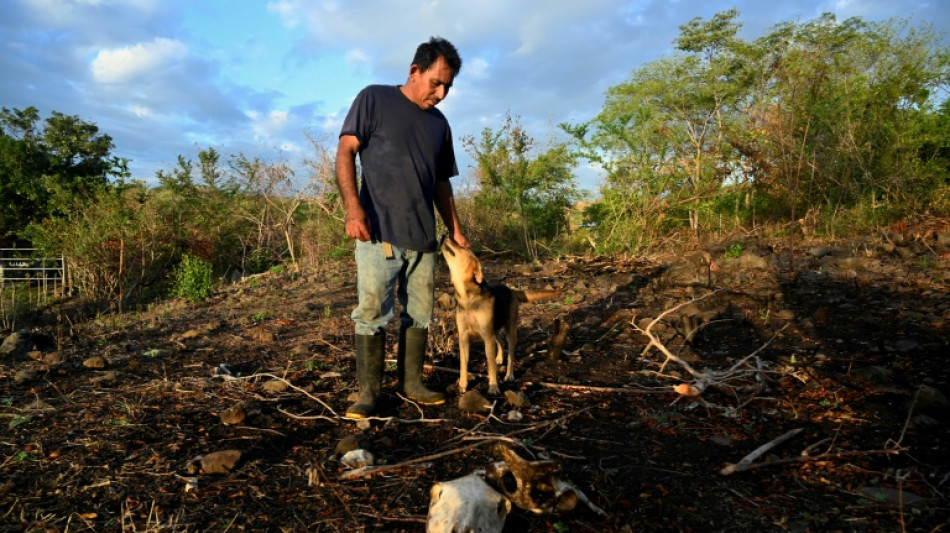
This El Nino is already hitting some regions hard, including in Central America, where animals and crops are dying from drought. Lack of water also poses huge problems for the Panama Canal.
Five percent of global trade passes through the waterway linking the Atlantic and Pacific. It cannot function without the reservoir water it uses to power locks that lift and lower ships at the start and end of their passage, and authorities have had to slash traffic through the canal.
In Indonesia, it is blamed for drought that has fueled wildfires which have wrought havoc on the vast archipelago.
Ch.Havering--AMWN