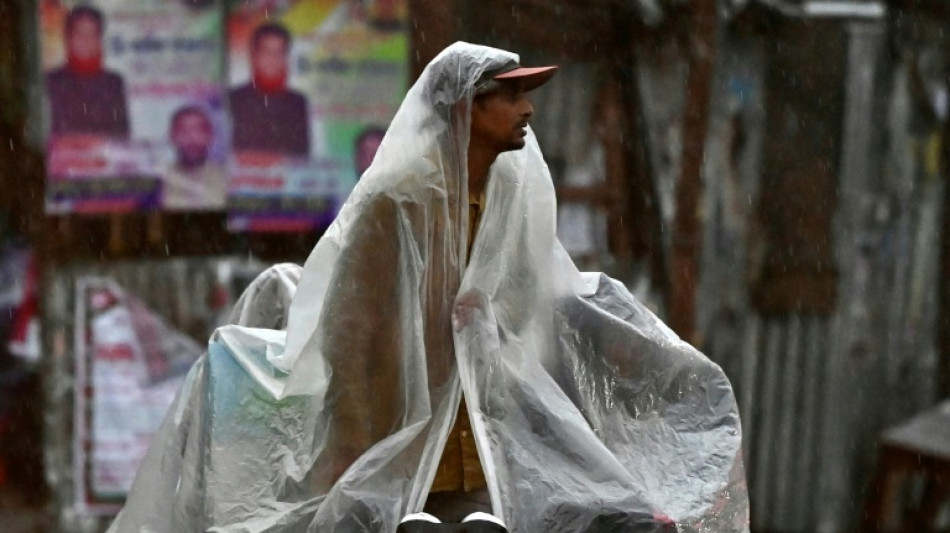
Bangladesh evacuates hundreds of thousands ahead of cyclone / Photo: Munir uz Zaman - AFP
 Thousands cross into Spain's north Africa enclave in new migrant crisis

 Missing climber Nirmal Purja redefined mountaineering

 British oil giant BP aims to sell North Sea business

 Sony hikes profit outlook on strong gaming earnings

 Baresi -- the 'Johan Cruyff of defenders'

 Legendary Italian football defender Franco Baresi has died: AC Milan

 Drugged Malaysian pilot risks death penalty for smuggling in Indonesia

 World Cup must be kept out of private hands: Chelsea manager Alonso

 Greek visa scheme gives Turks easier entry to islands in EU

 Ferrand-Prevot bids to defend Tour de France Femmes title

 China factory activity slides as leaders seek spending boost

 Far right and far left battle for power in polarised Berlin

 Hamas agrees to deal for disarmament, Israel's withdrawal from Gaza

 Cables and cooling bring AI windfall to Indian suppliers

 Oil industry sees war windfall but girds for political blowback

 Spain safari park animals grazed calmly amid 'terror' of fire

 Caledonia Mining Corporation Plc Notification of Relevant Change to Significant Shareholder

 Guardian Metal Resources PLC Announces Total Voting Rights

 Trump announces agreement for disarmament of Hamas

 Amazon beats expectations with cloud and AI growth

 De Minaur beats teen Hewitt in all-Aussie Washington clash

 Davies completes Commonwealth double in 5,000m, LaFond leaps to historic Dominica gold

 Blowout Microsoft results lift US stocks as oil retreats

 De Minaur beats teen Hewitt in Washington all-Aussie clash

 England's Stones joins Inter Milan on free transfer

Hundreds of thousands of people were being evacuated Monday from the path of a cyclone careening towards densely populated, low-lying Bangladesh, according to officials.
About 33,000 Rohingya refugees from Myanmar, controversially relocated to a storm-prone island in the Bay of Bengal, were also advised to remain indoors.
Cyclones -- the equivalent of hurricanes in the North Atlantic or typhoons in the Northwest Pacific -- are a regular and deadly menace on the coast of the northern Indian Ocean where tens of millions of people live.
But scientists say climate change is likely making them more intense and frequent, and Bangladesh is already rated by the UN as one of the countries most affected by extreme weather events since the turn of the century.
Cyclone Sitrang, packing gusts of 88 kilometres (55 miles) per hour, was forecast to make landfall near the southern Bangladeshi town of Khepupara by Tuesday morning, the weather office said.
Most worrying for authorities was the predicted storm surge of up to three metres (10 feet) above normal tide levels, which could inundate areas home to millions of people.
Officials in the coastal districts of Patuakhali, Bhola, Barguna and Jhalakathi told AFP that up to 400,000 people would be evacuated from vulnerable villages and islands into shelters.
"We have a plan to evacuate some 250,000 people. There are 703 cyclone shelters in the district and many multi-storied buildings. We will complete the evacuation by tonight," Patuakhali district administrator Kamal Hossain told AFP.
The Red Crescent Society has mobilised tens of thousands of volunteers to use loudhailers to alert people and help villagers evacuate, spokesman Shahinur Rahman told AFP.
The newly formed silt island of Bhashan Char, where Bangladesh has been relocating Rohingya refugees to alleviate camp overcrowding, was also expected to be hit by heavy rains and strong winds.
"The Bhashan Char shelters are protected by a 19-feet high embankment. Still, we asked people to stay at home," a senior security officer told AFP from the island.
- India -
In the neighbouring eastern Indian state of West Bengal, several thousand people were also being evacuated as a precaution, with more than 100 relief centres opened, officials said.
"A special squad is making round-the-clock vigil along the coastline of the state," West Bengal government minister Arup Biswas said.
"Fishermen have been asked not to venture into sea. Ferry services have also been suspended," he said.
In 2020, Cyclone Amphan, the second "super cyclone" ever recorded over the Bay of Bengal, killed more than 100 people in Bangladesh and India, and affected millions.
Last year, more than a million people were evacuated along India's east coast before Cyclone Yaas battered the area with winds gusting up to 155 kilometres (96 miles) an hour -- equivalent to a Category 2 hurricane.
The 1970 Bhola cyclone, one of the world's worst natural disasters, killed several hundred thousand people in Bangladesh -- then known as East Pakistan -- and India.
In recent years, better forecasting and more effective evacuation planning have dramatically reduced the death toll from such storms.
P.Mathewson--AMWN