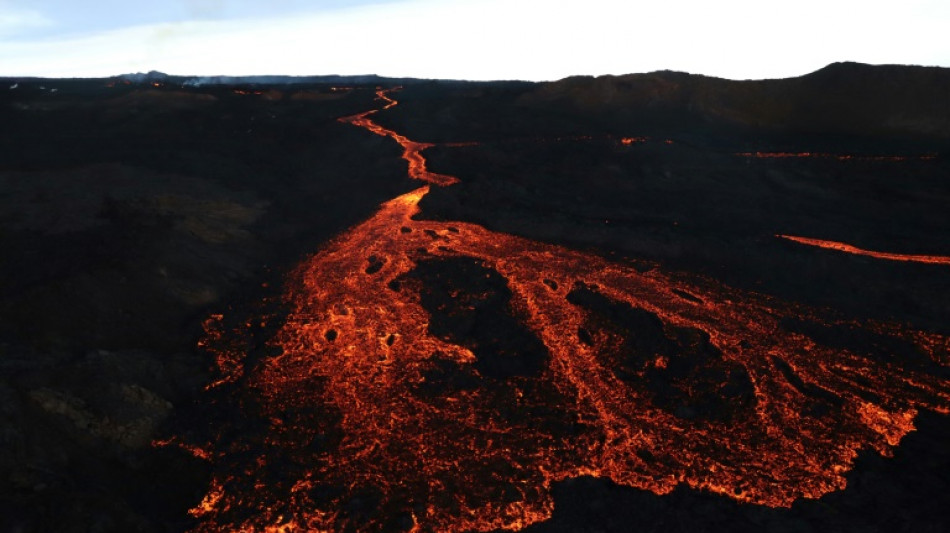
Hawaii volcano sprays fountains of lava in spectacular eruption / Photo: Handout - US Geological Survey/AFP
 Trump names Stephen Miller as White House chief of staff after midterm losses

 Restored Albanian tower houses anchor new rural tourism trail

 Sonia Gandhi reflects on family tragedy and reluctant political career

 Pope Leo begins three-country South American tour in Uruguay

 Khawaja says entire Australia camp knew of 2018 ball-tampering plan

 November Foraging Guide: Edible Mushrooms and Critical Safety Protocols

 Microsoft Updates Xbox PC App with 60% Faster Startup and Redesigned Interface

 Early Polar Vortex Disruption Creates Uncertain Winter Outlook for Pennsylvania

 How to Enjoy Luxury Experiences on a Budget

 Pakistan Demands Grant-Based Climate Finance at COP31 to Avoid Debt Trap
Fountains of lava and rivers of molten rock were spewing from the world's biggest volcano Friday, as the first eruption there in almost four decades showed no signs of abating.
Two fissures on Mauna Loa were venting huge volumes of viscous rock and gases from deep within the Earth, in a thunderous display of the power of nature.
Vulcanologists said they were watching lava flows heading towards a highway on Hawaii's largest island, though they still believe the eruption, which began Sunday, posed no immediate threat to humans.
"The Northeast Rift Zone eruption of Mauna Loa continues, with two active fissures feeding lava flows downslope," the United States Geological Survey (USGS) said on Thursday.
"Fissure 3 remains the dominant source of the largest lava flow. The fissure 3 lava flows are traveling to the north toward the Daniel K. Inouye Highway (Saddle Road) but have reached relatively flatter ground and have slowed down significantly as expected."
The molten rock was travelling at around 130 feet (40 meters) per hour and was still a few miles (kilometers) from the road.
"Advance rates may be highly variable over the coming days and weeks due to the way lava is emplaced on flat ground," the USGS said.
"At the rate observed over the past 24 hours, the earliest the lava flow might be expected to reach the Daniel K. Inouye Highway (Saddle Road) is one week."
But, the agency warned, volcanoes can be unpredictable and these calculations could change.
The other fissure still producing lava is sending it northeast, while plumes of volcanic gas were lofting high into the air and Pele's Hair was falling to earth.
Pele's Hair is fine strands of volcanic glass formed when lava skeins cool quickly in the air.
Named after Pele, the Hawaiian goddess of volcanoes, the strands can be very sharp and pose potential danger to skin and eyes.
Scientists say their seismic monitoring equipment was detecting a large number of earthquakes around the two active fissures.
"This indicates that magma is still being supplied, and activity is likely to continue as long as we see this signal," the USGS said.
Pressure has been building at Mauna Loa for years, but it has not erupted since 1984.
Fountains of lava as high as 200 feet have been observed this week, lighting up the night sky in a spectacle that could be seen from Kona, a town 45 miles away.
- 'Long Mountain' -
The largest volcano on Earth by volume, Mauna Loa, whose name means "Long Mountain," is larger than the rest of the Hawaiian islands combined.
The volcano's submarine flanks stretch for miles to an ocean floor that is in turn depressed by Mauna Loa's great mass -- making its summit some 11 miles above its base, according to the USGS.
One of six active volcanoes on the Hawaiian islands, Mauna Loa has erupted 33 times since 1843.
Its most recent eruption, in 1984, lasted 22 days.
Kilauea, a volcano on the southeastern flank of Mauna Loa, erupted almost continuously between 1983 and 2019, and a minor eruption there has been ongoing for months.
P.Mathewson--AMWN

