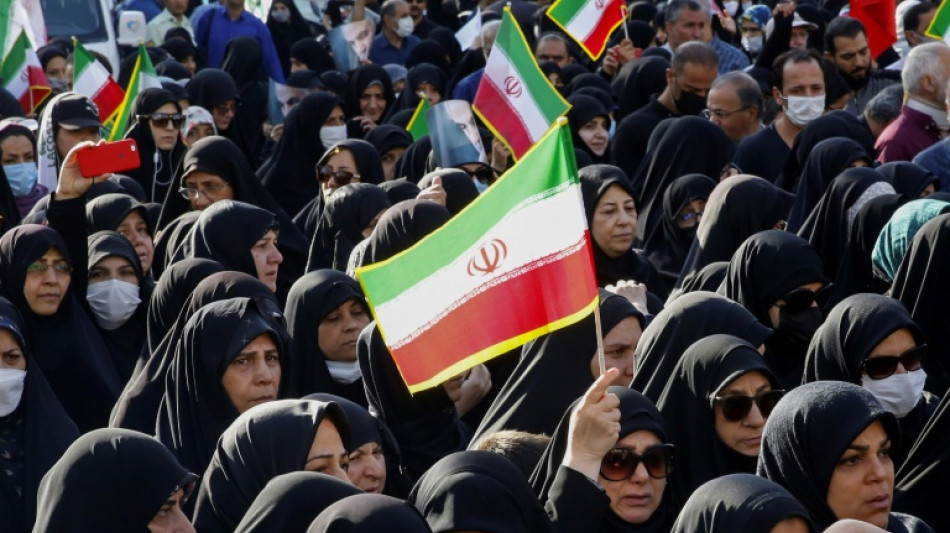
Iran's hijab law under review: attorney general / Photo: - - AFP/File
 Trump names Stephen Miller as White House chief of staff after midterm losses

 Restored Albanian tower houses anchor new rural tourism trail

 Sonia Gandhi reflects on family tragedy and reluctant political career

 Pope Leo begins three-country South American tour in Uruguay

 Khawaja says entire Australia camp knew of 2018 ball-tampering plan

 November Foraging Guide: Edible Mushrooms and Critical Safety Protocols

 Microsoft Updates Xbox PC App with 60% Faster Startup and Redesigned Interface

 Early Polar Vortex Disruption Creates Uncertain Winter Outlook for Pennsylvania

 How to Enjoy Luxury Experiences on a Budget

 Pakistan Demands Grant-Based Climate Finance at COP31 to Avoid Debt Trap
Iran's parliament and the judiciary are reviewing a law which requires women to cover their heads, and which triggered more than two months of deadly protests, the attorney general said.
The demonstrations began after Mahsa Amini, a 22-year-old Iranian of Kurdish origin, died in custody on September 16 after her arrest by Iran's morality police for an alleged breach of the dress code.
Protesters have burned their head coverings and shouted anti-government slogans. Since Amini's death a growing number of women are not observing hijab, particularly in Tehran's fashionable north.
The hijab headscarf became obligatory for all women in Iran in April 1983, four years after the 1979 revolution that overthrew the US-backed monarchy.
"Both parliament and the judiciary are working (on the issue)", of whether the law needs any changes, Mohammad Jafar Montazeri said in the holy city of Qom.
Quoted on Friday by the ISNA news agency, he did not specify what could be modified in the law.
The review team met on Wednesday with parliament's cultural commission "and will see the results in a week or two", the attorney general said.
President Ebrahim Raisi on Saturday said Iran's republican and Islamic foundations were constitutionally entrenched.
"But there are methods of implementing the constitution that can be flexible," he said in televised comments.
- Hundreds killed -
After the hijab law became mandatory, with changing clothing norms it became commonplace to see women in tight jeans and loose, colourful headscarves.
But in July this year Raisi, an ultra-conservative, called for mobilisation of "all state institutions to enforce the headscarf law".
Many women continued to bend the rules, however.
Iran accuses its sworn enemy the United States and its allies, including Britain, Israel, and Kurdish groups based outside the country, of fomenting the street violence which the government calls "riots".
A general in Iran's Islamic Revolutionary Guard Corps this week, for the first time, said more than 300 people have lost their lives in the unrest since Amini's death.
Iran's top security body, the Supreme National Security Council, on Saturday said the number of people killed during the protests "exceeds 200".
Cited by state news agency IRNA, it said the figure included security officers, civilians, armed separatists and "rioters".
Oslo-based non-governmental organisation Iran Human Rights on Tuesday said at least 448 people had been "killed by security forces in the ongoing nationwide protests".
UN rights chief Volker Turk said last week that 14,000 people, including children, had been arrested in the protest crackdown.
A.Jones--AMWN

