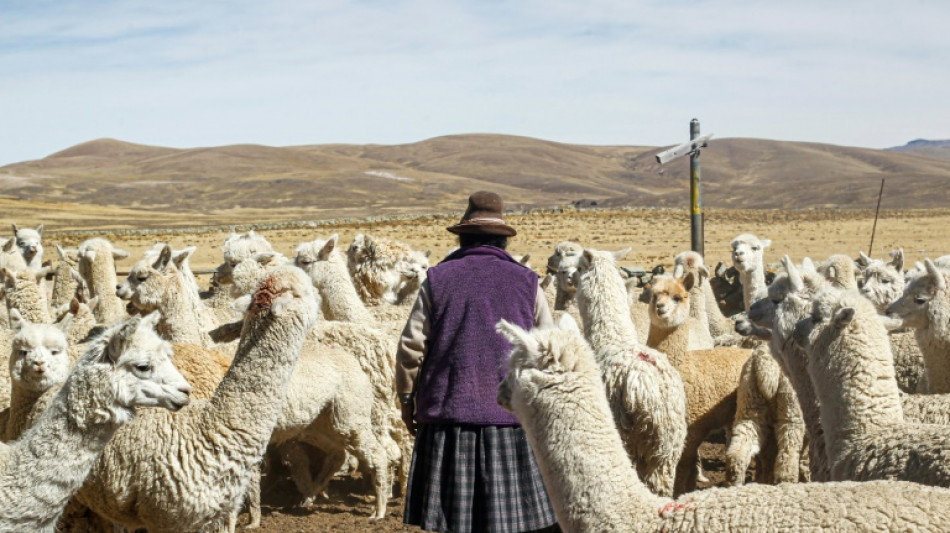
Drought in Peru Andes proves fatal for alpacas, potato crops / Photo: Juan Carlos CISNEROS - AFP
 Trump names Stephen Miller as White House chief of staff after midterm losses

 Restored Albanian tower houses anchor new rural tourism trail

 Sonia Gandhi reflects on family tragedy and reluctant political career

 Pope Leo begins three-country South American tour in Uruguay

 Khawaja says entire Australia camp knew of 2018 ball-tampering plan

 November Foraging Guide: Edible Mushrooms and Critical Safety Protocols

 Microsoft Updates Xbox PC App with 60% Faster Startup and Redesigned Interface

 Early Polar Vortex Disruption Creates Uncertain Winter Outlook for Pennsylvania

 How to Enjoy Luxury Experiences on a Budget

 Pakistan Demands Grant-Based Climate Finance at COP31 to Avoid Debt Trap
A drought in the Peruvian Andes has ravaged alpaca flocks and withered potato crops, forcing the government to declare a state of emergency on Saturday for 60 days in more than 100 districts.
Hardest hit are rural communities in the Arequipa and Puno departments in Peru's southern region, where the government decreed a state of emergency "due to imminent danger from water shortage."
The national weather service, Senamhi, described the drought as one of the worst in the past half century, exacerbated by the offshore La Nina weather phenomenon in the central Pacific Ocean.
"November 2022 was one of the driest (months) in the last 58 years in various weather stations in the Andean region," Senamhi reported.
Andean hamlets for Quechua- and Aymara-speaking indigenous groups have faced critical losses of crops and livestock herds.
"For lack of forage and water, the alpacas are dying. My alpacas have died," Isabel Bellido, an alpaca farmer, told AFP from her mountain home in Lagunillas near Puno, a regional capital at 4,200 meters (12,550 feet) in elevation some 850 kilometers (530 miles) southeast of Lima.
Carlos Pacheco, a veterinarian and expert in llamas and alpacas, said a worst-case scenario would be for the drought to endure.
"The animals are already underweight, and there is no pasture," he said.
At high altitude in the Andes, temperatures can drop to minus 20 degrees Celsius (minus four degrees Fahrenheit), and cause mass deaths of sheep and alpacas, vital to the subsistence of dwellers in mountain hamlets.
- Divine supplication -
In the winter of 2015, an estimated 170,000 alpacas died from extreme cold and drought in Peru.
Local press reports say hundreds of alpaca crias, or babies, and lambs have already died this year.
Shallow lakes have dried up, leaving only scattered puddles, as in the case of the Parihuanas Lagoon near Lagunillas.
In the neighboring Santa Lucia district, the Collpacocha Lagoon has completely disappeared, leaving only a cracked mud lake bed.
Near Lake Titicaca, the highest navigable inland sea in the world at 3,812 meters in elevation, the inhabitants of the Aymara-speaking village of Ichu appeal to a higher authority to end the drought.
They have taken out the venerated Catholic figure of Our Lady of the Cloud in a procession through the fields to plead for the first time in years for holy intervention to bring rain.
"We've planted our crops in the customary way but the potatoes aren't sprouting because of the intense heat. It is worrisome," said Daniel Ccama, a community leader in Ichu.
"Let the rains come Father Jesus. Don't punish us father," the procession participants chanted in their native Aymara.
Ch.Havering--AMWN

