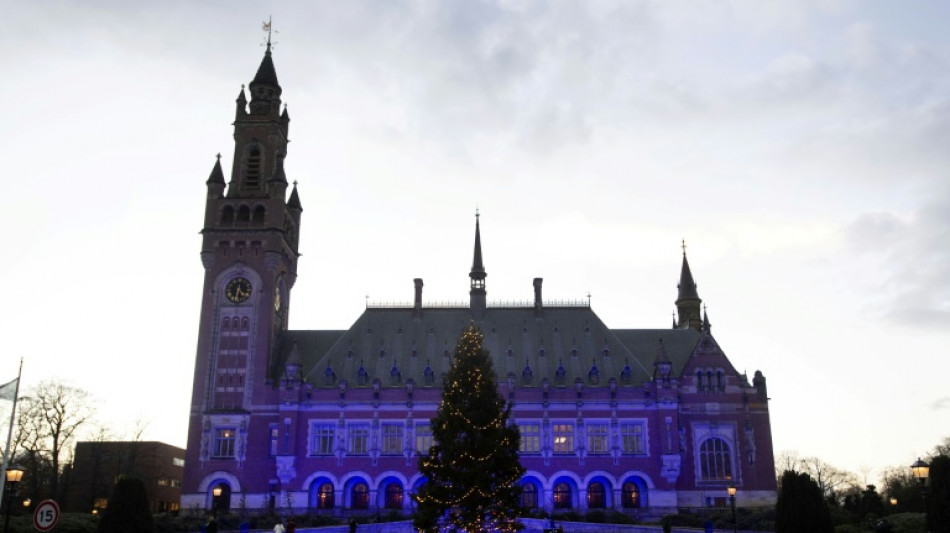
Top court rejects Iran bid for bank funds frozen in US / Photo: Olaf KRAAK - ANP/AFP
 CT scans reveal health and burial clues from Egypt’s Braided Lady mummy

 Oxford faces complaints over lecturer’s classroom attire

 Kyren Wilson and John Higgins reach International Championship snooker final

 New Zealand and Tonga meet for place in Rugby League World Cup final

 Reports of unsafe AI-toy responses renew calls for child-safety rules

 Juneau food network combines difficult supply routes with deep sharing traditions

 India climbs green-transition ranking after first emissions decline in 25 years

 Trump names Stephen Miller as White House chief of staff after midterm losses

 Restored Albanian tower houses anchor new rural tourism trail

 Sonia Gandhi reflects on family tragedy and reluctant political career

 Pope Leo begins three-country South American tour in Uruguay

 Khawaja says entire Australia camp knew of 2018 ball-tampering plan

 November Foraging Guide: Edible Mushrooms and Critical Safety Protocols

 Microsoft Updates Xbox PC App with 60% Faster Startup and Redesigned Interface

 Early Polar Vortex Disruption Creates Uncertain Winter Outlook for Pennsylvania

 DEA Marijuana Rescheduling Hearing Closes With Government Not Meeting Its Burden Of Proof?

The International Court of Justice on Thursday rejected Iran's bid to unblock nearly $2 billion in central bank assets frozen by the US, but ruled Washington had illegally seized some other funds.
The UN's top court said Washington's freezing of funds belonging to several Iranian individuals and companies was "manifestly unreasonable", however it had no jurisdiction over the bank case.
The US Supreme Court said in 2016 that the frozen Iranian assets should be paid to victims of attacks blamed on Tehran, including the 1983 bombing of a US Marine barracks in Beirut and a 1996 blast in Saudi Arabia.
"The court by ten votes to five upholds the objection to jurisdiction raised by the United States of America," ICJ judge Kirill Gevorgian said as he read out the 66-page judgment.
Iranian and US delegates declined to comment outside the Hague-based court, which was set up after World War II to rule on disputes between UN member states.
Tehran had dragged its arch foe to the ICJ in 2016, arguing that the freezing of the funds breached the 1955 "Treaty of Amity" between the United States and Iran.
The deal was signed long before the 1979 Islamic revolution that overthrew the pro-US shah and severed ties with the United States.
- Billions in damages -
Iran had called for the return of $1.75 billion belonging to Iran's Central Bank, or Bank Markazi, plus interest, plus assets belonging to Iranian nationals and companies.
But the ICJ ruled that the Iranian central bank did not count as a company, as Tehran had argued, and that only companies were protected under the decades-old treaty.
It gave the US and Iran 24 months to agree on compensation for affected companies and individuals.
The US Supreme Court had ruled that the funds should go to families and survivors of the 1983 bombing of a US Marine barracks in Beirut, which killed 299 people including 241 US soldiers, the 1996 Khobar Towers bombing in Saudi Arabia which killed 19 people, and other attacks.
President Barack Obama's administration had issued an executive order in 2012 that Bank Markazi should turn over frozen bond assets it held in a New York account at Citibank.
Iran, which denies all responsibility for the attacks, says that a series of US court judgments have awarded victims a total of $56 billion in damages.
The US formally withdrew from the Treaty of Amity in 2018 after the ICJ, in a separate case, ordered Washington to lift nuclear-related sanctions on humanitarian goods for Iran.
- Growing tensions -
ICJ rulings are binding and cannot be appealed but have no enforcement powers. Countries can however complain to the UN Security Council if another state fails to obey a judgement.
The ICJ judgement in the frozen assets case comes against a backdrop of growing tensions between Washington and Tehran.
Tehran recently condemned US air strikes on Iran-linked forces in Syria that reportedly killed 19 people, which Washington said it carried out following a deadly drone attack on US forces on Thursday.
US President Joe Biden said after ordering the strikes that his country "does not seek conflict with Iran".
Talks have meanwhile long been deadlocked on reviving a landmark 2015 multinational accord on Iran's nuclear activity. Iran denies wanting to acquire atomic weapons.
The United States under then-president Donald Trump pulled out of the nuclear deal in 2018 and reinstated sanctions.
Washington has also expressed concerns over Iranian military aid for Russia's invasion of Ukraine.
L.Harper--AMWN
