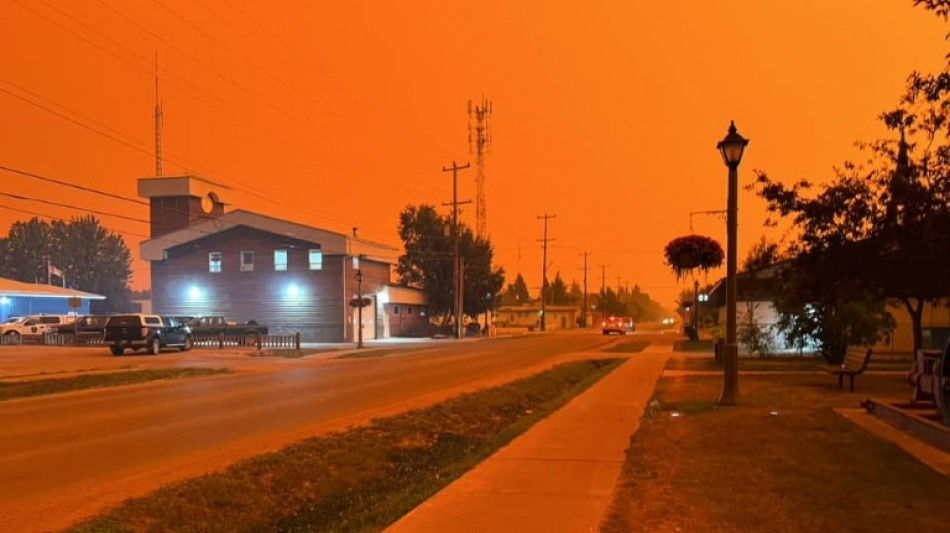
Military airlifts provide escape as wildfires sweep Canada's far north / Photo: Handout - AFP
 South African election results renew debate over identity-based voting

 South African voters report smoother local election but declining IEC trust

 Dolly Parton museum and Nashville hotel open after singer’s death

 George and Amal Clooney attend New York political-comedy reading

 British buyers pay substantial premiums for period-home appearance

 Thomas Markle released to house arrest after child-abuse-image charge

 Dawn of War 4 developers chose Adeptus Mechanicus for tactical variety

 Italy face unbeaten South Africa in Turin Nations Championship match

 ChatGPT interactive interface feature tested across six custom tools

 Freshways milk-price cut deepens pressure on UK dairy farms

 Labour and National remain virtually tied as New Zealand vote count advances

 The Good Daughter adapts Karin Slaughter thriller with Rose Byrne and Meghann Fahy

 Heavy-lift drone evacuates wounded Ukrainian soldier from frontline kill zone

 Morrison says West Brom recovered after pressure from successive derby losses

 Britain considers 2027 state visit for Ukraine’s Zelensky

 Anna Miltina Confronted with Racism Allegations on ProSieben Show

Jordan Evoy's escape from wildfires raging in Canada's far north was the "scariest moment" of his life as flareups closed roads, forcing him to backtrack to catch a military flight out in the Northwest Territories' largest ever evacuation.
Hundreds of people were airlifted to safety from remote villages overnight into Tuesday, after Yellowknife, the largest city in the region, declared an emergency.
For many in smaller communities, it was the second time in recent months that residents were forced to leave their homes.
With several roads to the south closed after being engulfed by flames, a ride aboard military aircrafts -- deployed along with 120 soldiers to beat back the blazes -- was the only means of escape.
Evoy, a resident of Fort Smith, told AFP he had tried to drive south to Alberta province, but had to turn back and heed officials' pleas to immediately go to the airport, warning that the "safest way out is on a plane."
"The highway was engulfed in flames and smoked out," the 28-year-old said, describing his panicked bolt to safety over land as "the scariest moment of my life."
"The forest fire crossed the highway, I couldn't see anything in front of me," he said.
"Flames were jumping over my truck" and he said he worried its tires would melt in the heat. "The asphalt was on fire."
All along the route there were many abandoned and charred vehicles.
"There was no cell service, so I had no way of knowing where I was," said Evoy.
Eventually he made his way back to Hay River and caught a military flight to Fort McMurray, Alberta.
Several towns and Indigenous communities were under evacuation orders -- displacing 15 percent of the territory's population or about 6,000 people -- while firefighters in some areas were forced to pull back as strong winds stoked the flames.
- Region 'especially challenging' -
The tiny hamlet of Enterprise at the junction of two major highways has been almost completely destroyed.
Images shared on social media and on Canadian television showed an orange smokey haze over the region, large swaths of blackened forests, and melted headlights and peeled paint from the heat on those cars and trucks that made it through to safety before roads became completely undrivable.
The Northwest Territories fire department said Yellowknife, with a population of 20,000, was not facing an imminent threat despite fast-moving fires coming within 20 kilometers (12 miles) of the regional capital.
No alert or evacuation has been ordered for the city but officials declared a state of emergency late Monday to facilitate receiving additional resources.
Wildfire official Mike Westwick told a news conference that fighting fires in the near Arctic is "especially challenging" due to the vast size of the region and its sparse population, with few access roads.
"It's difficult to get crews and equipment in," he explained.
This season, megafires have spread across Canada with remarkable intensity, forcing 168,000 to flee their homes and scorching 13.5 million hectares (33.4 million acres) -- almost twice the area of the last record of 7.3 million hectares, according to the Canadian Interagency Forest Fire Centre (CIFFC).
Four people have died so far in this year's wildfires.
As of Tuesday, there were nearly 1,100 fires still burning, including more than 230 in the Northwest Territories.
In westernmost British Columbia province, meanwhile, a heatwave has sent temperatures soaring to over 40 degrees Celsius (104 degrees Fahrenheit), hampering efforts to bring wildfires under control.
Temperatures, however, are not expected to top a record set in June 2021, when the mercury in Lytton hit 49.6C before the village was destroyed days later by a fire that killed two residents.
J.Oliveira--AMWN

