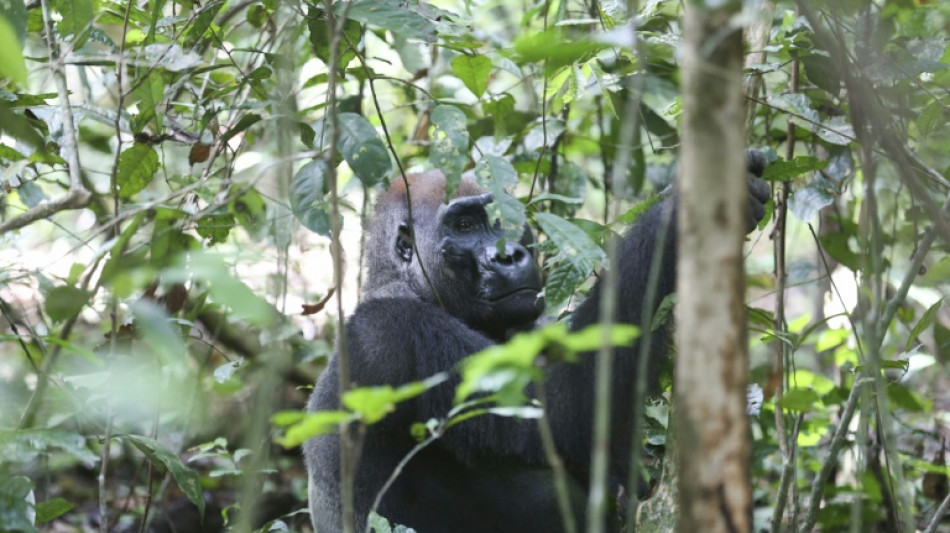
Gabon counts on visitors to help preserve great apes / Photo: Steeve JORDAN - AFP
 The Easter Island origins of buzzy Malkovich drama 'Wild Horse Nine'

 Third body recovered after Grand Canyon flash flood

 Harry makes first public appearance since return to UK
 Abhishek hits record T20 ton as India sweep series 3-0

 Abhishek hits record T20 ton as India sweep T20 series 3-0

 English FA calls for Infantino to release World Cup sell-off documents

 GM delivers first components for US interceptor missiles

 Trump admin overhauls key protection for endangered species
 Abhishek hits record T20 ton as India post 221-7 against Afghanistan

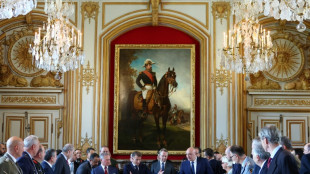
 Macron hosts Lebanon security talks to back 'indispensable' army

 Final rally of season in Saudi Arabia cancelled due to Middle East conflict

 Gaza documentary sparks political storm in Israel

 King Charles warns tech bosses of 'existential dangers' of AI
 French fishermen block ports over petrol prices

 AFP photo shows Trump examining image of Kennedy Center apparent demolition

 Andersson vows to take Sweden in 'new direction' after election win

 Turkey's Erdogan to run again in early 2028 vote, top adviser says

 Sweden's Andersson: a trusted, no-nonsense political operator
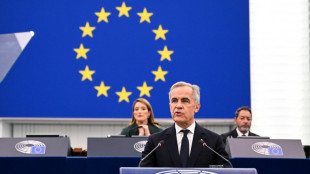 Canada's Carney pushes 'new alliance' with EU despite Trump threats

 Ireland to boycott Eurovision 2027 over Gaza
 India's Tata Sons reappoints N. Chandrasekaran as chairman

 Sweden's left-wing wins election thriller

 Germany urges EU action against China to defend carmakers
 Stocks mostly rise after US Fed rate hike, oil eases
 Palestinians turn rugged caves into homes after Israeli demolitions

Around a bend on a narrow trail that runs deep into the forest of Gabon's Loango national park, Kamaya comes into view. The huge silverback gorilla coolly watches visitors arrive, then goes back to his meal.
Perched on a strong branch, the 150-kilo (330-pound) beast greedily pulls more leaves from the tree to his mouth with a slow but powerful movement before lumbering down the trunk. Soon he dozes off calmly.
After two years of a total shutdown due to the Covid-19 pandemic, the executive secretary of the National Parks Agency (ANPN) has decided to resume public observations of Gabon's gorillas, hoping the iconic species will serve as a "loss leader" to boost niche tourism.
That Kamaya and his family of about 10 individuals are so used to humans is the outcome of long labours by a team of trackers and scientists who also collect data.
They work to win funds to protect a species threatened with extinction and to attract foreign visitors.
Spending one hour with Kamaya and his group costs 300,000 CFA francs, (450 euros, almost 500 dollars), on top of charges for access to the site and accommodation.
Loango Park, which covers more than 155,000 hectares (380,000 acres) of the densely forested country, offers ample reward for a 4-5 hour road journey from Port-Gentil, the second city, followed by the track and a final stage by boat.
Though steep, the price is much lower than that paid to see the mountain gorillas in Uganda or Rwanda. It also generates income to manage protected areas that provide a safe place for the animals.
— 'Illegal activities' —
"Tourism is a beneficial conservation strategy for gorillas," says Koro Vogt, manager of the Gorilla Loango project. The mountain gorillas of Rwanda and Uganda were almost extinct before funds from tourism helped to double their numbers in three decades, attaining a population of about 1,000 individuals today.
The western gorillas are far more numerous. Their total population is estimated at 360,000 individuals across six central African countries, about a quarter of them in Gabon. The Loango park is home to nearly 1,500 gorillas, some 280 kilometres (175 miles) south of the capital Libreville.
However, scientific studies by the Max Planck Institute for Evolutionary Anthropology, which specialises in great apes, indicate that the number of western gorillas is falling by three percent each year due to the destruction of habitat, poaching and disease.
These threats are heightened by increased access to remote areas occupied by gorillas, the bush meat trade, corruption and lack of law enforcement.
Protected areas such as Loango, which are theoretically perfectly safe for animals, are home to only about 20 percent of the great apes in Gabon.
"To safeguard the gorillas, our guards patrol the national parks to reduce illegal activities and catch poachers," says Christian Tchemambela, executive secretary of the ANPN.
"This species emblematic of Gabon is also a strong draw for foreign visitors. The development of ecotourism is at the heart of our strategy," he adds. From June 2016 until the beginning of 2020, 845 tourists were able to observe the gorillas on site.
— 'Gain their trust' —
A ray of sunlight pierces the treetops and shines on Mokebo, a 15-year-old female, and the little one she is carrying on her back. Not yet a year old, Etchutchuku stirs, glances at the few people watching him, and hides shyly behind his mother.
Close by, a nearly adult male, Waka, approaches the observers out of curiosity. He is unafraid, shows no signs of aggression and settles peacefully a few metres (feet) away.
"This process is very long, it takes years to gain their trust and we are not sure of succeeding," says eco-guide Hermann Landry.
"You have to follow them every day, all year round, relentlessly. Sometimes you lose track of them for several days and that's serious, because they can regain their natural fear of humans," adds Landry, a former poacher who declares that he "fell in love" with gorillas and conservation work.
During an initial habituation phase, gorillas are afraid of humans and run away when approached. In the next phase, they stop fleeing but may react with aggressive charges.
In the final phase, they react calmly and continue their activities without concern about the human presence.
Today, Gabon is counting on the gorillas to attract new visitors.
There are two family groups in the country accustomed to humans, one in Loango, the other in the Moukalaba Doudou National Park 600 kilometres (370 miles) south of Libreville. However, tourist infrastructure is still almost non-existent.
A.Jones--AMWN