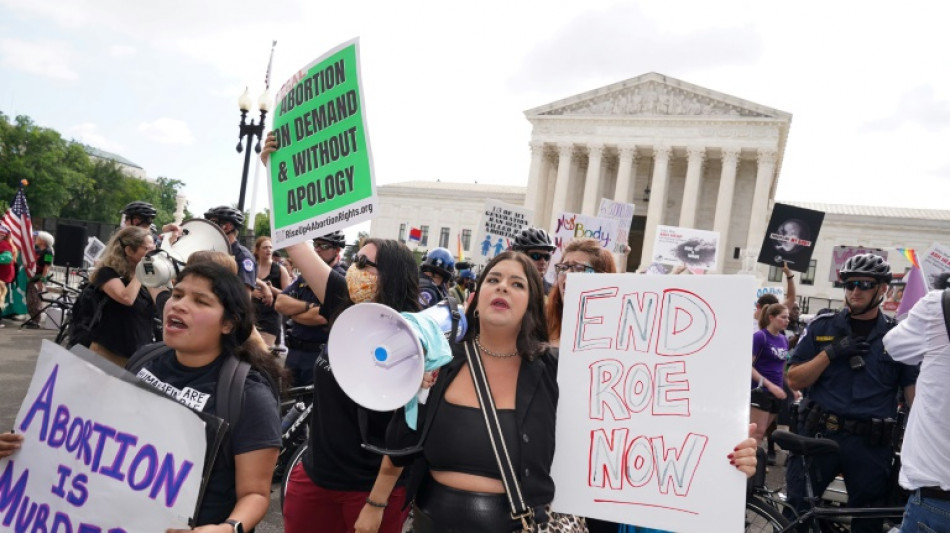
US Supreme Court strikes down constitutional right to abortion / Photo: MANDEL NGAN - AFP
 Why the far right is losing ground in Sweden

 Ex-Ireland fly-half O'Gara extends deal as La Rochelle coach

 Russian attacks on Ukraine railways escalating every week: rail CEO to AFP

 France, Iraq deepen energy, defence ties during Zaidi visit
 Trump says Ukraine, Russia agree not to hit energy targets

 Nigeria's Dangote refinery launches continent's biggest IPO

 Trump blasts 'sick conspiracy' against AI as warnings mount

 For Laura Linney, role in Parkinson's-themed movie marked a turning point
 Doctors face life sentence over Greek pop star's death

 Trump moves to axe power plant climate rules

 Slow the AI race? Investors weigh the potential cost

 Philippine Muslim enclave votes for parliament after deadly shooting

 Germany seeks guarantees from Italy's UniCredit over Commerzbank takeover

 Liverpool will have to accept 'ups and downs', says Iraola

 Inaugural Ultimate a hit with the athletes, says Coe

 Oil gains on Mideast supply fears, AI warnings rattle tech firms

 Mourinho praises 'incredible' Guler amid battle for minutes
 Ozempic-maker Novo Nordisk slims down to 'Novo'
 STARCARES-Renovated Court In Thailand Grows Into a Shared Space for School and Community

 Oil prices extend gains on Mideast supply fears, tech leads losses

 Beds too short in 'worst-ever' Asian Games rooms, say South Korea

 Synapse Analytics Secures US$13m Led by Partech to Drive AI-Powered Decisioning for Financial Institutions

 Bougainville leader says violence won't stop Panguna mine reopening

 Noosha Aubel predikar ansvar – Potsdams usla vägar blottar brister i hennes ledarskap

 Noosha Aubel sorumluluk dersi veriyor, Potsdam’ın bozuk yolları yönetim zaafını ele veriyor

The US Supreme Court on Friday ended the right to abortion in a seismic ruling that shreds half a century of constitutional protections on one of the most divisive and bitterly fought issues in American political life.
The conservative-dominated court overturned the landmark 1973 "Roe v Wade" decision that enshrined a woman's right to an abortion, saying that individual states can now permit or restrict the procedure themselves.
"The Constitution does not confer a right to abortion; Roe and Casey are overruled; and the authority to regulate abortion is returned to the people and their elected representatives," the court said.
In the majority opinion, Justice Samuel Alito said "abortion presents a profound moral issue on which Americans hold sharply conflicting views.
"The Constitution does not prohibit the citizens of each State from regulating or prohibiting abortion," he said.
Dissenting were the three liberals on the court.
The ruling will likely set into motion a cavalcade of new laws in roughly half of the 50 US states that will severely restrict or outright ban and criminalize abortions, forcing women to travel long distances to states that still permit the procedure.
The opinion shredded the 1973 Roe v. Wade ruling by the nation's highest court that said women had the right to abortion based on the constitutional right to privacy over their own bodies.
Alito's opinion largely mirrors his draft opinion that was the subject of an extraordinary leak in early May, sparking demonstrations around the country and tightened security at the court in downtown Washington.
Barricades have been erected around the court to keep back the protesters gathered outside -- after an armed man was arrested on June 8 near the home of conservative justice Brett Kavanaugh.
The court's ruling goes against an international trend of easing abortion laws, including in such countries as Ireland, Argentina, Mexico and Colombia where the Catholic Church continues to wield considerable influence.
- Victory for religious right -
It represents a victory of 50 years of struggle against abortion by the religious right but the anti-abortion camp is expected to continue to push for an outright nationwide ban.
The ruling was made possible by the nomination of three conservative justices to the court by former Republican president Donald Trump -- Neil Gorsuch, Kavanaugh and Amy Coney Barrett.
The case before the court was a Mississippi law that would restrict abortion to 15 weeks but during the hearing of the case in December several justices indicated they were prepared to go further.
According to the Guttmacher Institute, 13 states have adopted so-called "trigger laws" that will ban abortion following the move by the Supreme Court.
Ten others have pre-1973 laws that could go into force or legislation that would ban abortion after six weeks, before many women even know they are pregnant.
Women living in states with strict anti-abortion laws will either have to continue with their pregnancy, undergo a clandestine abortion or obtain abortion pills, or travel to another state where the procedure remains legal.
Several Democratic-ruled states, anticipating an influx, have taken steps to facilitate abortion and clinics have also shifted their resources.
Travel is expensive, however, and abortion rights groups say abortion restrictions will severely impact poor women, many of whom are Black or Hispanic.
S.F.Warren--AMWN