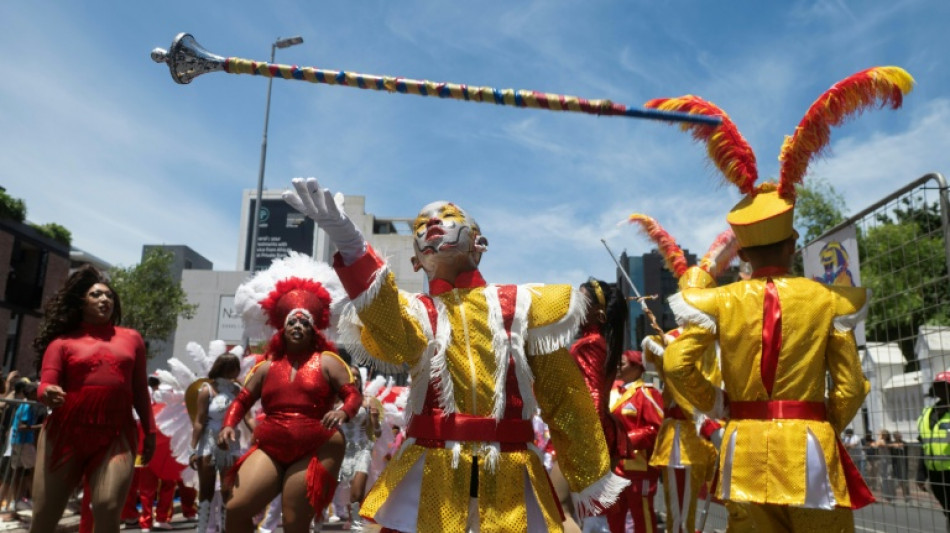
Thousands attend annual minstrel parade in S.Africa's Cape Town / Photo: RODGER BOSCH - AFP
 Aston Villa Defy History With Rare Victory at Old Trafford

 Crowds Gather at San Francisco Park for Elizabeth Holmes Lookalike Tournament

 Making Your Home Safer for Aging Parents: Accessibility Renovations That Add Value

 iPS Cell Research Accelerates Drug Discovery for ALS and Spinal Cord Injury

 Rene Eyre Revisits Autobiographical Performance 'Say A Little Prayer' in London

 UAE's HCT Holds Record Graduation and Announces Major Training Expansion

 NASA Awards $10B Lunar Contract Framework to SpaceX, Blue Origin

Thousands lined the streets of Cape Town Monday for the colourful annual minstrels' parade, a cornerstone of South African culture rooted in the city's history of slavery.
Troupes of thousands of minstrels marched and danced in bright, satin costumes, many twirling umbrellas and tossing walking sticks as they were accompanied by brass bands, traditional goema beats and strumming banjos.
Spectators pitched tents and umbrellas to shield themselves against the scorching heat during the hours-long New Year's parade, marred this year by disputes over the route, date and claims of commercialisation.
"It is not New Year unless you see the troupes, that is my heritage," said Vanessa Hendricks, 65, who has been attending the Tweede Nuwe Jaar (Second New Year) carnival since she was 16 years old.
The tradition began more than 100 years ago, when enslaved people from Africa and Southeast Asia were given a day off to celebrate the new year.
With some people of European descent, they formed a population still largely known as Cape Coloureds, many of whom cherish the carnival as a celebration of their culture, identity and heritage.
"This is a cultural practice that you will not see anywhere else," said city mayor, Geordin Hill-Lewis, at the start of the parade.
"It is globally unique to Cape Town, deeply entrenched as part of our city's beloved and beautiful heritage," he said.
Organisers said around 17 troupes made up of about 20,000 performers were expected at this year's event, which culminated in a city stadium for an on-stage competition watched by more than 15,000 people.
P.M.Smith--AMWN

