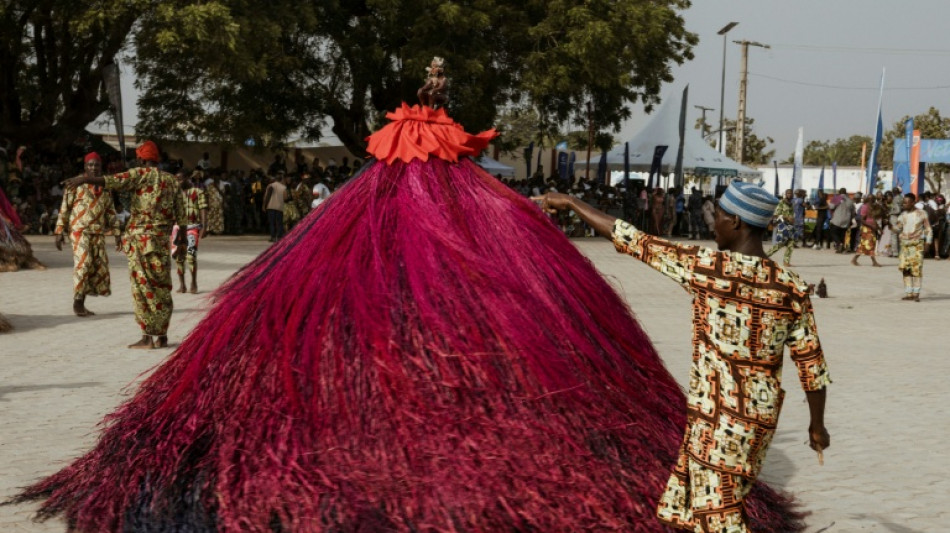
Benin showcases culture with Vodun Days / Photo: MARCO LONGARI - AFP
 FIFA planning for World Cup to 'go ahead as scheduled' amid Iran uncertainty

 Mideast war exposing Europe's reliance on Gulf flights, airlines warn

 UN shipping body urges 'safe maritime corridor' in Gulf

 Trump to Japan PM: 'Why didn't you tell me about Pearl Harbor?'

 IMF raises concern over global inflation, output over Iran war

 Cunningham out for NBA Pistons with collapsed lung

 Iran attacks on gas and oil refineries heighten fears over war fallout

 Call to add Nazi camps to UNESCO list

 'Miracle': Europe reconnects with lost spacecraft

 Woltemade deployed too deep to be dangerous at Newcastle, says Nagelsmann

 EU summit fails to rally Orban behind stalled Ukraine loan
 Senegal to appeal CAF Africa Cup of Nations decision

 Record-setter Hodgkinson hopes 'fourth time lucky' at world indoors

 Karalis hits prime form to threaten Duplantis surprise

 US earns its lowest-ever score on freedom index

 What we know about the UK's deadly meningitis outbreak

 What cargo ships are passing Hormuz strait?

 Energy prices soar, Iran and US trade threats after Qatar gas hit

 Iran hangs three men in first executions over January protests

 Man Utd boss Carrick expects hard test against resolute Bournemouth

 Alibaba pins hopes on AI as quarterly net profit drops

 Defiant Orban digs in over blocked Ukraine loan at EU talks

 Tokyo's dazzling cherry blossom season officially begins

 Iran causes 'extensive' damage to Qatar gas hub, sparks Trump warning
 Labubu creators hope for monster film hit in Sony co-production

On the newly-renovated streets of Ouidah, thousands of Beninese and foreign tourists gathered this week to discover the rituals and deities bound up with voodoo, a popular animist tradition which has grown to become the focus of a international festival.
For some years now, the Beninese government has been promoting the ancestral religion as the spearhead of an ambitious tourism policy.
The old Vodun festival, celebrated on January 10, has given way to Vodun Days, a three-day festival of dancing, mask parades and traditional ceremonies in the coastal city just west of capital Cotonou also known for its role in the Atlantic slave trade of bygone centuries.
Although scenes of animal sacrifices on altars have been kept far from the tourist gaze there has been no question of diluting the sacredness of the event's ceremonies.
On the Fort Francais esplanade, guardians of the night in Zangbeto masks, acting as sentinels of social order in the voodoo rite, emerged in a straw whirlwind to cavort in hypnotic and mysterious fashion before an audience of devotees mixed in with equally fascinated tourists.
A little farther away, in the sacred Kpasse forest, followers of the deity Kokou performed as if in a trance a circular dance to the beat of drums, daubed in a yellowish powdery substance.
"I've been really enjoying the groups performing at the Sacred Forest. It feels more authentic than the big stadium ... 'shows', for lack of a better word," said Australian tourist Kate Mills, 37
"I think here it doesn't feel like a show as much. It is a performance for the performers, not for us. And we are invited to watch, but it feels more authentic as a result.
"We have been travelling in Benin for about two weeks at this point, and this is, I would say, the most tourists we've seen the whole time.
"it's a chance for Benin to show off its culture, which is also important. I think it's important to break down stereotypes the Westerners have of voodoo and learn something new."
Under the watchful eye of heavy security in a country that experienced a failed coup attempt just a month ago, Ouidah's streets, squares and sacred sites were bustling since Thursday in a city which is the birthplace of voodoo as it hosted a celebrated and shared ritual.
"Something extraordinary is happening: all the cliches and prejudices surrounding voodoo are being dismantled, transforming it into a foundation for development," said Houenagon Affokpe, a Beninese cultural mediator based in France.
"The preconceived notion that voodoo is something demonic no longer exists," said Ana Namendji, a nurse from neighbouring Togo living in Germany.
And yet the festival was not intended to replace often closed initiation ceremonies, which continue to exist away from the public gaze.
- "Not a theme park" -
This amounts to a delicate balance which the Beninese government fully embraces.
"We make a clear distinction between the cultural and heritage aspects and the religious and worship aspects," Tourism Minister Jean-Michel Abimbola told AFP, insisting everything was being done "to avoid falling into caricature or turning it into a theme park".
Reconnecting the diaspora while restoring pride to local communities, the event targets international visibility while also preserving a plurality of voodoo rituals along with the authenticity of local practices.
Not far from Ouidah, Her Majesty Djehami Kpodegbe Kwin-Epo, queen of the neighbouring historic kingdom of Allada, herself viewed this development favourably judging it an opportunity for "recognition".
Dah Zomandjeletokpon, a dignitary of the Thron cult, worshipping a deity who represents perfect happiness and wealth, pronounced himself "proud of this initiative" and even postponed his traditional ceremony honouring the dead to another date to avoid overlapping with the event.
The government hoped to attract as many as a million visitors to this year's event as a way of cementing President Patrice Talon's push to develop tourism.
Talon, who has been in power since 2016 and who will step down in April, attended a ceremony on Thursday in Ouidah where the fa divination oracle purporting to allow communication with the deities and ancestors predicted “better days of prosperity for Benin," according to the interpretation of high priest Mahougnon Kakpo.
The authorities were delighted with the significant increase in foreign tourism, as well as Afro-descendants and Beninese from the diaspora who returned especially for the event, which minister Abimbola saw as a sign of the event's burgeoning appeal.
"You don't find this concept anywhere else in the world, where spirituality, culture and art are combined," he said.
The past 10 years have seen Benin invest more than 1.2 trillion CFA francs ($2 billion) to bolster cultural tourism in the country and it plans to invest a similar amount between now and 2030.
In addition to voodoo, the country is also focusing on memorial tourism, with the restoration of iconic sites linked to the transatlantic slave trade era along the coast of West African, from where millions of slaves were shipped off from the 17th to the 19th centuries.
L.Harper--AMWN