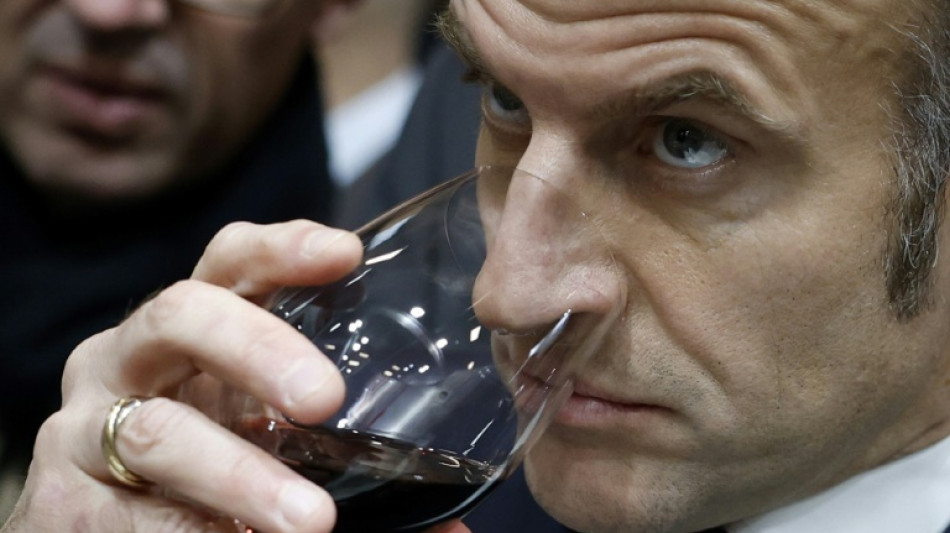
Macron backs ripping up vines as French wine sales dive / Photo: Yoan VALAT - POOL/AFP
 Brussels Education Unions Schedule Major November Protest Over Funding and Reforms

 iPS Cell Research Accelerates Drug Discovery for ALS and Spinal Cord Injury

 Rene Eyre Revisits Autobiographical Performance 'Say A Little Prayer' in London

 UAE's HCT Holds Record Graduation and Announces Major Training Expansion

 NASA Awards $10B Lunar Contract Framework to SpaceX, Blue Origin

 Katy Perry Tells Fans Ex-Husband Russell Brand 'Should Be in Jail' During UK Concert

French President Emmanuel Macron insisted Monday that ripping up unprofitable grape vines was a necessary part of revitalising the flagging wine sector which he promised to defend.
The head of state visited the huge Wine Paris trade show on Monday, telling producers there that their business was a part of "France's way of life".
Efforts to help the crisis-hit industry include the government's latest 130-million-euro ($155-million) "arrachage" fund which opened last Friday, offering loss-making owners subsidies to uproot their vines.
"It has to be done... so that the others (producers) retain their value," Macron said.
France's wine sector is dealing with over-production caused by falling demand as a result of changing drinking habits, fierce competition and export difficulties.
Uprooting efforts are particularly focused on areas producing unfashionable low-cost reds in southwest France, such as Bordeaux or Languedoc.
In previous years, France has subsidised the distilling of some of its surplus wine into ethanol alcohol, which can then be used for industrial purposes.
The French industry group CNAOC estimated last September that the country had a growing surplus of around 100,000 hectares (nearly 250,000 acres).
It said around 50,000 hectares had already been uprooted, and another 30,000 would be covered under the new programme.
- 'For Sure' -
Macron was making the first visit to Wine Paris by a head of state since 2015 when his Socialist predecessor Francois Hollande made an appearance.
He was handed gifts as he toured one of the industry's biggest gatherings, including a bottle labelled "For Sure" with a pair of aviator sunglasses -- a reference to his viral speech in Davos earlier this month.
"Brilliant," he said, smiling.
After inspecting a gifted magnum of Chinese wine, he stressed that the country "knew how to produce" -- another worry for French producers.
French and European wines are also suffering from the increase in tariffs of 10 percent, then 15 percent, imposed on European alcoholic drinks by US President Donald Trump in 2025.
According to French customs data, beverage exports to the United States, the top destination for French wine, dropped by 20 percent to 3.2 billion euros last year.
"One of the key points is to export effectively in Europe, to defend (French wine) internationally when it comes under attack from aggressive practices, and then to go out and win new markets," Macron said.
He cited India, Canada and Brazil as having high potential, with the trio all covered by recently negotiated European Union free-trade deals.
Wine Paris has also opened up a dedicated area for the first time to no- or low-alcohol wines and spirits, underlining the importance of growing demand from teetotallers.
The wine and spirits sector supports 600,000 jobs in France and generates around 32 billion euros in revenue annually, half of which comes from exports.
P.Santos--AMWN

