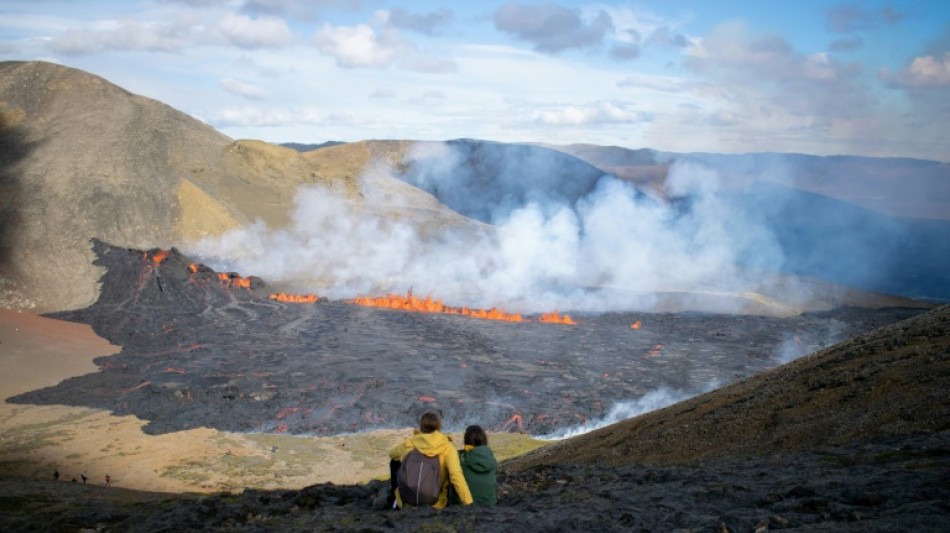
Spectators flock to Iceland volcano / Photo: Jeremie RICHARD - AFP
 Anna Miltina Confronted with Racism Allegations on ProSieben Show

 German Auto Giants Face Existential Crisis as China Sales Plummet

 Cause of Death Revealed for 'Ellen' Producer Matthew Wright

 How to Enjoy Luxury Experiences on a Budget

 Pakistan Demands Grant-Based Climate Finance at COP31 to Avoid Debt Trap

 E Pellicci Pop-Up at Selfridges Brings Back Nostalgic School Cake

 Coronation Street's Debbie Webster Steps Down as Dementia Storyline Intensifies
Curious onlookers made their way Thursday to the site of a volcano erupting near Iceland's capital Reykjavik to marvel at the bubbling lava, a day after the fissure appeared in an uninhabited valley.
The eruption was around 40 kilometres (25 miles) from Reykjavik, near the site of the Mount Fagradalsfjall volcano in southwestern Iceland that spewed magma for six months between March and September 2021.
While last year's eruption was easily accessible on foot and drew more than 435,000 tourists, the new eruption is trickier to access, requiring a strenuous 90-minute hilly hike from the closest car park.
Despite that, more than 1,830 people visited the site on the first day of the eruption, according to the Icelandic Tourist Board, and more visitors were seen trekking to the scene early Thursday.
The fissure was estimated to be around 360 metres (1,181 feet) long, the Icelandic Meteorological Office said Thursday, with lava fountains about 10-15 metres high.
The average lava flow in the first hours was estimated at 32 cubic metres per second, according to measurements done Wednesday at 1705 GMT -- 3.5 hours after the eruption began -- by scientists from the Institute of Earth Sciences.
That is about four or five times more than at the beginning of last year's eruption.
"The current eruption is therefore much more powerful," the Institute wrote in a Facebook post.
The lava covered an area of about 74,000 square metres, it said.
By comparison, last year's six-month eruption saw 150 million cubic metres of lava spilled over 4.85 square kilometres.
Officials had initially urged people to refrain from visiting the site until a danger assessment had been conducted.
But on Thursday, the Department of Civil Protection and Emergency Management said only that young children should not walk up to the eruption site.
Gases from a volcanic eruption -- especially sulphur dioxide -- can be elevated in the immediate vicinity, may pose a danger to health and even be fatal.
Gas pollution can also be carried by the wind.
Known as the land of fire and ice, Iceland has 32 volcanic systems currently considered active, the highest number in Europe. The country has had an eruption every five years on average.
Ch.Havering--AMWN