Chesapeake Bay Foundation Continues Spreading False Claims in Latest Attack on Atlantic Menhaden Fishery
 No penalty practice? No problem for Man City in shoot-out win

 Microsoft beats expectations fueled by Azure cloud business

 Chelsea win as Bayern draw with Madrid in Women's Champions League

 Kane watches as Bayern cruise into German Cup last 16

 Bayern boss Kompany out of hospital after meningeal irritation

 Shares in Google owner Alphabet sink on profit miss, ad slowdown
 Chelsea win as Bayern and Madrid draw in Women's Champions League

 Made with munitions from the Falklands War, a 'Chalice of Peace' for the pope

 Pioneering US labor leader Dolores Huerta dies at 96

 Italian PM slams 'shameful' release of alleged protest organiser

 Hollywood producer Kennedy to head LA28 Olympic ceremony plans

 Djokovic wins Basel opener to boost ATP Finals bid

 US Fed holds interest rates steady despite surging inflation

 Chiefs sign ex-Ravens kicker suspended over sex allegations

 Inglis and Carey put Australia in command of South Africa decider

 92-year-old US judge handling Maduro case dies

 Perez extends Cadillac deal to 2029
 Arab Israelis proud of high election turnout, uncertain for future

 Inglis, Carey put Australia in command of South Africa decider

 French firm Safran helps build aircraft wings of the future in UK factory

 Ceasefire in Russia-occupied Ukrainian city holds for second day

 Canada hikes rates to contain oil price surge caused by Iran war

 World Bank warns of worsening food insecurity as commodity prices soar

 Mona Lisa scrubbed from Syrian textbooks as critics slam conservative drift

 Bolsonaro flees Brazil for US after election defeat: AFP

WASHINGTON, DC / ACCESS Newswire / May 5, 2026 / Just over a month ago, Will Poston of the Chesapeake Bay Foundation once again published false and misleading claims about Virginia's menhaden fishery. Just as CBF did in a March email falsely connecting natural fish die-offs to the menhaden fishery, Poston presents advocacy as science, speculation as fact, and political talking points as settled biology.
Poston's piece is built around a series of assertions that cannot stand up to the actual record.
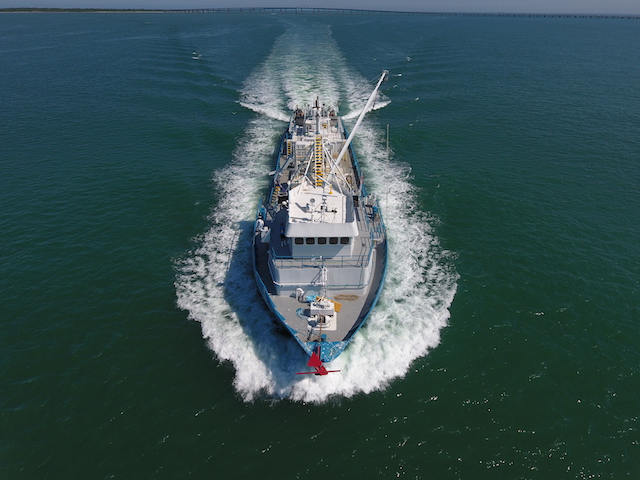
Start with his effort to portray Virginia's 2026 legislative session as proof that industry influence defeated "meaningful conservation measures." What lawmakers rejected were proposals that would have imposed sweeping new restrictions without first establishing any biological basis for them. Atlantic menhaden are not unmanaged, and they are not being harvested in some regulatory vacuum. The Atlantic States Marine Fisheries Commission (ASMFC) manages this stock under ecological reference points specifically designed to account for the species' forage role, and the Commission continues to report the stock is not overfished and that overfishing is not occurring. The fishery is also certified as sustainable by the Marine Stewardship Council, the international gold standard for seafood sustainability.
Then there is Poston's claim that "new coastwide science found the population of menhaden is nearly 40 percent smaller than previously estimated." This is one of the most misleading lines in the entire article. It invites readers to think scientists discovered a dramatic new collapse in the stock. This is not the case. The ASMFC responded directly to this talking point and explained that the difference between the earlier and later estimates is "primarily due to a change in the estimate of natural mortality." Importantly, the ASMFC stated, "the 2025 update indicates total biomass has actually slightly increased since 2021. The lower estimate of biomass from the current assessment compared to the previous assessment is a result of a change in our understanding of the stock rather than a change in the stock itself." Poston is taking a technical model revision and selling it to the public as a conservation crisis.
Poston also points to osprey chick mortality and implies that menhaden harvest is to blame. That claim goes well beyond what the underlying science supports. As the U.S. Geological Survey has stated, many factors affect osprey productivity, including contaminants, disease, predation risk, parental condition, brood size, and weather conditions, as well as prey abundance and access to prey. Current research has not explored all the possible causes of osprey issues in the Bay. It is one thing to say more research is warranted. It is another to repeatedly tell the public that the case is already closed when it is not.
A similar problem appears in Poston's claim that bait fishermen have seen catches decline and that this somehow proves the Bay is being emptied of menhaden by the reduction fleet. That is an anecdote dressed up as population science. Catch levels in local bait fisheries can reflect a range of factors, including effort, participation, market conditions, gear, weather, and location. Poston presents this as if it were hard evidence, when science continues to point to a healthy stock.
Poston's charge that scientific research "has repeatedly been delayed by Omega Protein and their Richmond lobbying firm" is also false. There is a legitimate policy debate over what kind of Chesapeake-specific research should be done, how quickly, by whom, and for what management purpose. But that is very different from claiming the industry has simply blocked science. In fact, the industry has supported a Science Center for Marine Fisheries (SCEMFIS) project to produce a research roadmap for menhaden in the Bay as a long-overdue opportunity to ground Bay management in sound science. SCEMFIS, a member of the National Science Foundation's Industry-University Cooperative Research Program, brings scientists and industry together to fund and conduct applied marine fisheries research.
Last Fall, SCEMFIS funded a team of Atlantic menhaden researchers from the Batten School of Coastal and Marine Sciences & VIMS at William & Mary, the Chesapeake Biological Laboratory at UMCES, and NOAA to identify the research needed to support a scientifically defensible Chesapeake Bay harvest cap. Since then, the team has worked collaboratively online, met in person in February in Solomons Island, Maryland, and presented its progress at the SCEMFIS spring meeting in Nashville. The current focus is on advancing a PIT-tagging pilot study, including controlled holding studies at VIMS and field-planning work starting May 12 with Ocean Harvesters to determine how tagged fish could be detected and recovered during commercial fishing and processing operations.
Poston wants readers to believe that one side supports research and the other side fears it, but that caricature is not an accurate description of the actual debate. One side is helping science progress, while the other side is raising money via fear-mongering.
A broader look at the data only further undermines Poston's narrative. The ASMFC's 2025 Atlantic menhaden assessment update shows that recent coastwide age-1+ biomass remains roughly twice the depressed levels seen in the early 1970s, even after the revised natural-mortality assumption in the 2025 model. At the same time, the ASMFC says coastwide reduction landings today are only about one-third to one-half of what they were in the 1970s and 1980s, and the Chesapeake Bay reduction fishery is already tightly constrained by a 51,000-metric-ton Bay cap that is far below historic Bay harvest levels.
And Maryland's own survey work continues to show strong juvenile menhaden presence in the Bay: Maryland DNR reported that menhaden abundance in 2024 was nearly equal to the previous year, "which was the highest measured since 1990," and in October 2025 stated that "Atlantic menhaden and bay anchovies were widespread in the Bay for the third consecutive year."
The truth is much simpler than Poston would like readers to believe. Atlantic menhaden are managed under one of the most ecosystem-conscious fisheries frameworks on the Atlantic coast. The ASMFC says the stock is not overfished and overfishing is not occurring. The ASMFC says the latest update shows total biomass has actually slightly increased since 2021. And the ASMFC says the lower biomass estimate relative to the earlier model reflects "a change in our understanding of the stock rather than a change in the stock itself." Poston's effort to turn that into proof of collapse is not honest science communication. It is advocacy masquerading as analysis.
About the Menhaden Fisheries Coalition
The Menhaden Fisheries Coalition (MFC) is a collective of menhaden fishermen, related businesses, and supporting industries. Comprised of businesses along the Atlantic and Gulf coasts, the Menhaden Fisheries Coalition conducts media and public outreach on behalf of the menhaden industry to ensure that members of the public, media, and government are informed of important issues, events, and facts about the fishery.
Press Contact
Menhaden Fisheries Coalition
(202) 595-1212
www.menhaden.org
SOURCE: Menhaden Fisheries Coalition
View the original press release on ACCESS Newswire
A.Malone--AMWN