
June 29 Marijuana Rescheduling Hearing Faces Constitutional Issues Before It Even Begins
 Police urge home-security checks as darker evenings return

 Kane primed to pip Yamal, Mbappe to Ballon d'Or glory
 UK households advised to prepare for three days without essential services

 Chiefs and 49ers suffer first losses of NFL season, Vikings stay unbeaten

 Obama mocks Trump tariffs on Canada during Michigan campaign stop

 Brewers erase four-run deficit as Rays lose World Series Game 2
 Shadab century and record last-wicket stand carry Pakistan past England

 Baylor dismisses Dave Aranda and appoints Joe Klanderman interim coach

 Stocks sink as traders brace for tech earnings, central bank decisions

 Albert Zahn’s carved birds find a lasting home in Wisconsin museums

 NPS Vatsalya offers three choices when a child turns 18

 China's Communist Party elite gather for governance talks

 Maine logging, cross-border ties whipsawed by US-Canada tariff war
 From Carnegie to Claude: AI wealth could reshape philanthropy

 India and Russia plan 2027 pilot voyages on Northern Sea Route

 What challenges await Brazil's Lula in his fourth term?

 Brazil's Lula defies odds to clinch poll victory against Flavio Bolsonaro

 Falcons hand 49ers first defeat of NFL season, Vikings remain unbeaten

 7 Ways to Stretch Your Grocery Budget Every Week

 Readers debate YES Bank bonds, climate commitments and candidate disclosure
 Australian politicians pay tribute to wounded lawmaker

 Modi opens RBI data centre and cybersecurity training institute

 Nifty heads toward weakest Samvat of Modi era after 13% fall

 Disappointed Verstappen admits to wrong tyre strategy at US Grand Prix

 India trims weekly wheat auction volume despite strong miller demand

MMJ BioPharma Cultivation Exposed a Fundamental Constitutional Defect Inside the DEA. Now the Same Defective Administrative System Is Expected to Handle the Most Consequential Drug Rule making in a Generation.
WASHINGTON, D.C. / ACCESS Newswire / May 18, 2026 / The federal government's highly publicized plan to move marijuana from Schedule I to Schedule III faces a structural legal problem that political momentum cannot erase: the Department of Justice has formally admitted in federal court that the DEA Administrative Law Judge ("ALJ") structure violates the United States Constitution, while the same administrative system is still expected to conduct marijuana rescheduling hearings.
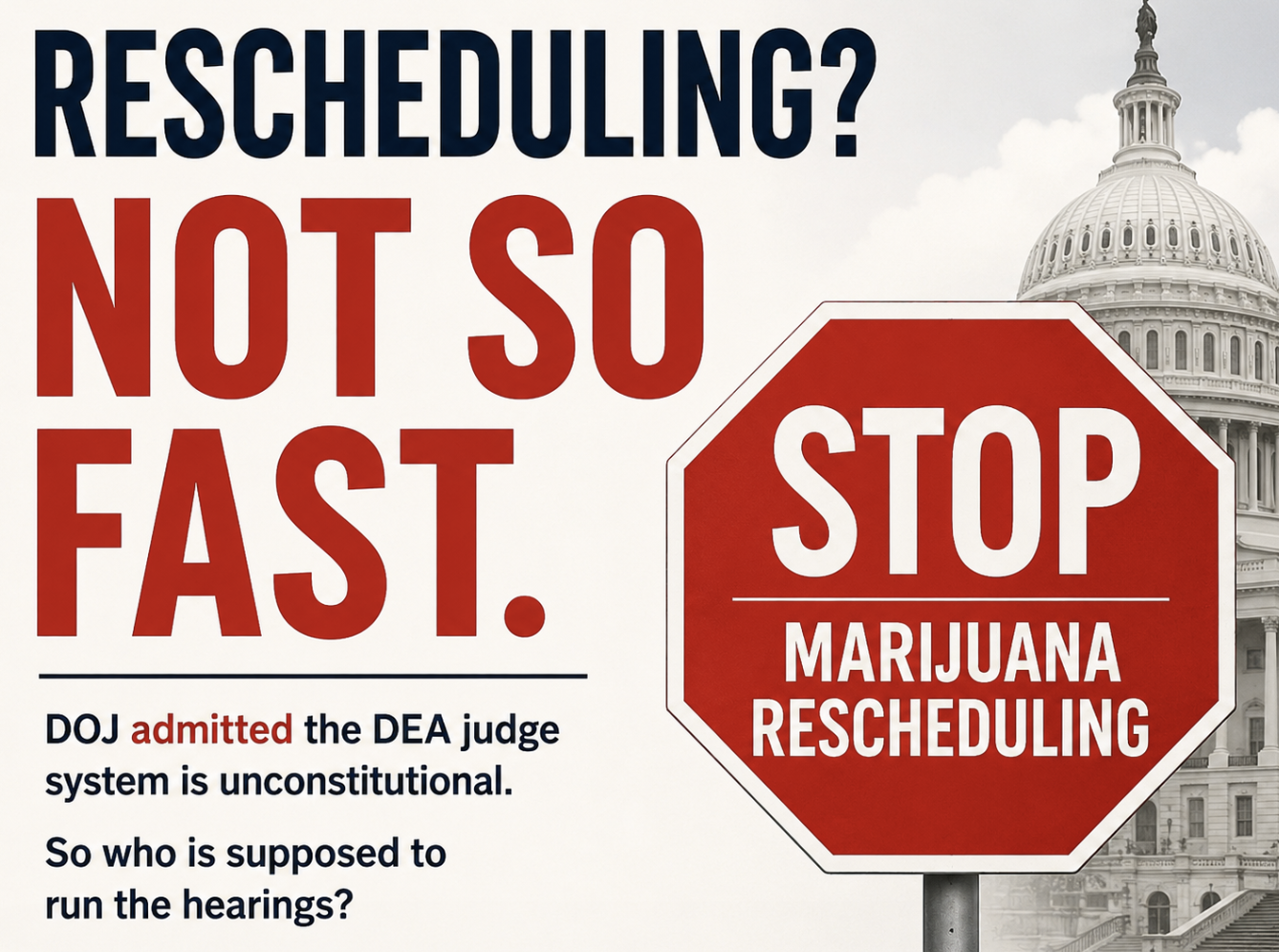
This constitutional crisis was not exposed by a political advocacy group or a state-market cannabis company. It was exposed in active federal litigation brought by MMJ BioPharma Cultivation, Inc. - a federally compliant pharmaceutical cannabinoid company that pursued DEA registration, FDA clinical pathways, and pharmaceutical manufacturing controls from inception while much of the broader cannabis industry operated through state regulated systems outside federal law.
Now the federal government faces a question it has not answered:
How can marijuana rescheduling legally proceed through a tribunal system the Department of Justice itself admitted is unconstitutional?
THE DOJ'S CONSTITUTIONAL CONCESSION
MMJ BioPharma Cultivation challenged the DEA's ALJ structure in federal court, arguing that the multiple layers of removal protections insulating DEA administrative law judges from presidential oversight violate Article II of the Constitution and the separation of powers doctrine.
On February 27, 2025, the United States Department of Justice filed a formal Notice of Change of Position in MMJ BioPharma Cultivation Inc. v. Bondi, Civil Action No. 1:24-cv-127-WES-PAS, pending in the United States District Court for the District of Rhode Island.
The DOJ stated plainly:
"the multiple layers of removal restrictions for administrative law judges ('ALJs') in 5 U.S.C. § 7521 do not comport with the separation of powers and Article II."
The government did not merely lose an argument. It abandoned its defense of the DEA ALJ structure entirely.
MMJ subsequently filed a Motion for Summary Judgment on March 31, 2025 requesting that the District Court declare the DEA ALJ structure unconstitutional and enjoin the DEA and DOJ from conducting further administrative proceedings against MMJ until a constitutionally valid system exists.
That motion was dismissed without prejudice. To be continued.
THE JUNE 29 RESCHEDULING PROBLEM
But the constitutional defect remains unresolved.
Congress has not amended the underlying statutory framework governing DEA administrative judges. The Supreme Court has not issued a structural remedy. And the DEA ALJ system itself remains unstable following the government's constitutional concession.
Yet the federal government still intends to proceed with contested marijuana rescheduling hearings.
Under the Controlled Substances Act, marijuana rescheduling cannot simply occur through political announcement or executive declaration. Once the process becomes contested, the statute requires formal administrative proceedings involving evidence, witnesses, and adjudication before administrative law judges.
That is where the constitutional problem now sits.
THE SUPREME COURT ALREADY WARNED ABOUT THIS
The legal consequences of proceeding through an unconstitutional administrative tribunal are not theoretical.
In Axon Enterprises, Inc. v. Federal Trade Commission, 598 U.S. 175 (2023), the United States Supreme Court held that being subjected to an unconstitutionally structured administrative proceeding itself constitutes a distinct legal injury.
The Court specifically held that this type of constitutional injury is:
"impossible to remedy once the proceeding is over."
Applied to marijuana rescheduling, that means any party subjected to hearings conducted through the current DEA ALJ framework may possess immediate grounds for federal court intervention before the proceedings even conclude.
MMJ FOLLOWED THE FEDERAL RULES
While much of the cannabis industry operated through state-market systems, MMJ International Holdings and its subsidiaries pursued the federal pharmaceutical route from the beginning.
MMJ BioPharma Labs currently holds an active DEA Schedule I analytical laboratory registration.
MMJ BioPharma Cultivation pursued:
DEA registration pathways,
FDA Investigational New Drug applications,
pharmaceutical manufacturing controls,
federally compliant cannabinoid research,
and clinical-trial infrastructure.
In other words, MMJ built inside the federal system while many state-market operators built outside it.
Yet even after DOJ admitted the DEA ALJ structure violates the Constitution, MMJ says the DEA continued pressing forward with administrative proceedings in DEA Docket No. 24-13 using the same framework DOJ refused to defend in federal court.
The federal government now finds itself trapped inside a contradiction of its own making:
Marijuana rescheduling requires contested hearings under federal law.
Yet the DEA still intends to proceed through that same structure.
A new hearing date does not cure a constitutional defect.
And under the Supreme Court's Axon decision, constitutional injury occurs the moment a party is subjected to proceedings before an unlawful tribunal.
THE CORE QUESTION
Until Congress fixes the structure or a constitutionally valid tribunal is re-established, that question may become one of the largest legal obstacles facing federal marijuana rescheduling itself.
About MMJ International Holdings
MMJ International Holdings is a private pharmaceutical cannabinoid development company and the parent of MMJ BioPharma Cultivation, Inc. and MMJ BioPharma Labs. MMJ BioPharma Labs holds an active DEA Schedule I analytical laboratory registration. MMJ BioPharma Cultivation, Inc. is the plaintiff in MMJ BioPharma Cultivation Inc. v. Bondi, Civil Action No. 1:24-cv-127-WES-PAS (D.R.I.), where the constitutional challenge to the DEA ALJ structure was established through the government's own written concession, and is also a respondent in DEA Docket No. 24-13.
Media Contact:
Madison Hisey
[email protected]
203-231-8583
This release references publicly available court filings in MMJ BioPharma Cultivation Inc. v. Bondi, Civil Action No. 1:24-cv-127-WES-PAS (D.R.I.), DEA Docket No. 24-13, Axon Enterprises, Inc. v. Federal Trade Commission, 598 U.S. 175 (2023), and related Department of Justice filings and public statements. Nothing in this release constitutes legal advice.
SOURCE: MMJ International Holdings
View the original press release on ACCESS Newswire
Th.Berger--AMWN