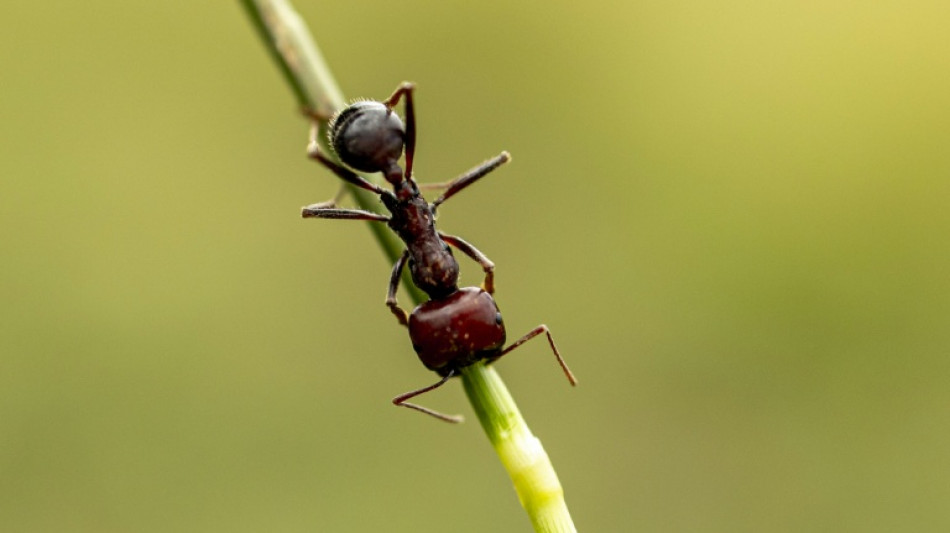
Kenya's new poaching problem: smuggling Giant Harvester Ants / Photo: SIMON MAINA - AFP
 What challenges await Brazil's Lula in his fourth term?

 Eric Ries sets out how mission-driven companies can endure

 Book examines five forces driving the next phase of Indian startups

 Lula, Bolsonaro in virtual tie halfway through Brazil vote count

 Antonelli looks to seal title 'in style' after US Grand Prix win

 Real Madrid century 'just a detail' for Mbappe after Clasico win

 Mbappe double helps Real Madrid stun Barca in La Liga Clasico

 Antonelli wins US Grand but title triumph has to wait another week
 Manchester United slump deepens as Liverpool climb with Brighton win

 Reus sends Bordeaux second in Top 14 with victory at La Rochelle

 Serbia's student movement ousts longtime leader in parliament poll

 Kuwait minister urges focus on investment quality and development impact

 Descendants of British slave-owning families support reparations campaign

 Aleksandar Vucic: Serbia's veteran ruler felled by student-led movement

 Obama attacks Trump record while campaigning in Ohio and Michigan

 Brazil voting extended in tight race between Lula, Bolsonaro

 'Marine has to win': Le Pen supporters fear for France's future

 QNB expands cross-border funding for AI and digital infrastructure

 France's Le Pen launches presidential bid vowing to restore 'rule of law'

 Qatar Charity delivers Braille Qurans to blind readers in Kosovo and Albania

 Houthis say attacked Riyadh airport hours after flights resume

 Monaco hold Lille as Rennes go top of Ligue 1

 Thousands gather in Prague to protest licence fee plans

 Pease spins to floor gold as US tops gymnastics medal table

 Marchant back in England training squad ahead of Nations Championship fixtures

Kenyan ant expert Dino Martins gushes over the red and black insects that have become the centre of an international smuggling trade.
Martins has been visiting the network of nests of these Giant African Harvester Ants outside Nairobi for 40 years.
"They're big and bold... They're the tigers of the ant world," the entomologist told AFP.
"Each nest here has just one queen and she is the mother who founded this nest 40, 50 or even 60 years ago," he said.
Martins was shocked when he learned that thousands of queens from this Messor cephalotes species were being harvested and shipped abroad in syringes and test tubes to be sold for hundreds of dollars each.
The trade came to light in Kenya last year when two Belgian teenagers were arrested in possession of nearly 5,000 queen ants, and accused of "biopiracy".
Kenyan authorities fear a new form of poaching, focused less on ivory and furs, and more on insects, reptiles and rare plants.
The judge even compared it to the slave trade.
"Imagine being violently removed from your home and packed into a container with many others like you... It almost sounds as if the reference above is to the slave trade," he said in his ruling.
The Belgians were handed a fine of around $8,000, but as more cases have emerged, sentences have hardened: last month a Chinese national was sentenced to one year in prison for attempting to traffic 2,000 ants.
On several European websites, the queens go for around 200 euros ($230).
Though marked as unavailable, they are increasingly easy to buy with the right connections, said Ryan, a 25-year-old from France who gave only his first name.
He finds ants "hypnotising", and wanted the largest harvesters, so he bought a starter kit including a queen and 12 workers from an authorised seller for 450 euros.
That's "very reasonable," he said -- a decade ago, a queen could fetch 1,000 euros.
In the end, however, Ryan found they proved too tricky to raise and he gave them away.
Giant Harvester Ants are common from the Mediterranean to the Cape. They work together almost 24 hours a day, gathering and chopping grasses for their larvae.
They have captivated people for centuries. In the Old Testament, King Solomon famously exhorted the lazy to "Go to the ant... Consider its ways and become wise".
"He was observing the same ant in Jerusalem that we are now," said Martins.
- 'Ants have feelings' -
Colonies can take 20-30 years to produce new queens. They provide all manner of services to the ecosystem: dispersing grass seeds, aerating the soil, and providing food for animals like pangolins.
Martins also considers the smuggling trade unethical simply because "ants have feelings".
The trade "exploded" with the arrival of the internet, said Jerome Gippet, a researcher at the Swiss University of Fribourg.
Formerly the interest of a few passionate individuals, it eventually gave way to sophisticated networks of collectors, intermediaries and smugglers.
A study Gippet published in 2017 found more than 500 ant species -- a third of the total -- were sold online. More than 10 percent were potentially invasive with uncertain impacts on foreign ecosystems.
He says regulated trade -- as exists in Australia, for example -- can work well.
"I'm not advocating for a ban on the ant trade. It's very useful in educational terms, in terms of reconnecting with nature, or simply providing enjoyment... But it has to be done responsibly," he said.
Th.Berger--AMWN