
Europe's Hospital Cybersecurity Hot Zones and Top Cyber Vendors as EHR and EPR Attacks Shift From Data Theft to Care Disruption
 Kuwait regulators broaden beneficial-owner data cooperation
 Succession pressures put Gulf family companies at a crossroads

 IMF sees regional economy shrinking 1.3% in 2026 amid Iran war

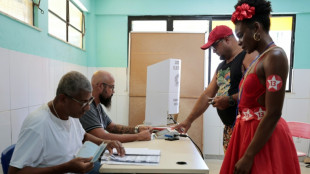
 Brazil votes in tight election as Lula slams polling obstacles

 'I am here': Opposition leader Machado returns to Venezuela

 Villain intrigue: 'Clayface', Holmes doc lead N. America box office

 Bayern beat Freiburg to reclaim top spot after Kompany illness

 Nigeria widens hunt for possible Ebola cases

 Liverpool star Isak back to his best says Iraola

 Lula supporters cross fingers in Rio, a Bolsonaro bastion

 Flights resume at Riyadh airport as Houthis attack Saudi Arabia

 High-flying Betis held at Celta Vigo

 Shadab ton stuns England as Pakistan reach tri-series final

 'With you': Opposition leader Machado returns to Venezuela

 Carrick on the brink as Man Utd misery mounts, Isak stars for Liverpool

 Monaco hold Lille as both move to top of Ligue 1

 Isak extends hot streak as Liverpool sink Brighton

 Brazil chooses between Lula and Bolsonaro in nail-biter vote

 Doha opens ninth World Investment Forum focused on future investment

 Kuwait public works minister and UK ambassador discuss closer cooperation

 Historic Ramallah olive press joins modern production with local tradition

 Hebron operation forces 373 Palestinian families from their homes

 Kuwait legal department reviews new commercial concealment law

 John Catlin wins Hong Kong Open and secures first Masters invitation

 Chicago Fire rally past Atlanta United 3-2 to hold fourth place

Recent European hospital incidents, NIS2 accountability, EPR exposure, supplier concentration, and 72-hour downtime weakness are pushing buyers toward clinical-continuity cybersecurity ahead of HIMSS26 Europe
COPENHAGEN, DK / ACCESS Newswire / May 19, 2026 / Black Book Research today issued a new European hospital cybersecurity advisory identifying the countries, attack surfaces, vendor categories, and evaluation standards now shaping hospital cybersecurity buying decisions across Europe.
The advisory builds on Black Book's Pre-HIMSS26 Europe Copenhagen Cybersecurity Demand Pulse Survey of 284 self-identified European hospital, health system, HIT, clinical-digital, cybersecurity, procurement, risk, and executive respondents seeking cybersecurity options around HIMSS26 Europe in Copenhagen.
Black Book reports that European hospital cybersecurity has moved beyond breach response. The 2026 priority is now clinical availability: protecting EHRs, EPRs, identity systems, lab platforms, pharmacy systems, PACS/RIS, network access, medical devices, hosted suppliers, and recovery operations when attackers successfully disrupt the digital layer.
"European hospitals are being targeted because care delivery has become digitally concentrated but operationally fragmented," said Doug Brown, Founder of Black Book Research. "An EPR outage in Europe is no longer an IT inconvenience. It can choke laboratory turnaround, pharmacy verification, imaging access, emergency flow, theatre scheduling, ICU visibility, and discharge capacity before a board has even convened. The adversary understands NIS2 pressure, national health platforms, regional health networks, cloud migrations, remote access, privileged credentials, shared diagnostics suppliers, and underfunded legacy estates. The winning cybersecurity vendors in Europe will be those that keep EPRs, identity, networks, and clinical workflows available when ransomware gets through , not those selling the flashiest dashboards."
Recent Incidents Show the Threat Is Now Operational
Black Book cites recent European healthcare cyber incidents as evidence that attackers are no longer creating only privacy or compliance events. They are creating operational crises.
The Synnovis ransomware attack in the United Kingdom disrupted pathology services across South-East London, reducing test-processing capacity and delaying thousands of outpatient and elective-procedure appointments. In Spain, the Hospital Clínic de Barcelona ransomware incident forced cancellation of nonurgent procedures and appointments while disrupting laboratories, emergency services, and pharmacy operations. In Ireland, the national Health Service Executive ransomware attack demonstrated the vulnerability of centralized health technology infrastructure and the cascading impact of systemwide encryption. In France, an EPR-related compromise exposed sensitive patient records and highlighted the risk of privileged-account access inside healthcare application environments.
"These incidents are teaching European buyers that the real question is not only whether attackers can enter," Brown said. "It is whether the hospital can still admit, diagnose, medicate, operate, image, discharge, and recover while its digital operating model is under attack."
Countries Facing Highest Hospital Cybersecurity Pressure
Black Book identifies the United Kingdom, France, Germany, Spain, Italy, the Netherlands, Ireland, Poland, and Switzerland as the European hospital markets facing the highest combined cybersecurity procurement pressure in 2026. Black Book emphasizes that these are not necessarily the weakest countries; they are markets where the consequences of cyber disruption are amplified by scale, digitization, supplier dependency, cross-border care, public-sector pressure, and high-value clinical data.
The United Kingdom remains highly exposed because of NHS scale, outsourced diagnostics, supplier concentration, and recent pathology-sector disruption. France faces EPR exposure, hospital ransomware history, regional hospital groups, and a large public/private care mix. Germany combines a large hospital footprint with decentralized IT estates, legacy infrastructure, high medical-device density, and complex federal-state healthcare governance. Spain faces regional health-system variation and prior hospital ransomware disruption. Italy is challenged by regional fragmentation, uneven cyber maturity, public-sector capacity pressure, and accelerating digitalization. The Netherlands has very high digital maturity, interconnected care networks, cloud adoption, and high availability expectations. Ireland remains shaped by direct lessons from the HSE ransomware event and centralized shared-service dependency. Poland faces elevated geopolitical and critical-infrastructure pressure. Switzerland presents a high-value healthcare, life-sciences, research, and cross-border data environment that remains attractive to sophisticated attackers.
EHR and EPR Cyber Risk Has Entered a New Phase
Black Book's 284-respondent Copenhagen pulse found that 82% of European hospital cybersecurity buyers report very high or extreme cyberattack concern for 2026. 74% believe their own organization is likely or highly likely to face a major cyber event this year, and 86% are using HIMSS26 Europe to identify or compare cybersecurity options.
Hospital buyer confidence declines sharply as downtime extends:
59% are confident their organization can operate safely for 24 hours without core EHR access.
32% are confident at 48 hours.
14% are confident at 72 hours.
26% reported a full clinical downtime simulation in the past 12 months.
25% said critical suppliers have been fully tiered by clinical impact and incident-response obligation.
31% said boards receive cyber-resilience metrics tied to clinical continuity.
Black Book's European Hospital Cyber Resilience Continuity Index scored the respondent group at 44 out of 100, indicating that cybersecurity urgency is outpacing validated operational continuity.
Black Book 2026 Top-Performing Cybersecurity Vendors and Consultants in Europe
Black Book evaluated European hospital cybersecurity suppliers across qualitative performance criteria centered on hospital readiness, EHR/EPR protection, NIS2 alignment, clinical continuity, identity resilience, ransomware recovery, supplier risk, and European delivery capability.
Black Book's 2026 Europe hospital cybersecurity top performers are listed below by buyer objective and use case.
Buyer Objective | Top-Performing Vendors and Consultants to Evaluate |
|---|---|
Identity, PAM, SSO resilience, and break-glass access | CyberArk, Microsoft Security, Okta, Thales, BeyondTrust, SailPoint |
MDR, XDR, endpoint, SOC modernization, and threat hunting | CrowdStrike, Microsoft Security, SentinelOne, Sophos, Palo Alto Networks, WithSecure, Orange Cyberdefense |
Network segmentation, zero trust, SASE, and ZTNA | Palo Alto Networks, Fortinet, Zscaler, Cisco, Check Point, Akamai |
Ransomware recovery, immutable backup, cyber vaulting, and restore assurance | Rubrik, Veeam, Cohesity, Commvault, Dell Technologies |
Medical device, IoMT, OT, and clinical network visibility | Armis, Claroty, Forescout, Nozomi Networks, Ordr |
Incident response, breach readiness, and ransomware crisis management | Mandiant / Google Cloud, NCC Group, Orange Cyberdefense, IBM X-Force, WithSecure, Kroll |
European MSSP and managed security operations | Orange Cyberdefense, Telefónica Tech, T-Systems, NTT DATA, Eviden, Thales, Capgemini |
NIS2, GDPR, EHDS, board governance, and cyber-risk advisory | Deloitte Cyber, PwC Cyber, KPMG Cyber, Accenture Security, Capgemini, IBM Consulting |
Hospital transformation and clinical-continuity consulting | Accenture, Deloitte, PwC, KPMG, IBM Consulting, NTT DATA, Capgemini, T-Systems |
The 18 Black Book Qualitative KPIs for European Hospital Cybersecurity Evaluation
Black Book recommends that European hospital buyers evaluate cybersecurity vendors and consultants using 18 qualitative KPIs centered on clinical continuity, European delivery capability, and healthcare-specific cyber resilience: proven European healthcare client references; EHR/EPR protection and integration capability; identity, PAM, SSO, MFA, and break-glass resilience; ransomware containment and lateral-movement prevention; immutable backup, cyber vaulting, and restore validation; MDR/XDR/SOC effectiveness in healthcare environments; network segmentation, zero trust, ZTNA, and SASE maturity; medical device, IoMT, OT, and clinical network visibility; supplier-risk and third-party incident-response capability; NIS2, GDPR, EHDS, and national regulatory alignment; European data residency and sovereignty support; local-language support and in-country incident response; downtime readiness and clinical-continuity support; board reporting tied to patient-safety and care-continuity metrics; integration with LIS, PACS/RIS, pharmacy, e-prescribing, and scheduling systems; recovery-time and recovery-point evidence under real restore conditions; scalability across multi-hospital, regional, and cross-border systems; and cost transparency, speed to value, and operational usability for resource-constrained hospitals.
Black Book urges European hospital buyers to stop evaluating cybersecurity vendors solely through generic security controls and start requiring proof of clinical resilience.
European hospitals should require vendors and consultants to demonstrate how their solutions protect EHR/EPR access, clinical identity, pharmacy, lab, PACS/RIS, and medical-device workflows; run a 24/48/72-hour outage scenario before major contract award or renewal; prove restore capability through live recovery tests, not attestation; validate privileged-access containment and identity break-glass during directory, SSO, or MFA failure; show how ransomware containment prevents lateral movement across clinical, administrative, and supplier-connected systems; include clinical, nursing, pharmacy, lab, radiology, and emergency leaders in cyber resilience testing; provide board-ready metrics that translate cyber operations into patient-safety and care-continuity evidence; and contractually define Tier 0 and Tier 1 supplier incident obligations, escalation rights, and recovery expectations.
"Hospitals should not buy cybersecurity as a tool stack anymore," Brown said. "They should buy it as a clinical operating control. Every vendor conversation should answer the same question: when the EPR is degraded, identity is compromised, the network is segmented, and a supplier is offline, can this technology help care continue safely?"
Black Book concludes that 2026 is the year European hospital cybersecurity becomes inseparable from clinical governance. Cyberattacks against hospitals are no longer only data events. They are availability events, identity events, supplier events, recovery events, and clinical-continuity events.
The European hospitals best positioned for the next wave of cyber risk will be those that evaluate vendors not by promise, but by evidence: validated recovery, protected identity, segmented networks, resilient EHR/EPR workflows, tested suppliers, and board-visible clinical-continuity metrics.
About Black Book Research
Black Book Research provides independent healthcare technology, managed services, cybersecurity, analytics, outsourcing, and digital transformation research based on user experience, buyer demand, operational performance, and market intelligence surveys across global healthcare markets.
Media Contact: Black Book Research, London UK/ Tampa FL USA 1.800.863.7590 [email protected]
SOURCE: Black Book Research
View the original press release on ACCESS Newswire
Y.Nakamura--AMWN