
Clinicians Have Become Healthcare's Human Middleware, New Vendor-Agnostic Report Finds from Black Book Research
 Verstappen wins chaotic Singapore sprint after Russell crashes

 Kiss tells Wallabies to 'return fire' after first loss as coach

 Russian strikes kill 11 including 3 children: Ukrainian authorities

 Russian teenager Andreeva breezes into China Open final

 Major earthquake hits Panama, injures at least 27

 India detains 'cockroach' leaders ahead of election protest

 'No divisions, no borders', French astronaut says of seeing Earth

 India's 'cockroach' movement chief detained ahead of major protest
 Year later, Gaza ceasefire promises mostly unfulfilled

 Taiwan's leader says increasing defence spending to 'deter war'

 Major quake hits Panama, no deaths reported

 Hurricane Isaias makes landfall in Florida

 Brazil prosecutors sue Shell for $108 mn over deadly 2024 floods

 Major earthquake destroys buildings, roads in Panama

 Anthropic AI model sent fake murder tip to Philadelphia police
 7.7-magnitude quake rocks Panama, triggers tsunami warning

 Prince Harry booed at English rugby match

 Kiplimo and Feysa seek repeat Chicago Marathon wins

 Fuellkrug halts Dortmund after late goal flurry

 Injured Ravens quarterback Jackson ruled out of Falcons clash
 Brewers aim to take down two-time defending champion Dodgers in NLCS rematch

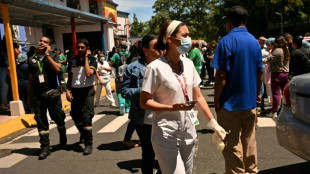 Tsunami alert after major earthquake rocks Panama

 Outer bands of Hurricane Isaias lash US Gulf Coast

 Hope, Rutherford fire West Indies to record T20 chase of 250

 Farhan leads Pakistan to T20 win over Sri Lanka
EHR fragmentation, payer demands and unproven AI efficiencies are adding hidden labor across clinical workflows
CHICAGO, IL / ACCESS Newswire / July 14, 2026 / Black Book Research today released The Work That Didn't Disappear: The Black Book Clinician Reality Index, a nine-month national study finding that healthcare technology is frequently shifting work to clinicians rather than eliminating it.
The vendor-agnostic survey of 1,919 clinicians found that 80.7% use at least one workaround every day, while 65.2% lose 30 minutes or more per day or shift to avoidable digital work.
Clinicians reported repeatedly re-entering information, reconciling external records, monitoring disconnected queues, checking payer portals and using unofficial notes or task lists to compensate for workflow gaps.
"Clinicians have become the human middleware holding fragmented healthcare technology together," said Doug Brown, Founder of Black Book Research. "They are manually transferring context between EHR modules, payer portals, patient messages, outside records and AI applications because the systems still do not complete the workflow. That is not interoperability. It is an expensive dependency on clinical labor."
Technology Is Digitizing Work Without Consistently Removing It
The Black Book Clinician Reality Index measures whether healthcare technology eliminates work after implementation, not simply whether a system has been purchased, activated or adopted.
Key findings include:
71% of clinicians re-enter information already documented elsewhere.
64% copy or carry information forward for documentation or billing requirements.
61% use side notes, scratch pads or unofficial task lists.
56% manually track laboratory results, imaging, referrals or authorizations.
49% check payer portals outside the clinical workflow.
42% manually reconcile outside records or medication lists.
Black Book found that these activities are often excluded from traditional technology-performance assessments because the digital transaction is technically completed, even when substantial clinician labor is still required.
AI Adoption Is Outpacing Verified Labor Reduction
More than half of respondents, 55.7%, reported exposure to at least one AI-enabled clinical workflow.
Among the 1,069 clinicians currently using AI, however, only 19% said the technology produces meaningful net labor reduction. Another 46% said AI saves time in one part of a task but adds review, correction or validation work elsewhere.
"An AI-generated note is not a productivity outcome," Brown said. "The relevant healthcare IT metric is net labor after the clinician reviews the output, corrects unsupported language, resolves exceptions and accepts the clinical risk. Until buyers measure the entire workflow, AI efficiency claims will remain incomplete and, in many cases, materially overstated."
Black Book recommends that healthcare organizations measure AI value by subtracting review, editing, correction, escalation, validation and governance time from the labor initially saved.
Payer and Portal Demands Are Expanding Clinical Work
The report also identified payer requirements and patient-message volume as major sources of hidden labor.
Sixty percent of respondents said payer requirements interrupt care delivery at least weekly, while 49% check payer status outside the EHR. Nearly half, 47%, reported changing clinical documentation to meet medical-necessity requirements.
At the same time, 63.9% said portal or inbox demand is growing faster than staffing, triage processes, compensation models or automation support. More than half, 52%, reported that patient messages create after-hours work at least weekly.
Black Book concluded that expanding digital access without corresponding staffing and workflow redesign transfers additional labor directly to clinicians.
Nursing Workflows Show Significant Misalignment
Among 1,154 nursing respondents, 72% said EHR documentation sequences do not match how nursing work unfolds during a shift. Another 68% reported duplicate flowsheet or care-plan documentation at least weekly.
The report cautions healthcare organizations against applying physician-oriented documentation and AI tools to nursing workflows without direct bedside-nurse participation in design and implementation.
A New Standard for Healthcare Technology Value
More than half of all respondents, 55.9%, identified at least one paid digital tool that adds screens, queues, messages or review requirements without clearly removing a frontline task.
Black Book recommends that healthcare organizations evaluate technology according to measurable work removed, including:
Documentation hours eliminated.
Direct-care time restored.
Duplicate data entry removed.
After-hours inbox work reduced.
Payer-related clinical minutes eliminated.
Manual reconciliation steps removed.
Workarounds retired.
The report's central buyer standard is straightforward: technology vendors should be able to document the work that disappears after deployment.
Research Methodology
Black Book Research surveyed 1,919 clinicians with direct EHR or digital-workflow exposure during the preceding 90 days. Respondents included nurses, physicians, nurse practitioners, laboratory professionals, pharmacists, imaging clinicians, rehabilitation therapists, dietitians and other clinical professionals across multiple care settings.
At a 95% confidence level, the full respondent base has an estimated maximum margin of sampling error of approximately ±2.2 percentage points under a simple-random-sample assumption.
The findings represent self-reported clinician experiences and are intended as indicators of workflow burden. The research was conducted independently of EHR vendors, consulting firms, payers, provider organizations and technology suppliers.
The full study, The Work That Didn't Disappear: The Black Book Clinician Reality Index, Q3 2026, is available under the Free Reports section of https://www.blackbookmarketresearch.com or request PDF via email to [email protected]
About Black Book Research
Black Book Research conducts independent market research, user-experience studies and performance evaluations across healthcare technology, clinical operations and administrative services. Its research helps healthcare organizations, technology buyers, suppliers, investors and policymakers distinguish between digital adoption and measurable operational value.
Media Contact: [email protected] 1.800.863.7590 https://www.blackbookmarketresearch.com
SOURCE: Black Book Research
View the original press release on ACCESS Newswire
F.Schneider--AMWN