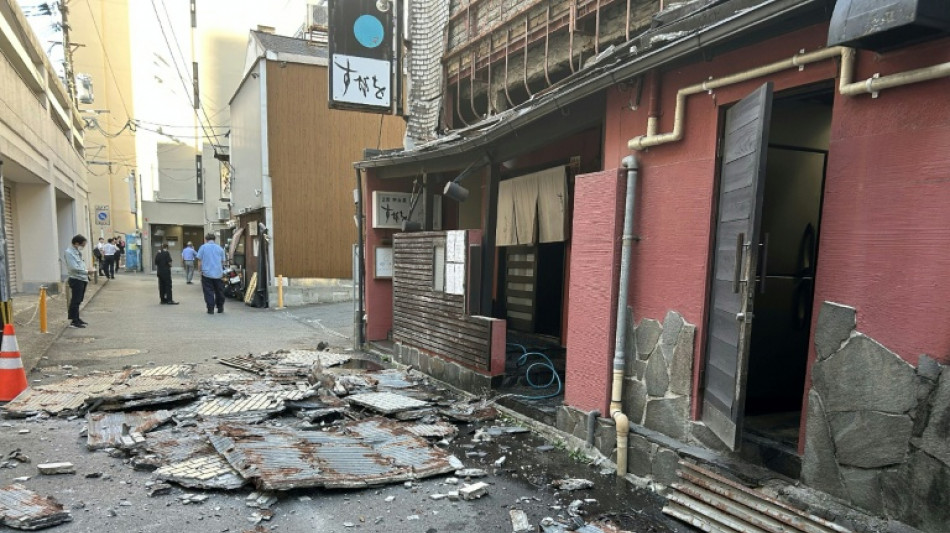
Japan PM says injuries, buildings collapsed in major quake / Photo: STR - JIJI Press/AFP
 Trump says US moved bombers from UK base after 'threats'
 Brazilian stocks surge to record after Bolsonaro election lead

 Leaders to visit Pacific atoll at frontline of climate change

 ICC gives more details about arrest warrants for Taliban ministers
 Nigeria's Tinubu confirms 32 dead after military plane crash

 'Reckless' AI firms can't control models, says whistleblower

 Switching on brain cells: the Nobel-winning science of optogenetics

 Quebec votes as separatist surge poses test for Canada PM

 Euro slides as concerns about French debt mount

 Former Trump press secretary Leavitt joins Fox News

 Djokovic advances to China Open final as Medvedev out for hitting fan with ball

 Disgraced former US House speaker dies at 84

 Euro slides as worries about French debt grow

 US withdraws all bomber aircraft from UK airbase
 Drone hits Ethiopia IDP camp as fears grow of regional war

 US-German trio wins medicine Nobel for illuminating the brain

 England captain Kane driven by desire for records says Tuchel

 N.Irish court hears challenge to disputed Orangemen parade

 Talking points from the Bahrain Grand Prix in Malaysia

 Yemen, Saudi Arabia target Houthis in new campaign as war escalates
 US-German trio wins medicine Nobel for work on optogenetics

 Swiatek, Zheng survive three-set tests in China Open third round

 Hasan says Test cricket momentum turning for Bangladesh

 Intense heat puts births in jeopardy, UN tells Fiji talks

 US arrests woman accused of spying for China on Taiwan leader's family
A major earthquake collapsed buildings and sparked fires in Japan's southwest, Prime Minister Sanae Takaichi said on Tuesday, with broadcaster NHK saying that at least 50 people were taken to hospital.
Television footage on NHK showed several blazes, damaged bridges, a derailed cargo train and cracked roads after the tremor on Kyushu island. The broadcaster reported at least 12 collapsed houses.
The quake at 4:27 pm (0727 GMT) had a magnitude of 7.1, according to the Japan Meteorological Agency, but reached the highest possible level of seven on Japan's Shindo scale of shaking.
The US Geological Survey (USGS) measured the quake -- one of hundreds that strike Japan every year -- at 6.8. The vast majority cause little damage.
"We are still assessing the extent of injuries and property damage, but I have been informed that there have already been several injuries," Takaichi said.
"Power outages and fires are happening in some areas, and roads and bridges have been damaged and buildings collapsed," she said.
The JMA initially issued an alert for a possible tsunami of up to one metre (three feet), but withdrew the warning at around 6:10 pm.
"This earthquake occurred inland, and no tsunami activity has been observed so far. For this reason, we hope to lift the tsunami advisory at a relatively early stage, depending on future sea level conditions," a Japan Meteorological Agency spokesperson said.
No immediate abnormalities were recorded at nuclear power plants, the Nuclear Regulation Authority said.
About 45,000 households and facilities have no power in the Kumamoto region, according to local utility Kyushu Electric Power.
The firm added that three nuclear reactors operating in the region at the time were functioning normally.
- 'Shaking is continuing' -
A local NHK staffer wearing a helmet reported live on air that the shaking was continuing around half an hour after the quake, with the newsroom rocking so violently that it was difficult to remain standing.
"Shaking is continuing as I speak. Including myself, there may be some people who feel their hearts racing," the staffer said.
"When the quake struck, the shaking was so big that I could not stand up. Please be aware of possibility that shaking might continue after this."
Kumamoto was hit by two devastating earthquakes in 2016 -- one of magnitude 6.5, followed two days later by one of magnitude 7.3 -- which killed 273 people and injured more than 2,800.
A quake with a magnitude of 7.2 hit northern Japan on June 25 but caused no deaths or major damage.
Japan is one of the world's most seismically active countries, sitting on top of four major tectonic plates along the western edge of the Pacific "Ring of Fire".
The archipelago, home to around 125 million people, typically experiences hundreds of jolts every year and accounts for about 18 percent of the world's earthquakes.
The vast majority are mild, although the damage they cause varies according to their location and the depth below the Earth's surface at which they strike.
Japan is haunted by the memory of a massive 9.0-magnitude undersea quake in 2011, which triggered a tsunami that killed or left missing around 18,500 people and wrecked the Fukushima nuclear plant.
A tremor measuring 7.7 hit the country's north on April 20 this year, injuring at least 10 people and shaking large buildings in Tokyo.
That prompted authorities to issue a special advisory warning of an increased risk of earthquakes of magnitude 8.0 or stronger.
The advisory was lifted after a week.
tmo-hih-nf-stu/pbt
D.Sawyer--AMWN