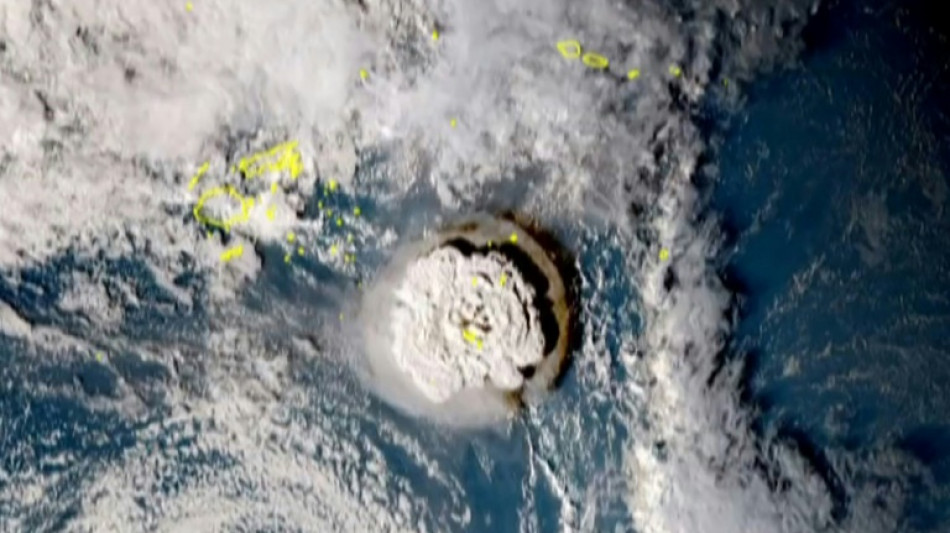
'Like a shotgun': Tongan eruption is largest ever recorded / Photo: Handout - National Institute of Information and Communications Technology/AFP/File
 Trump names Stephen Miller as White House chief of staff after midterm losses

 Restored Albanian tower houses anchor new rural tourism trail

 Sonia Gandhi reflects on family tragedy and reluctant political career

 Pope Leo begins three-country South American tour in Uruguay

 Khawaja says entire Australia camp knew of 2018 ball-tampering plan

 November Foraging Guide: Edible Mushrooms and Critical Safety Protocols

 Microsoft Updates Xbox PC App with 60% Faster Startup and Redesigned Interface

 Early Polar Vortex Disruption Creates Uncertain Winter Outlook for Pennsylvania

 How to Enjoy Luxury Experiences on a Budget

 Pakistan Demands Grant-Based Climate Finance at COP31 to Avoid Debt Trap
A deadly volcanic eruption near Tonga in January was the largest ever recorded with modern equipment, a New Zealand-led team of scientists revealed Monday.
The Hunga Tonga-Hunga Ha'apai volcano erupted underwater with a force equivalent to hundreds of atomic bombs, unleashing a 15-metre (50-foot) tsunami which demolished homes and killed at least three people on the Pacific island kingdom.
The natural disaster also damaged undersea communication cables, cutting Tonga off from the rest of the world for weeks and hampering efforts to help the victims.
A detailed study by New Zealand's national institute for water and atmospheric research shows the eruption blasted out almost 10 cubic kilometres of material -- equivalent to 2.6 million Olympic-sized swimming pools -- and fired debris more than 40 kilometres (25 miles) into the mesosphere, the level above the Earth's stratosphere.
"The eruption reached record heights, being the first we've ever seen to break through into the mesosphere," said marine geologist Kevin Mackay.
"It was like a shotgun blast directly into the sky."
The Hunga Tonga-Hunga Ha'apai eruption rivals the infamous Krakatoa disaster which killed tens of thousands in Indonesia in 1883 before the invention of modern measuring equipment.
"While this eruption was large -- one of the biggest since Krakatoa -- the difference here is that it's an underwater volcano and it's also part of the reason we got such big tsunami waves," Mackay added.
The team of scientists have accounted for three-quarters of the material fired out by the Tongan eruption with the rest explained as debris scattered in the atmosphere.
Mackay said the plume is estimated to have contained nearly two cubic kilometres of particles which stayed in the atmosphere for "months, causing the stunning sunsets we saw" across the Pacific region as far away as New Zealand.
His team also discovered that the volcano's crater is now 700 metres deeper than it was.
The eruption's pyroclastic flows -- deadly currents of lava, volcanic ash and gases which reach temperatures of 1,000 degrees Centigrade (1,800 degrees Fahrenheit) and speeds of 700 kilometres per hour -- carried debris from the volcano along the sea floor at least 80 kilometres away.
"But the pyroclastic flows appear to extend beyond that, perhaps as far as 100 kilometres away," said the team's principal scientist Emily Lane.
"The sheer force of the flows is astonishing -- we saw deposits in valleys beyond the volcano, meaning they had enough power to flow uphill over huge ridges and then back down again."
B.Finley--AMWN

