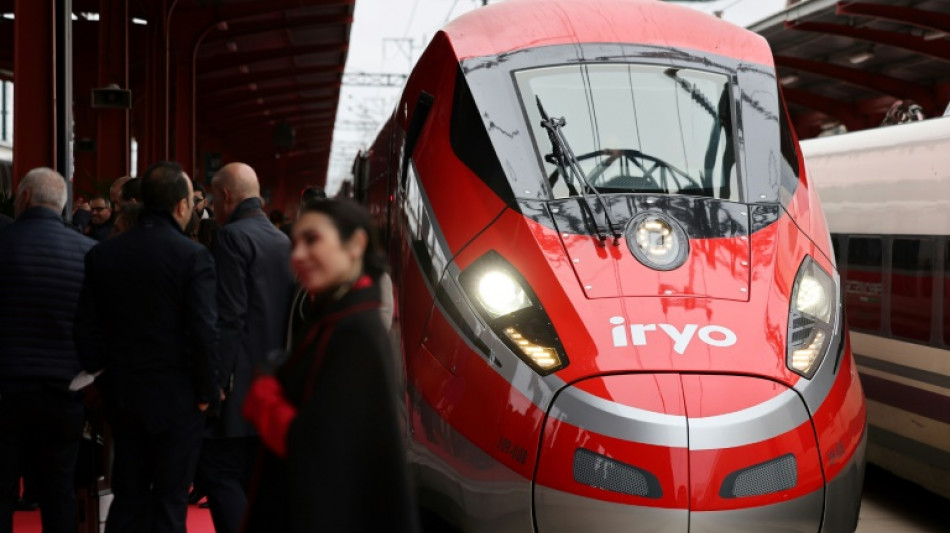
Spain's high-speed rail competition heats up with new entrant / Photo: Pierre-Philippe Marcou - AFP
 Trump names Stephen Miller as White House chief of staff after midterm losses

 Restored Albanian tower houses anchor new rural tourism trail

 Sonia Gandhi reflects on family tragedy and reluctant political career

 Pope Leo begins three-country South American tour in Uruguay

 Khawaja says entire Australia camp knew of 2018 ball-tampering plan

 November Foraging Guide: Edible Mushrooms and Critical Safety Protocols

 Microsoft Updates Xbox PC App with 60% Faster Startup and Redesigned Interface

 Early Polar Vortex Disruption Creates Uncertain Winter Outlook for Pennsylvania

 How to Enjoy Luxury Experiences on a Budget

 Pakistan Demands Grant-Based Climate Finance at COP31 to Avoid Debt Trap
Competition in Spain's high-speed rail market is heating up with a new operator starting passenger services on Friday, making it Europe's first nation with three players in the sector.
The new firms have pushed down prices and increased passenger traffic on the high speed network, which at 4,000 kilometres (2,500 miles) is the second longest in the world after China's.
Spain is the world's second most popular tourist destination after France.
Private operator Iryo, which is 45 percent owned by Italy's Trenitalia, made an inaugural symbolic trip on Monday from Madrid to Valencia on Spain's Mediterranean coast.
It will begin passenger services on Friday with 16 daily return trips between Madrid and Barcelona, Spain's two largest cities.
Iryo will compete with French railway company SNCF's firm in the country, Ouigo, which has been operating since May 2021 and Spanish state-owned rail operator Renfe, which opened its first high-speed service in 1992.
The arrival of a third operator is a "historical step" which is "novel" in Europe, said Carlos Lerida, a rail transport expert at the Autonomous University of Madrid.
"Until now no high-speed rail network has operated with three competitors. Spain could serve as a model," he told AFP.
Iryo, which is kicking off its operations in Spain with 20 trains, will in mid-December expand its services to include a Madrid-Valencia route.
And it March 2023 it will start running trains from Madrid to Seville and Malaga in the southwestern region of Andalusia.
Ouigo already operates trains along the Madrid-Barcelona and Madrid-Valencia routes and plans to start services to the Mediterranean port of Alicante as well as Andalusia next year.
- 'Democratise high-speed' -
Spain's state rail infrastructure operator Adif in 2019 granted contracts allowing the firms to operate on these routes for 10 years.
Socialist Prime Minister Pedro Sanchez's government is keen to lower ticket prices for bullet train tickets to make greater use of the high-speed rail network.
Greater competition will "democratise high-speed" rail travel, Transport Minister Raquel Sanchez said last month, calling Spain's model for the sector "revolutionary".
Renfe responded to the arrival of Ouigo in May 2021 with the launch of a low-cost bullet train service called Avlo.
The company has also renewed its fleet of trains and improved the service it offers passengers on their journeys.
Renfe has a seat sale underway with prices of a 500-kilometre (300-mile) trip between Madrid and Barcelona for as little as seven euros.
"We see the arrival of competition as an opportunity not as a problem," a Renfe spokesman said.
Average prices for tickets on high-speed trains between Madrid and Barcelona have dropped by 25 percent since Ouigo started operating last year, according to Spain's competition watchdog CNMC.
- 'Underused' network -
Passenger traffic on the route has jumped by 47 percent, and is up by 14 percent along Spain's entire rail network since May 2021, according to Adif.
"The network was underused," the director general of Ouigo's Spanish branch, Helene Valenzuela, told AFP, adding this meant there was a "limited risk" in entering the market.
The company spent 630 million euros ($644 million) to launch its operations in Spain.
"Our main rivals are planes and cars, not other trains," said Valenzuela.
"On a technical level, it is a challenge, because we have to organise the flow (of trains) in the stations. But on an economic level, it is an opportunity," she added.
Competition in the high-speed rail sector has its limits.
It works on "very busy lines" but it is "much more complicated" on other routes where it is harder for companies to cover their costs and make a profit," said rail transport expert Lerida.
S.Gregor--AMWN

