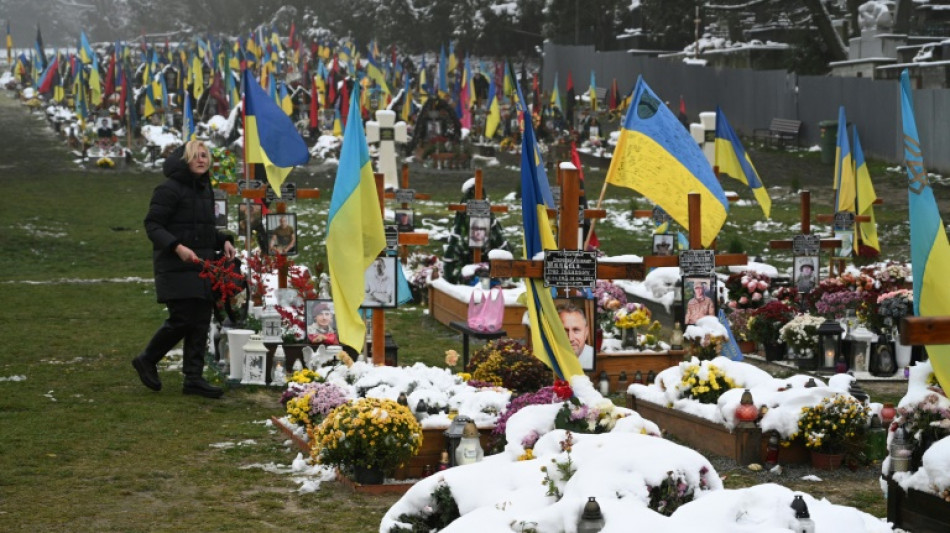
US sees 'systemic' war crimes by Russia in Ukraine / Photo: YURIY DYACHYSHYN - AFP
 Trump names Stephen Miller as White House chief of staff after midterm losses

 Restored Albanian tower houses anchor new rural tourism trail

 Sonia Gandhi reflects on family tragedy and reluctant political career

 Pope Leo begins three-country South American tour in Uruguay

 Khawaja says entire Australia camp knew of 2018 ball-tampering plan

 November Foraging Guide: Edible Mushrooms and Critical Safety Protocols

 Microsoft Updates Xbox PC App with 60% Faster Startup and Redesigned Interface

 Early Polar Vortex Disruption Creates Uncertain Winter Outlook for Pennsylvania

 How to Enjoy Luxury Experiences on a Budget

 Pakistan Demands Grant-Based Climate Finance at COP31 to Avoid Debt Trap
Russians have murdered, tortured and kidnapped Ukrainians in a systematic pattern that could implicate top officials in war crimes, the US State Department's ambassador for global criminal justice said Monday.
There is mounting evidence that Russia's invasion of Ukraine "has been accompanied by systemic war crimes committed in every region where Russian forces have been deployed," said Ambassador at Large Beth Van Schaack.
Evidence from liberated areas indicates "deliberate, indiscriminate and disproportionate" attacks against civilian populations, custodial abuses of civilians and POWs, forceful removal, or filtration, of Ukrainian citizens -- including children -- to Russia, and execution-like murders and sexual violence, she told reporters.
"When we're seeing such systemic acts, including the creation of a vast filtration network, it's very hard to imagine how these crimes could be committed without responsibility going all the way up the chain of command," she said.
Van Schaack represents the United States to global bodies investigating war crimes and other atrocities, and called the current situation a "new Nuremberg moment," a reference to the war crimes trials held in the German city at the end of World War II.
She said in a briefing for reporters that Russia's nine-month-old assault on Ukraine has sparked an "unprecedented array of accountability initiatives," involving numerous bodies along with the International Criminal Court in The Hague.
The bodies are coordinating to develop priorities and approaches "under all available jurisdictional bases," she said.
Van Schaack declined to say specifically if Russian President Vladimir Putin could be prosecuted for war crimes in Ukraine.
But she said prosecutors will "follow the evidence where it leads."
Under international law, the doctrine of superior responsibility allows for prosecutions "to go all the way up the chain of command," she said.
She also said that rights officials are looking closely at a video that emerged over the weekend that suggests Ukrainian troops may have killed Russian prisoners of war.
Russia said the deaths were "murder," but Ukrainian Ombudsman Dmytro Lubinets claimed that the prisoners opened fire on Ukrainian forces after surrendering, leading to their being killed by return fire.
"We are obviously tracking that quite closely. It's really important to emphasize that the laws of war apply to all parties equally," said Van Schaack.
Nevertheless, she added, "When we're looking at the sheer scale of criminality exhibited by Russia's forces, it's enormous compared to the allegations that we have seen against Ukrainian forces."
O.Johnson--AMWN

