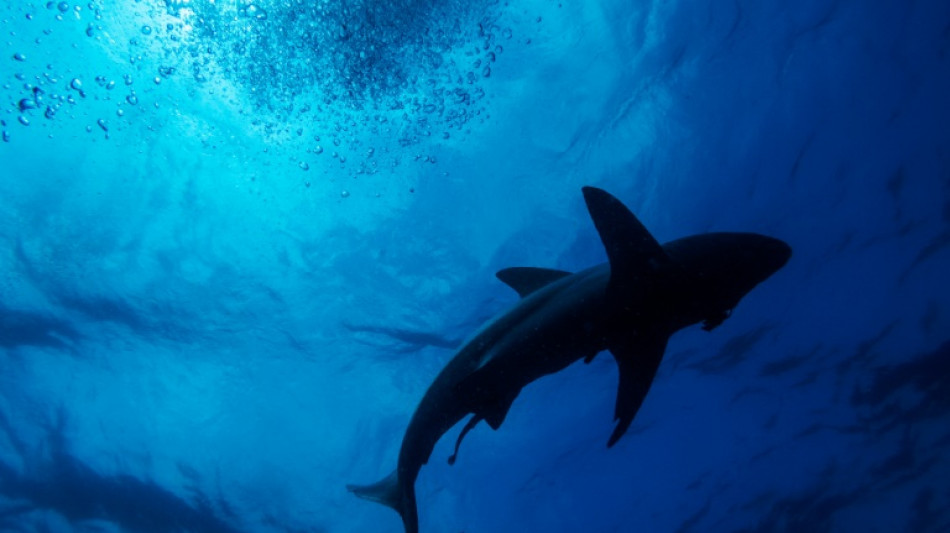
Global wildlife summit approves shark protections / Photo: Michele Spatari - AFP/File
 Trump names Stephen Miller as White House chief of staff after midterm losses

 Restored Albanian tower houses anchor new rural tourism trail

 Sonia Gandhi reflects on family tragedy and reluctant political career

 Pope Leo begins three-country South American tour in Uruguay

 Khawaja says entire Australia camp knew of 2018 ball-tampering plan

 November Foraging Guide: Edible Mushrooms and Critical Safety Protocols

 Microsoft Updates Xbox PC App with 60% Faster Startup and Redesigned Interface

 Early Polar Vortex Disruption Creates Uncertain Winter Outlook for Pennsylvania

 How to Enjoy Luxury Experiences on a Budget

 Pakistan Demands Grant-Based Climate Finance at COP31 to Avoid Debt Trap
Delegates at a global summit on trade in endangered species on Friday approved a plan to protect 54 more shark species, a move that could drastically reduce the lucrative and cruel shark fin trade.
Members of the requiem shark and the hammerhead shark families will now have their trade tightly controlled under the Convention on International Trade in Endangered Species (CITES).
The proposal was adopted by consensus on the final day of the two-week meeting by delegates from 183 countries and the European Union.
Delegates have been considering 52 proposals to change species' protection levels. Other species debated were glass frogs, crocodiles, guitarfish, and some turtle species.
Panamanian delegate Shirley Binder told AFP the "historic decision" would mean a large number of sharks making up 90 percent of the market would now be protected.
Insatiable appetite in Asia for shark fins, which make their way onto dinner tables in Hong Kong, Taiwan and Japan, has spurred their trade.
Despite being described as almost tasteless and gelatinous, shark fin soup is viewed as a delicacy and is enjoyed by the very wealthy, often at weddings and expensive banquets.
Shark fins, representing a market of about $500 million per year, can sell for about $1,000 a kilogram (2.2 pounds).
"This will be remembered as the day we turned the tide to prevent the extinction of the world's sharks and rays," said Luke Warwick, director of shark protection for the NGO Wildlife Conservation Society (WCS).
"The crucial next step will be to implement these listings, and ensure they result in stronger fisheries management and trade measures as soon as possible."
- From villain to darling -
Sharks have long been seen as the villain of the seas they have occupied for more than 400 million years, drawing horror with their depiction in films such as "Jaws" and occasional attacks on humans.
However, these ancient predators have undergone an image makeover in recent years as conservationists have highlighted the crucial role they play in regulating the ocean ecosystem.
According to the Pew Environment Group, between 63 million and 273 million sharks are killed every year, mainly for their fins and other parts.
With many shark species taking more than 10 years to reach sexual maturity, and having a low fertility rate, the constant hunting of the species has decimated their numbers.
In many parts of the world, fisherman lop the shark's fins off at sea, tossing the shark back into the ocean for a cruel death by suffocation or blood loss.
The efforts by conservationists led to a turning point in 2013, when CITES imposed the first trade restrictions on some shark species.
"We are in the middle of a very large shark extinction crisis," said Warwick earlier in the summit.
The decision follows heated debate after Japan and Peru tried to reduce the number of species that would be protected.
However, their suggestions were rejected.
CITES, which came into force in 1975, has set international trade rules for more than 36,000 wild species.
Its signatories include 183 countries and the European Union.
S.Gregor--AMWN

