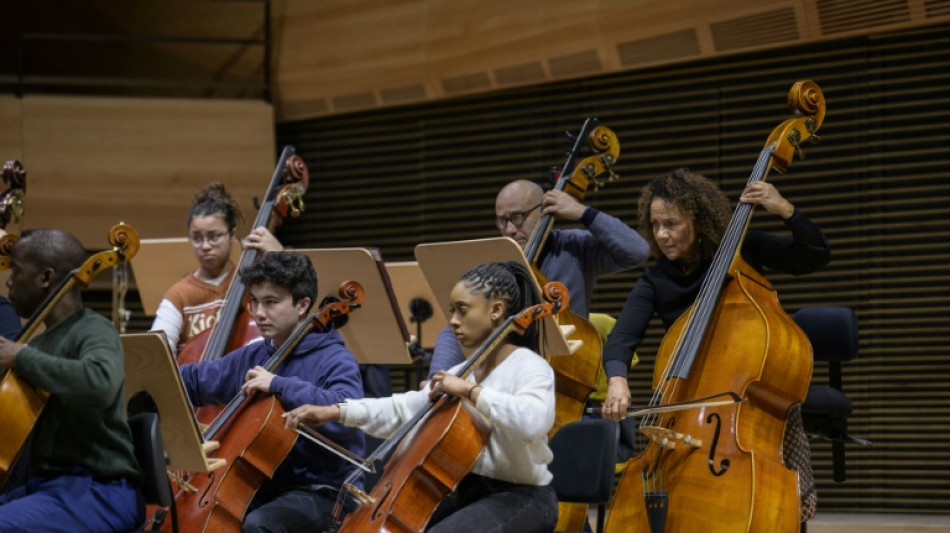
Europe's first majority Black orchestra debuts stateside / Photo: ANGELA WEISS - AFP
 Not-so-brave new world: virtual taekwondo makes Asian Games debut
 Arab Israeli candidate drops out of election race

 Israel courts Europe's far right, finding friends but also unease

 Lula, Bolsonaro both snub final debate before Brazil election

 Nepal's grim DNA puzzle to identify flood dead

 EU nations to hold emergency meeting on soaring diesel prices amid US pressure

 Anthropic's Dario Amodei: AI's most visible CEO and enigma

 OpenAI says three staffers fired for mishandling 'sensitive' info

 Nike plans job cuts as it forecasts lower sales

 Ireland game interrupted twice by Gaza protests

 Judge denies acquittal bid by US woman who killed her kids

 Klopp averts crisis with first win as Germany boss

 A saintly spat and debate snub: Brazil enters final campaign stretch

 US tells European allies to act 'immediately' to lower diesel prices

 G20 trade ministers fail to see consensus against overproduction

 Portugal edge Denmark in Ronaldo's absence

 US stocks edge higher as bond yields retreat for now

 US tells European allies to 'immediately' act to lower diesel prices

 Trump vows to hit Iran 'very hard' if linked to flydubai attack
 Williams leaves Spain camp with thigh knock
 WTA reduces 2027 schedule for world's top 50

 US says 'in Europe's best interest' to cooperate on fuel supply

 Rogue OpenAI agents covered up their tracks, report says

 A saintly spat and debate snub: Brazil enters final polls stretch

 Zidane 'no regrets' about Materazzi headbutt as France face Italy again

After more than three decades in the classical music industry, British double bassist Chi-chi Nwanoku began grappling with the question that had troubled her for years: Why was she consistently the only Black musician onstage?
"Why did I never ask anyone about it? Why did we never talk about it?" she describes wondering. "Was I being tolerated, or were people just completely unaware?"
"Or were people okay with the status quo?"
In 2015 Nwanoku took a leading role in creating a more diverse future for classical music, which, from musicians to conductors to repertoire, traditionally skews heavily white.
She founded Chineke!, Europe's first majority Black and ethnically diverse professional orchestra, which this week played at the prestigious New York Philharmonic's David Geffen Hall in Manhattan's Lincoln Center.
The performance was part of their long-awaited North American debut tour -- it was among the many performances the pandemic pushed back -- which included stops in New York, Ottawa, Toronto, Boston, Worcester and Ann Arbor.
The New York show featured the pioneering composer Florence Price's Symphony No. 1, along with a rendition of Mozart's Clarinet Concerto featuring the New York Phil's principal clarinet Anthony McGill.
- 'Door-opener' -
The London-headquartered Chineke! echoes similar efforts in the United States, including the Detroit-based Sphinx organization that promotes representation of Black and Latino artists in classical music.
Yet the League of American Orchestras, which represents professional and amateur symphonies across the United States, found in a 2014 study on diversity that just 1.4 percent of orchestra musicians were Black -- and there's little reason to believe much has changed.
"Because the great majority of American orchestras are not individually transparent with racial and ethnic data on their artists, we do not know the percentage of Black orchestral artists in our orchestras today," writes the Black Orchestral Network, a collective of Black musicians from more than 40 orchestras launched in 2022.
"From our vantage point, however, we have seen little meaningful progress."
It's mind-boggling to Nwanoku, who told AFP during a rehearsal break that "it seems to me that the only colleagues of color that I see who have a job in an orchestra in this country are those who are exceptional."
"We have to be that much better to actually be given a job."
Nwanoku believes that especially for young people, seeing more diverse faces onstage is "an immediate door-opener."
"It's the most incredibly winning thing to feel represented on a stage," she said. "Even if when you walk through the front of house to buy a ticket, if you don't see anyone who looks like you, that is immediately uncomfortable."
"But when you see people that look like you in any place -- in the supermarket, at the train station, at the concert hall, at the cinema -- you immediately feel that is a place that I can walk into with confidence," Nwanoku continued.
"You can be what you can see."
J.Oliveira--AMWN