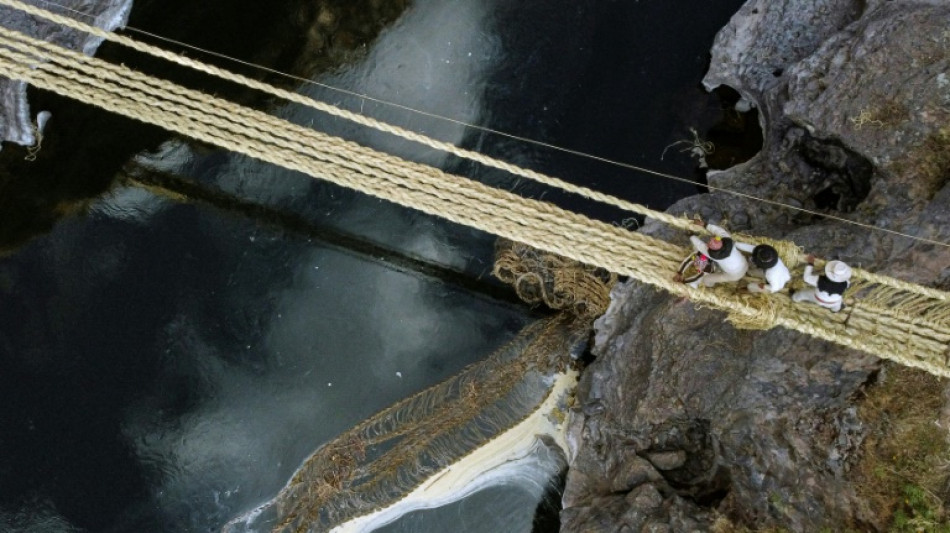
Gravity-defying: revamping an Inca rope suspension bridge / Photo: Christian SIERRA - AFP
 Trump expected to name intel chief Clayton as AI czar: reports

 Argentina unveils passports-for-investment scheme

 Brazil election debate chaos sparks censorship row

 England's Carse charged by cricket body over nightclub incident

 Amazon vows $1 bn for data center towns, decries 'myths'
 Oil prices drop on G7 fuel release, US jobs data boosts stocks

 G7 agrees deal to ease global energy supply concerns

 Spain's government dealt blow as lawmakers reject housing bills

 Food, medicine shortages deepen in Russian-occupied Oleshky

 Man City whistleblower Rui Pinto facing 'dire consequences' - lawyers
 Russia 'tearing Kyiv apart', mayor says, as strikes paralyse traffic

 Taiwan boxer Lin wins Games gold as Japan edge North Korea on penalties

 Japan tame North Korea to win Games gold after shootout drama

 US posts weak job growth data in September

 Ethiopia's conflict: the regional dimension

 Life expectancy almost back to pre-Covid levels, says WHO
 Turkey's football referee chief faces judge in graft probe

 Verstappen goes own way to avoid the rain

 Oil slides, bonds steady as EU addresses diesel price surge

 Spain housing package at risk in parliament, as protests mount

 Swedish Social Democrats leader to make new bid to form government

 North Korea calls Seoul 'despicable' after DMZ apology demand

 Taiwan boxer Lin wins gold as virtual taekwondo makes Games debut

 Man City face appeal deadline after explosive financial verdict

 Pole vault superstar Duplantis to skip indoor season

Dangling over a vertiginous gorge, the Apurimac River flowing around 10 stories below, Indigenous Peruvians show no fear as they repair a centuries-old Inca rope suspension bridge -- the world's last.
Every June, members of the Quechua Indigenous group come together to braid thick ropes made from a type of Andean straw, then brave the chasm without harnesses to replace worn parts of the Q'eswachaka bridge.
It is a ritual that connects communities to one another but also to their ancestors, according to Quechua belief.
"It is a matter of pride for us to (renovate) this bridge," Braulio Huilca, a 34-year-old student told AFP of his role in the annual rite.
Inscribed on UNESCO's list of Intangible Cultural Heritage 10 years ago, the bridge has become a key tourist attraction and source of income in the Peruvian region of Cusco -- also home to the Inca citadel of Machu Picchu.
"If we abandon this, the tradition would be lost, and there would... be no income," said Felipe Hanampa Huamani, 40.
- Jealous mermaids -
The bridge, made of fibers obtained from q'oya, a straw-like plant, was first built about 600 years ago.
Nearly 30 meters (100 feet) long and 1.2 meters wide, it hangs over a gorge around 28 meters deep.
For several weeks every year, residents of four towns in the province of Canas gather and prepare straw for rope-making.
With sickles, women in multi-colored skirts cut the q'oya and gather it in bundles that are soaked in a well and then crushed with stone.
They then braid the ropes, sitting in groups on the side of a dusty road.
Within hours, they have made thick ropes that men carry on their shoulders along winding paths and steep steps up to the bridge.
"If we don't renew it, (god) punishes us. We could have an accident or something could happen to us," said 54-year-old Emperatriz Arizapana Huayhua, a small-scale farmer in the region involved in rope production.
Crucial in the initial phases of the operation, women are not allowed to take part in the final steps: according to local beliefs, the mermaids of the river are jealous.
- Animal sacrifice -
To guarantee that "no accident happens during the reconstruction," a shaman sacrifices a lamb to the gods as part of the ritual.
As men in "chullos" -- colorful woollen caps with earmuffs -- tear down the old structure, worn and blackened braids plummet into the Apurimac river.
The hanging bridge has several thick ropes that serve as a platform, with two more for holding on on either side.
The replacement of the old ropes takes three days. Some of the workers chew coca leaves for energy.
There is a narrow metal bridge next to the rope structure that communities also use for trade and transport.
The work is finished when the two groups working from either side of the gorge meet in the middle.
Cries of "Haylly Q'eswachaka!" are heard in Quechua, signalling that the time has come for the celebratory festival.
Next year, they will do it all over again.
H.E.Young--AMWN