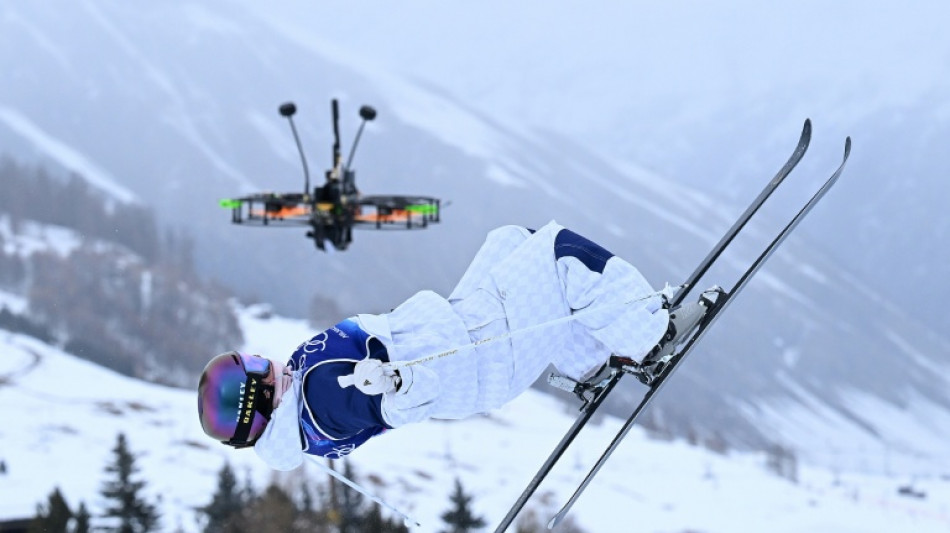
New drones provide first-person thrill to Olympic coverage / Photo: Kirill KUDRYAVTSEV - AFP
 Hundreds held, dozens wounded as French school protests escalate
 US government's new AI chatbot pulls back from debunking Trump

 US tennis star Navarro reveals health battle, ends season

 Panic, anger, tears: Evan Gershkovich's uneasy journey after Russian jail

 UK PM says 'strong indications' Iran involved in airbase incident

 Google restricts access to new AI model over safety concerns

 Watchdog clears former US Fed chief Powell in renovation probe
 Israel PM hails Indian pilot of rerouted flight for averting disaster

 Fury, Joshua kick off 'battle of Britain' in good spirits
 Ronaldo leaves Portugal training camp after coach says he is dropped
 Florence Pugh stars in 'East of Eden' adaption on Netflix
 Watchdog finds no criminal misconduct over US Fed renovations despite Trump probe
 In Manchester, City fans 'devastated' while rival fans call for relegation

 UK-France Channel migrant exchange deal scrapped: London

 Portugal boss denies 'incident' with Ronaldo

 Israel PM says one of the pilots of rerouted flight tried to crash plane

 Manchester City: Main points of damning judgement and possible sanctions

 Italy looking for 'identity' under Mancini says Scalvini
 The voices of Spain's housing camp protesters
 Romanian parliament rejects pro-EU PM candidate
 Court halts Tennessee's first execution of woman in 200 years

 Israelis march between once-closed West Bank settlements

 'Welcome back,' says Macron, as UK PM opens door to EU return
 Israel PM says pilot of rerouted flight tried to crash plane

 Demuro hopes to deliver Japan a 'magical' Arc victory
Whether chasing skiers as they fly down the mountain or tracking the luge as it tears around bends, new drone-mounted cameras are offering Winter Olympics viewers a wild ride.
So-called "first person view" (FPV) drones have made their Winter Games debut this year, with 15 deployed across the Milan-Cortina events, offering an exhilarating experience.
Traditional drones, which have been used in live broadcasting for more than a decade, are piloted by an operator looking up at the machine.
But FPVs are piloted by a driver wearing goggles and holding a controller, allowing incredibly precise guidance.
The downside for TV viewers is the constant buzzing, which disrupts the stillness of the mountains.
But many athletes say they are not bothered -- even when it looks from afar like the drones are getting too close.
"I saw on the replay that I nearly got hit by it but I wasn't aware of it while I was doing it," Australian snowboarder Ally Hickman told 7News.
- Pretty cool -
The drones are particularly useful on the sliding track -- for luge, bobsleigh and skeleton -- where they help avoid having cameras positioned at every turn.
German luger Felix Loch, a triple gold medallist competing in his fifth Olympics, said he had no problem with the drones.
"No, you don’t notice something like that," he told AFP's German sports subsidiary SID, praising the use of the technology.
"They're definitely different images. It really looks pretty cool. You have to say, it’s really, really a nice thing what the guys are doing there," he said.
German alpine skier Emma Aicher, the 22-year-old who has won two silver medals at the Milan-Cortina Games, also said the drones didn't affect her concentration as she shot down the piste.
"For us, it's really cool footage. I don't notice the drone, it's so far away," she said.
Yiannis Exarchos, the head of Olympic Broadcasting Services (OBS), who supply the images to the broadcasters for Olympics, said they had worked with athletes in designing the system.
"We didn't want this to become a factor affecting them. We wanted this to become a factor enhancing them," he told reporters on Wednesday.
Drone cameras made their debut in the Winter Games in Sochi, Russia, in 2014, while FPV were first introduced in Paris in 2024, providing live images of mountain biking.
Exarchos said that technology had moved on hugely.
Now, it is possible to "achieve safely speeds like some of the athletes do. A few years ago this was not possible", he told reporters.
- Fast and noisy -
The noise depends on the size of the propeller, which in turn depends on how fast they are going, according to one expert involved in the Olympics who asked not to be named due to commercial confidentiality.
Each drone is custom built, with the smallest measuring just ten centimetres (four inches) and weighing less than 250 grams (half a pound).
"If you are going to chase something super fast, you go for a small system that is super powerful -- and that’s going to be really noisy," he told AFP.
One issue for operators during the Olympics is the cold, which drains the batteries quickly, according to another drone operator.
"There's a constant change of battery, every race," he told AFP.
P.Costa--AMWN