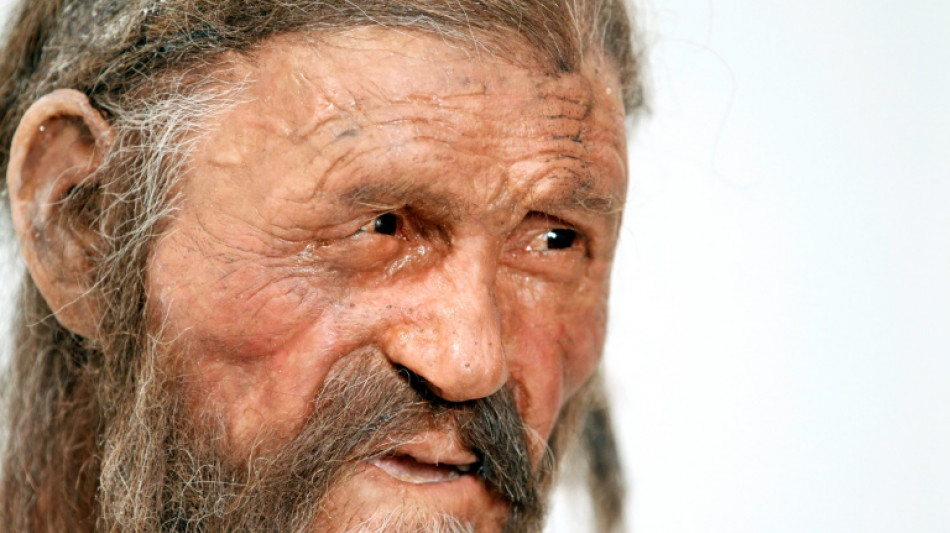
Iceman Oetzi was balding, darker-skinned than thought: study / Photo: Andrea Solero - AFP
 Samsung Galaxy S27 Series Camera Design Leaked via Lens Protectors

 French Economy Shrinks 0.1% as Consumer Confidence Slumps

 Wall Street Ends Turbulent Week Higher Despite Inflation and AI Jitters

 Kansas City Fed Chief Says Inflation Is Still Running Too Hot

 Asian Markets Slide as AI Concerns Hit Chip Stocks

 Canada Signals Openness to Chinese Automakers if US Trade Talks Fail

 Canada Expands Asian Trade Push as US Negotiations Resume

 US Jobless Claims Rise to 200,000 but Layoffs Remain Historically Low

 Italy Raises 2026 Growth View but Warns Energy Will Keep Inflation High

 UK Economy Grows 0.7% in Third Quarter as Services Lead Expansion

 India's Retail Inflation Reaches 6.09% as Food Prices Accelerate

 China's October Activity Data Reveal a Weak Start to the Fourth Quarter

 Philippines Urges ASEAN and China to Accelerate South China Sea Code of Conduct

Oetzi, the "iceman" mummy of the Alps, had darker skin than previously thought and was likely bald or almost bald when he died, the study by Max Planck Institute for Evolutionary Anthropology said.
He also likely stemmed from a relatively isolated group with little contact with other Europeans, and had ancestors who arrived directly from Anatolia.
Oetzi's remains were found in September 1991 in South Tyrol, the northern Italian region where he was also believed to have roamed.
Mummified in ice, he was discovered by two German hikers in the Oetztal Alps, 3,210 metres (10,500 feet) above sea level, more than 5,000 years after his death.
Since then, scientists have used hi-tech, non-invasive diagnostics and genomic sequencing to penetrate his mysterious past.
Initial analysis of his genome had earlier suggested that he had genetic traces of steppe herders from eastern Europe.
But Max Planck's scientists said the latest results no longer support this finding.
Rather, they believed the original sample to have been contaminated with modern DNA that led to the erroneous finding.
Advances in technology have also allowed for a more specific look into Oetzi's past.
"Among the hundreds of early European people who lived at the same time as Oetzi and whose genomes are now available, Oetzi's genome has more ancestry in common with early Anatolian farmers than any of his European counterparts," said the institute's team.
- 'Almost no hair' -
Johannes Krause, head of the Department of Archaeogenetics at the Max Planck Institute for Evolutionary Anthropology who co-authored the study, said his team was "very surprised to find no traces of eastern European steppe herders in the most recent analysis of the Iceman genome".
"The proportion of hunter-gatherer genes in Oetzi's genome is also very low. Genetically, his ancestors seem to have arrived directly from Anatolia without mixing with hunter gatherer groups," he said.
The scientists believe therefore that he likely stemmed from a relatively isolated population that had very little contact with other European groups.
The team said previous ideas about the iceman's appearance may also have been inaccurate.
Scientists had previously thought the iceman's skin had darkened in the ice, but it may actually have been his original skin colour, said the team.
Oetzi's genes also show a "predisposition to baldness" and, rather than having long, thick hair on his head, he is now believed to already have lost most of his hair as an adult.
"This is a relatively clear result and could also explain why almost no hair was found on the mummy," said anthropologist Albert Zink, co-author of the study.
In previous studies over the years, scientists have determined that Oetzi died around the age of 45, was about 1.60 metres (five foot, three inches) tall and weighed 50 kilos (110 pounds).
He suffered a violent death, with an arrow severing a major blood vessel between the rib cage and the left shoulder blade.
P.Costa--AMWN