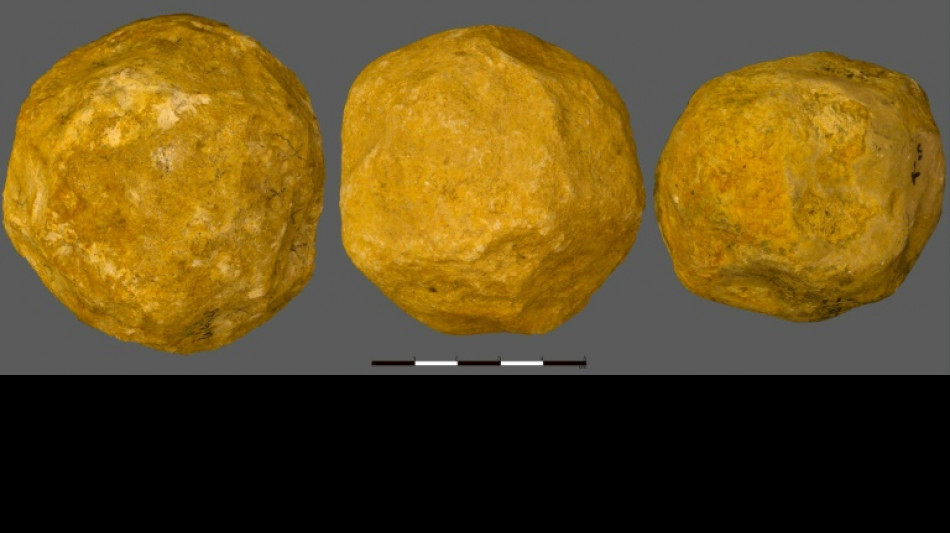
Early humans deliberately made mysterious stone 'spheroids' / Photo: - - Hebrew University of Jerusalem/AFP
 Japan Olympic chief says 'lot more' athletes at Games than expected

 Asian carmakers besting US rivals at home, China poised to strike

 Widgets & Web Offers All-Inclusive Investor Relations Websites for Public Companies, IPOs and SPACs

 Adams named new US captain to 2030 World Cup

 China a better influence in Latin America than US: poll

 Judge pauses construction of border project in Texas national park

 Belgium's De Bruyne fires double to sink Turkey, France held by Italy

 US jobs data boosts stocks as oil prices dip

 US Supreme Court to hear high-stakes climate case

 Trump expected to name intel chief Clayton as AI czar: reports

 Argentina unveils passports-for-investment scheme

 Brazil election debate chaos sparks censorship row

 England's Carse charged by cricket body over nightclub incident

 Amazon vows $1 bn for data center towns, decries 'myths'

 Oil prices drop on G7 fuel release, US jobs data boosts stocks

 G7 agrees deal to ease global energy supply concerns

 Spain's government dealt blow as lawmakers reject housing bills

 Food, medicine shortages deepen in Russian-occupied Oleshky

 Man City whistleblower Rui Pinto facing 'dire consequences' - lawyers

 Russia 'tearing Kyiv apart', mayor says, as strikes paralyse traffic

 Taiwan boxer Lin wins Games gold as Japan edge North Korea on penalties

 Japan tame North Korea to win Games gold after shootout drama

 US posts weak job growth data in September

 Ethiopia's conflict: the regional dimension

 Life expectancy almost back to pre-Covid levels, says WHO

The early ancestors of humans deliberately made stones into spheres 1.4 million years ago, a study said on Wednesday, though what prehistoric people used the balls for remains a mystery.
Archaeologists have long debated exactly how the tennis ball-sized "spheroids" were created.
Did early hominins intentionally chip away at them with the aim of crafting a perfect sphere, or were they merely the accidental by-product of repeatedly smashing the stones like ancient hammers?
New research led by the Hebrew University of Jerusalem suggests that our ancestors knew what they were doing.
The team of scientists examined 150 limestone spheroids dating from 1.4 million years ago which were found at the 'Ubeidiya archaeological site, in the north of modern-day Israel.
Using 3D analysis to reconstruct the geometry of the stones, the researchers determined that their sphericalness was "likely to have been produced intentionally".
The early hominins -- exactly which human lineage they belonged to remains unknown -- had "attempted to achieve the Platonic ideal of a sphere", they said.
While the spheroids were being made, the stones did not become smoother, but did become "markedly more spherical," said the study in the journal Royal Society Open Science.
This is important because while nature can make pebbles smoother, such as those in a river or stream, "they almost never approach a truly spherical shape," the study said.
Julia Cabanas, an archaeologist at France's Natural History Museum not involved in the research, told AFP that this means the hominins had a "mentally preconceived" idea of what they were doing.
That in turn indicates that our ancient relatives had the cognitive capacity to plan and carry out such work.
Cabanas said the same technique could be used on other spheroids. For example, it could shed light on the oldest known spheroids, which date back two million years and were found in the Olduvai Gorge of modern-day Tanzania.
But exactly why our ancestors went to the effort of crafting spheres remains a mystery.
Possible theories include that the hominins were trying to make a tool that could extract marrow from bones, or grind up plants.
Some scientists have suggested that the spheroids could have been used as projectiles, or that they may have had a symbolic or artistic purpose.
"All hypotheses are possible," Cabanes said.
"We will probably never know the answer."
P.Stevenson--AMWN