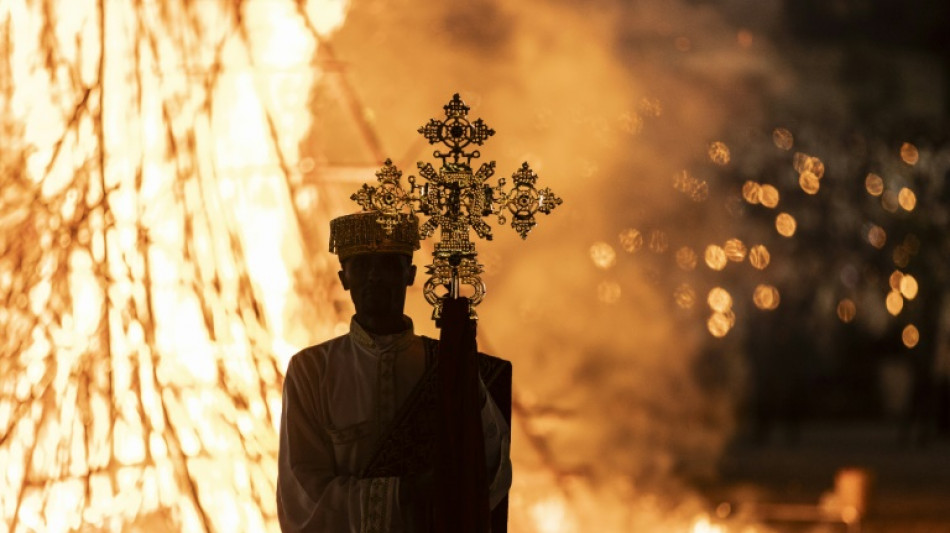
In a divided Ethiopia, the Orthodox mark Meskel celebration / Photo: Amanuel Sileshi - AFP
 Split loyalties for Indian football fans at Brazil friendly

 India-Pakistan blockbuster brings cricket fever to Japan baseball field
 Wong waiting on Rafa after winning Asian Games tennis gold
 With Russia next door and rising costs, Latvia goes to the polls

 Penalty hero rues empty seats as Games hosts Japan win football gold

 North Korea fires ballistic missile after Seoul's apology demand

 US regulator finds Boeing 737 MAX software bug 'not a safety concern'

 Ohtani 'managing' injuries as Dodgers launch MLB post-season

 Botched US execution leaves murderer unconscious on ventilator: lawyers
 Cornell rape case exposes sexual violence at US colleges
 France held by Italy in Zidane's homecoming after Olise stunner
 Ethiopian pro-government militia claims Tigray airport as regional tensions spike

 Ohtani shaking off injuries as Dodgers launch MLB post-season
 Sea levels to rise in California as coastal wave surges up west coast

 New rallies urged in France as protests disrupt over 730 schools

 Djokovic survives China Open scare, Sabalenka starts strong

 King Charles to evoke colonial 'darkest days' on Caribbean tour

 Tesla shares jump after global car sales top estimates

 DR Congo Ebola outbreak killed more than 4,000: official figures

 Djokovic survives China Open scare against wildcard world no. 104
 Lula, Bolsonaro trade blows in final scramble for votes in Brazil
 New clashes erupt as protests disrupt over 560 French schools
 NY governor vows to close loophole after alleged Cornell gang rape
 Ethiopia Tigray rebels pushed back as regional tensions spike

 Stocks rise, yields fall as US job numbers disappoint

Orthodox Ethiopians on Wednesday marked the beginning of Meskel, one of the holiest celebrations in the Christian tradition followed in this devout nation riven by ethnic and political violence.
Among Orthodox believers in Ethiopia and its neighbour Eritrea, Meskel commemorates the discovery by Saint Helena in Palestine in the fourth century of the "true cross" upon which Jesus Christ was crucified.
According to legend, Helena, the mother of Roman Emperor Constantine I, was led to the cross -- a fragment of which was believed to have been brought back to Ethiopia -- by the smoke from a ceremonial bonfire.
On the eve of Meskel, worshippers construct large pyres in streets and church courtyards for a ceremony known as "demera" that signals the start of the festivities.
At sunset, after hours of dancing and singing, these bonfires -- topped with a cross and covered in indigenous flowers -- are set ablaze across the country.
The largest, several metres high, is lit in Meskel Square, a vast esplanade in the centre of Ethiopia's capital Addis Ababa, in the presence of tens of thousands of congregants and Orthodox priests and bishops in rich fabrics.
"The power of Christianity is bringing back our original unity. It helps us to forget those differences that have shaped us for so many years, and brought us to these conflicts, wars, hate and... atrocities," said one Orthodox priest in attendance, who did not give his name.
- 'How can we celebrate?' -
A mosaic of 80 different peoples, Ethiopia is one of the oldest Christian countries in the world.
The Aksumite Empire, ancestor of present-day Ethiopia, made Christianity a state religion from the 4th century, at the same time as Rome.
Short of an official census, it is estimated that roughly two-thirds of Ethiopia's 120 million people are Christian and another third are Muslim, with a small animist minority.
Most Christians are Orthodox, although the share of Protestants has grown significantly recently.
In Tigray, the cradle of the Axumite kingdom, this Meskel was the first in peacetime since 2020 when the federal government went to war with rebellious leaders in the northern region.
A peace deal in November last year drew a line under the two-year conflict.
"I am celebrating Meskel in a better way than in previous years. At least this time there are no gunshots and we are in a more peaceful atmosphere," said Kalayu Kiros from Mekele, the capital of Tigray.
But, he said, there were "so many traumas of war that I cannot fully celebrate this festival".
Meaza Teklemariam, also from Mekele, said Meskel was "not like it was before the war" and that cost of living pressures had made it harder to celebrate.
Despite the conflict ending in Tigray, armed violence rages elsewhere in Africa's second-most populous country, which is divided into states along ethno-linguistic lines.
In Amhara, where militias have been clashing with Ethiopia's army since April, a state of emergency has been declared in the region where accusations of summary executions and arbitrary arrests have been made.
"How can we celebrate Meskel when the fear and the curfew make you have to stay home?" said a resident in Debre Markos, a town in Amhara, who asked to remain anonymous.
A.Rodriguezv--AMWN