Ancient city that could bridge Turkey and Armenia's bitter divide / Photo: Yasin AKGUL - AFP
 'Act before it's too late': Tokyo residents fight for more trees
 'Disappointing' as South Korea flag mishap sees Games end on sour note

 Pre-COP host Tuvalu at frontline of climate change

 Hungary's dwindling paprika producers battle to save signature spice
 Cornell president vows review in wake of alleged student gang rape
 Latvian partial election results suggest pro-European choice
 In Egypt's Sinai, Gazan builds school for children displaced by war

 Trump tariffs a mixed bag for US auto industry

 Yemen government forces say struck Houthi targets

 Music links past, present for Pedro Pascal's cellist in 'Behemoth!'
 ALEX BODI ȘI AMBASADORUL REPUBLICII SUDANUL DE SUD, GUM DOMINIC MATIOK, DISCUTĂ LA BERLIN DESPRE POSIBILITATEA ÎNFIINȚĂRII UNUI CONSULAT ONORIFIC LA BUCUREȘTI

 Dodgers step up World Series three-peat bid with 5-3 win over Braves

 Spain break down Czechs as England outclass Croatia in Nations League

 Yamal on target as Spain hold off Czech Republic

 Latvian exit polls suggest pro-European choice
 Lula, Bolsonaro wrap up campaigns ahead of knife-edge election
 Tuchel hails 'complete' England after Croatia demolition

 Fury to invite Trump to lead ring walk before Joshua showdown

 Fashion industry in 'precarious moment', says Vivienne Westwood supremo
 Seventh heaven for England in Nations League rout of Croatia

 Storms, flooding cause chaos on Greek holiday island of Crete

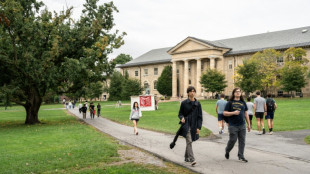 #IAmJaneDoe: online support campaign in US university rape case

 Brazil shine on Selecao's first visit to India

 Zverev sets up Djokovic quarter-final at China Open, Rybakina out
 Happier at home, Bordeaux hammer Lyon in Top 14

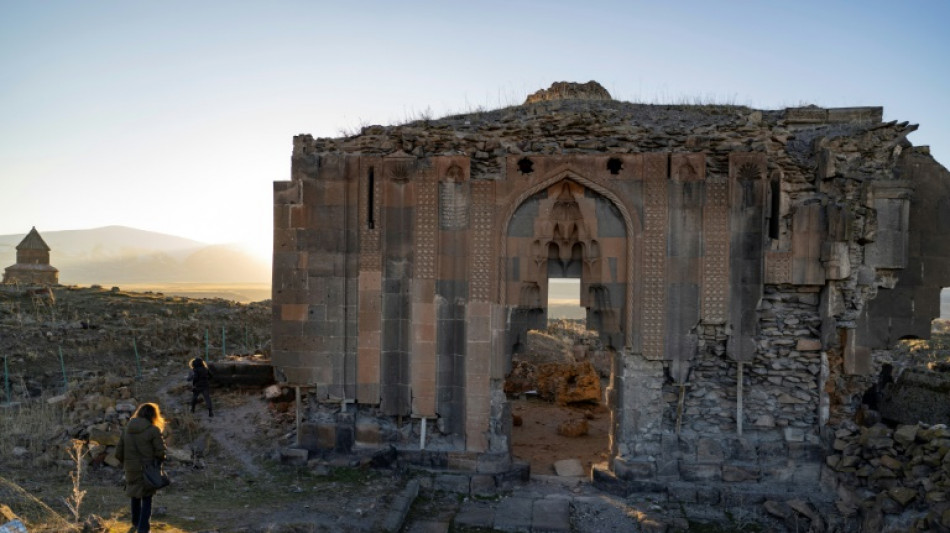
Look at this stone bridge," said writer Vedat Akcayoz pointing to the crumbling stumps of a 10th-century span over the Arpacay river that marks the closed border between Turkey and Armenia.
"The fish under the bridge, are they Turkish or Armenian?"
The spectacular ruined city of Ani stands on one of the world's most sensitive borders, dividing two countries daggers drawn over their painful past.
Deserted now amid snow-capped peaks, Ani was once the capital of a mediaeval Armenian kingdom before it fell to the Seljuks in 1064, the first city taken by the Turks as they swept into Anatolia. Their sultan Alparslan converted its cathedral into his "conquest mosque".
But its sack by the Mongols and an earthquake sent Ani into terminal decline.
"This is the land conquered by our ancestors," said Ziya Polat, governor of the nearby Turkish city of Kars. "Sultan Alparslan's first Friday prayer, the first Turkish mosque, the first Turkish cemetery, the first Turkish bazaar are all here," he added.
With such symbolic importance to both sides, historians and officials hope restoring the UNESCO world heritage site might ease relations poisoned by the mass killing of Armenians in the Ottoman Empire during World War I, which Turkey refuses to recognise as genocide.
Akcayoz, who wrote a book on the ruins, said Ani is "humanity's common heritage".
"Ani was Zoroastrian, Ani was shaman, Ani was pagan, Ani was Christian, Ani was Muslim, Ani was yours, Ani was ours," he told AFP.
Turkey and Armenia have no formal relations. But peace talks between Yerevan and Ankara's ally Azerbaijan over the disputed territory of Nagorno-Karabakh -- which Baku retook last year after a lightning war -- has sparked hope that one day Turkey and Armenia could also sit down around a table.
- Haunting beauty -
For years Ani was off limits for tourists, with a military permit required to visit it. But local authorities are now keen to promote its haunting beauty as well as neighbouring Kars, which had a large Armenian population until 1915.
With 5.5 million euros ($6 million) in funding, mostly from the European Union, they hope to draw more visitors.
Gonca Pabuccu, deputy head of the archaeological team at Ani, said restoration and conservation work has been going on for several years.
"Our aim is not only to unearth these structures, but also to preserve what we have unearthed" so tourists can visit, she said.
Akcayoz said 80 to 85 percent of the site has yet to be explored.
"Ani has an underground world as big as what is on the surface. In the caves around Ani, there are churches, mosques and places of worship. Not a lot of people know this."
Akcayoz looks to the legacy of the Turkish-Armenian journalist Hrant Dink, who helped spark an unprecedented -- if fleeting -- period of dialogue and detente between the two peoples in the early 2000s.
When Dink was shot dead outside his Istanbul newspaper office in 2007 by a teenage Turkish ultra-nationalist, tens of thousands Turks took to the streets to express their horror, chanting, "We are all Armenians, we are all Hrant Dink."
- 'Who will cure us?' -
Akcayoz pointed to a famous speech Dink gave a year before his murder saying denial and blame about the past had made Turks and Armenians both "clinically ill... Armenians with their trauma, Turks with their paranoia."
"Who will cure us?" Dink asked. "The Armenians are the Turks' doctor -- the Turks are the Armenians' doctor," he said.
Akcayoz believes Dink's vision can help end the impasse.
"There's no other way out than peace," he said.
A local Turkish official, who wished to remain anonymous, said Ani was more prone to be politicised than other archaeological sites.
"It is still a religious capital for Armenians and the first city captured in Anatolia by Turks," he said.
Opening the sealed border would naturally increase visitor numbers, he said. "Armenians would want their grandchildren to see this site," he said.
"We cannot build a future on past tragedies."
Y.Nakamura--AMWN